
 Afrika
 Asien
Asien Europa
 Südamerika
 Australien & Ozeanien
 Antarktis
 Pazifischer Ozean
 Atlantischer Ozean
 Indischer Ozean
 Nordpolarmeer
 Mittelmeer
 Rotes Meer
 Karibisches Meer
 Korallenmeer
 Südchinesisches Meer
 Philippinensee
 Andamanensee
 Nordsee
 Timorsee & Arafurasee
 Golf von Bengalen
 Golf von Kalifornien
Paraguayan three-striped scorpion
 Stiche
This is a scorpion from South America, also called the Brazilian red house scorpion. It lives in Brazil, Argentina, Paraguay and Uruguay, and it is often found in people's homes. Its sting can cause serious symptoms, so it is important to know what it looks like.1

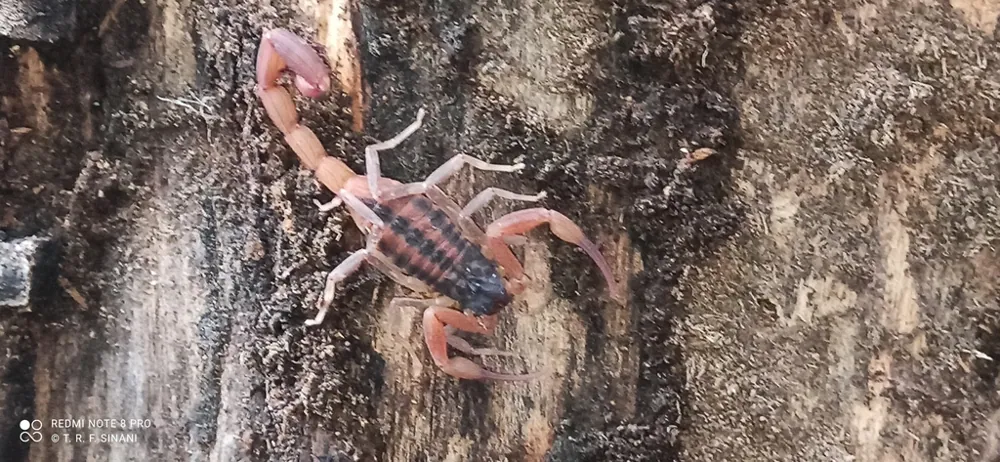
 So erkennst du es
- The back of the body is yellow or reddish-yellow.1
- The legs, pedipalps (the front limbs used like tweezers) and tail are pale yellow or yellow-brown.1
- The legs and pedipalps may have dark segmented marks.1
- Young scorpions are reddish, with dark spots on the legs.1
- It is nocturnal, so it is mostly active at night.1
Giftkraft
Das Gift kommt durch einen Stachel heraus.
Was macht sein Gift, wenn es beißt oder sticht?
The venom causes pain in most cases, and swelling, burning, redness and itching around the sting are also common. Neurological symptoms include tingling, cramps, excitement and headache. Other reported symptoms include pale skin, a fast heartbeat, difficulty breathing, low blood pressure, an irregular heartbeat and chest pain, along with low body temperature in some cases. Vomiting, nausea and sweating can also occur.1
Wie gefährlich ist es für Menschen?
Gefahr für Menschen: ErnstEin Stich gehört zum Arzt. Todesfälle sind sehr selten.It is the main cause of more serious scorpion accidents in Argentina. It is not usually aggressive. How severe a sting is depends on the age of the person stung and the amount of venom injected.1
Was macht es, wenn es Angst hat?
It can sting to defend itself when it is handled, stepped on, or hidden in clothing when someone is getting dressed.1
 Wenn es sticht
- Kühl den Stich mit einem Kühlpack und halte die Person ruhig. Hol schnell ärztliche Hilfe, besonders bei Kindern: Manche Skorpione sind für Kinder tödlich.
Ruf immer zuerst deine Notrufnummer an (112, 000, 911). Das sind allgemeine Erste-Hilfe-Hinweise, keine ärztliche Beratung. Erste-Hilfe-Grundlagen
 Bleib sicher
- Fass ein wildes Tier niemals an, fang es nicht und ärgere es nicht, auch kein kleines, und auch nicht, wenn es schlafend aussieht oder tot.
- Halte Abstand. Wenn du einem begegnest, bleib ruhig, geh langsam zurück und lass es seiner Wege gehen.
- Wenn dich eines sticht: Bleib ruhig, halt still, ruf deine Notrufnummer an (112, 000, 911) oder fahr schnell in ein Krankenhaus. Merk dir, wie es aussah, ein Foto hilft.
Es hat es nicht auf dich abgesehen. Es benutzt sein Gift, um Futter zu fangen oder sich zu schützen, und versteckt sich viel lieber. Mehr über Sicherheit
Wo auf der Welt?
Wie groß ist es?
Wie lang ist es?
 so lang wie 2 Bausteine in einer Reihe
 könnte 100 Meter in 260 Sekunden schaffen (der schnellste Mensch braucht 9,6)
Wie groß ist Paraguayan three-striped scorpion im Vergleich zu DIR?
Nur Rechnen in deinem Browser. Nichts wird gespeichert oder irgendwohin geschickt.
Wie schnell ist es?


Fakten
In Argentina it is the species behind most of the more serious scorpion stings.1
It uses its pedipalps like tweezers to hold prey before it stings.1
It is found only in South America, where it is common in houses.1
It hides in small gaps such as cracks, pipes, under floors and behind baseboards.1
Its young are reddish with dark spots on their legs, unlike the yellow-brown adults.1
Woher die Fakten kommen
- Tityus trivittatus (Wikipedia (CC BY-SA 4.0))
- Tityus trivittatus (iNaturalist): Namen und Klassifikation.
- Venom Wiki: die Gefahrenstufe, die typische Größe und die geschätzte Geschwindigkeit sind von uns. So berechnen wir sie: So bewerten wir die Gefahr.
Jeder Fakt auf dieser Seite hat eine Nummer, die auf seine Quelle zeigt. Wenn wir etwas falsch haben: Entschuldigung, wir sind Tierfans, keine Fachzeitschrift. Schreib uns an [email protected] und wir korrigieren es.
 Der Skorpion hat Hunger! Venom Wiki ist ein Ein-Mann-Projekt: kostenlos, ohne Werbung und ohne Tracker. Ein kleines Trinkgeld hilft, es online zu halten.Füttere den Skorpion
 Brazilian yellow scorpion
 Amazonian black scorpion
 Caracas scorpion
 Panamanian black scorpion
 Zulia scorpion
 Amazon forest scorpion
 Schrecklicher Pfeilgiftfrosch
 Terciopelo-Lanzenotter
 Brazilian wandering spider
 Eyelash viper
 Golden lancehead
 South American bushmaster