
 Afrika
 Asien
Asien Europa
 Südamerika
 Australien & Ozeanien
 Antarktis
 Pazifischer Ozean
 Atlantischer Ozean
 Indischer Ozean
 Nordpolarmeer
 Mittelmeer
 Rotes Meer
 Karibisches Meer
 Korallenmeer
 Südchinesisches Meer
 Philippinensee
 Andamanensee
 Nordsee
 Timorsee & Arafurasee
 Golf von Bengalen
 Golf von Kalifornien
Savigny's long-spined urchin
 Giftstacheln
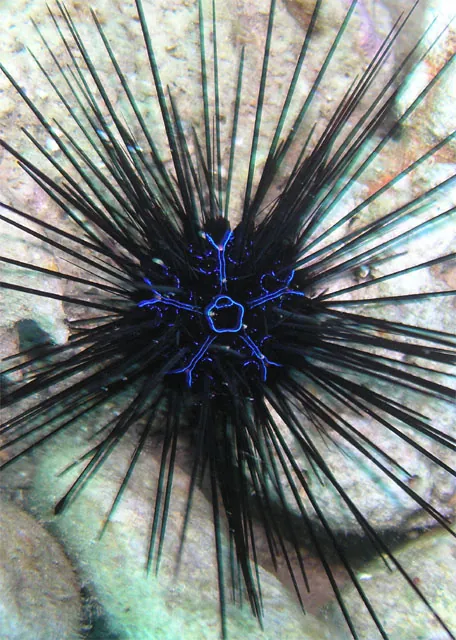
Savigny's long-spined urchin is a spiny sea animal that lives on reefs and in shallow lagoons. It has very long, thin spines that can grow up to 25 cm, and it comes out at night to graze on algae. Its spines are the part that can hurt people, so it is worth giving it plenty of room.1


 So erkennst du es
- Usually black, with a rounded body (called a test) up to about 9 cm across1
- Long, thin, hollow spines that grow in tufts and can reach 25 cm; they are usually black but can be grey, dark brown or purple1
- Juveniles may have bands of lighter and darker shades, and the occasional individual is completely white1
- Iridescent green or blue lines around the interambulacral areas and around the periproct (the cone-shaped region surrounding the anus)1
Oft verwechselt mit: It is very similar to Diadema setosum, which shares much of its range and often lives in the same groups. Savigny's long-spined urchin lacks the thin orange ring around the periproct that Diadema setosum has.1
Giftkraft
Spitze Stacheln tragen das Gift. Drauftreten oder Anfassen tut weh.
Wie gefährlich ist es für Menschen?
Gefahr für Menschen: SchmerzhaftEs kann richtig wehtun, ist aber fast nie gefährlich.Was macht es, wenn es Angst hat?
When a shadow falls on it, it angles its spines towards the possible attacker.1
 Wenn dich seine Stacheln stechen
- Leg die Wunde in heißes Wasser, so heiß, wie die Person es aushält, ohne sich zu verbrühen, und hol ärztliche Hilfe, um die Stacheln entfernen zu lassen. Grab nicht selbst danach.
Ruf immer zuerst deine Notrufnummer an (112, 000, 911). Das sind allgemeine Erste-Hilfe-Hinweise, keine ärztliche Beratung. Erste-Hilfe-Grundlagen
 Bleib sicher
- Fass ein wildes Tier niemals an, fang es nicht und ärgere es nicht, auch kein kleines, und auch nicht, wenn es schlafend aussieht oder tot.
- Halte Abstand. Wenn du einem begegnest, bleib ruhig, geh langsam zurück und lass es seiner Wege gehen.
- Wenn dich seine Stacheln stechen: Bleib ruhig, halt still, ruf deine Notrufnummer an (112, 000, 911) oder fahr schnell in ein Krankenhaus. Merk dir, wie es aussah, ein Foto hilft.
Es hat es nicht auf dich abgesehen. Es benutzt sein Gift, um Futter zu fangen oder sich zu schützen, und versteckt sich viel lieber. Mehr über Sicherheit
Wo auf der Welt?
Wie groß ist es?
Wie lang ist es?
 so lang wie 3 Bausteine in einer Reihe
 langsamer als eine Weinbergschnecke
Wie groß ist Savigny's long-spined urchin im Vergleich zu DIR?
Nur Rechnen in deinem Browser. Nichts wird gespeichert oder irgendwohin geschickt.
Wie schnell ist es?


Fakten
Its spines are brittle, thin and hollow, and grow in tufts that can be as long as 25 cm.1
Small fish such as cardinal fish, flatworms and shrimps sometimes shelter among its long spines.1
It spawns just after the full moon, while its close relative Diadema setosum mostly spawns around days eight to ten of the lunar cycle, which keeps the two species from interbreeding.1
Its grazing helps control algae, which might otherwise smother corals.1
It is nocturnal, hiding in crevices or under boulders by day, though several individuals sometimes huddle together in the open.1
Its predators include pufferfish, porcupinefish, lobsters and snails.1
Für Giftexperten
- Wissenschaftlicher Name
- Diadema savignyi
- Gruppe
- Seeigel, Seesterne & Würmer
- Familie
- Diadematidae2
- Ordnung
- Diadematoida
- Kontinente
- Indischer Ozean, Pazifischer Ozean, Rotes Meer, Arabisches Meer & Persischer Golf, Timorsee & Arafurasee, Golf von Bengalen, Die Ozeane
- Babys
- It does not have live young. Instead it releases eggs and sperm into the water (spawning), mainly during the north-east monsoon period, peaking in May, and timed to the lunar cycle.1
- Gefahr für Menschen
- 2 / 5: Schmerzhaft3
Woher die Fakten kommen
- Diadema savignyi (Wikipedia (CC BY-SA 4.0))
- Diadema savignyi (iNaturalist): Namen und Klassifikation.
- Venom Wiki: die Gefahrenstufe, die typische Größe und die geschätzte Geschwindigkeit sind von uns. So berechnen wir sie: So bewerten wir die Gefahr.
Jeder Fakt auf dieser Seite hat eine Nummer, die auf seine Quelle zeigt. Wenn wir etwas falsch haben: Entschuldigung, wir sind Tierfans, keine Fachzeitschrift. Schreib uns an [email protected] und wir korrigieren es.
 Der Skorpion hat Hunger! Venom Wiki ist ein Ein-Mann-Projekt: kostenlos, ohne Werbung und ohne Tracker. Ein kleines Trinkgeld hilft, es online zu halten.Füttere den Skorpion
Mehr aus derselben Gruppe: Seeigel, Seesterne & Würmer
 Crown-of-thorns starfishSeeigel, Seesterne & WürmerBraucht einen ArztNicht anfassen
 Flower urchinSeeigel, Seesterne & WürmerKann töten
 Fire urchinSeeigel, Seesterne & WürmerBraucht einen ArztNicht anfassen
 Bearded firewormSeeigel, Seesterne & WürmerTut nur wehNicht anfassen
 Black long-spined urchinSeeigel, Seesterne & WürmerTut nur wehNicht anfassen
 BloodwormSeeigel, Seesterne & WürmerTut nur weh
Lebt auch in: Indischer Ozean
 Australische WürfelqualleQuallen & Nesseltiere im MeerTödlichNicht anfassen
 Landkarten-KegelschneckeKegelschnecken & KrakenTödlich
 Großer BlauringkrakeKegelschnecken & KrakenTödlich
 Südlicher BlauringkrakeKegelschnecken & KrakenTödlich
 Hawksbill sea turtleAndere passiv giftige TiereKann töten
 Irukandji jellyfishQuallen & Nesseltiere im MeerKann tötenNicht anfassen