
 Afrika
 Asien
Asien Europa
 Südamerika
 Australien & Ozeanien
 Antarktis
 Pazifischer Ozean
 Atlantischer Ozean
 Indischer Ozean
 Nordpolarmeer
 Mittelmeer
 Rotes Meer
 Karibisches Meer
 Korallenmeer
 Südchinesisches Meer
 Philippinensee
 Andamanensee
 Nordsee
 Timorsee & Arafurasee
 Golf von Bengalen
 Golf von Kalifornien
Geography cone
 Stiche
The geography cone is a predatory sea snail that lives on shallow tropical reefs in the Indo-Pacific. It hunts small fish. Its venom is strong enough to kill a person, which makes it one of the most dangerous cone snails.1


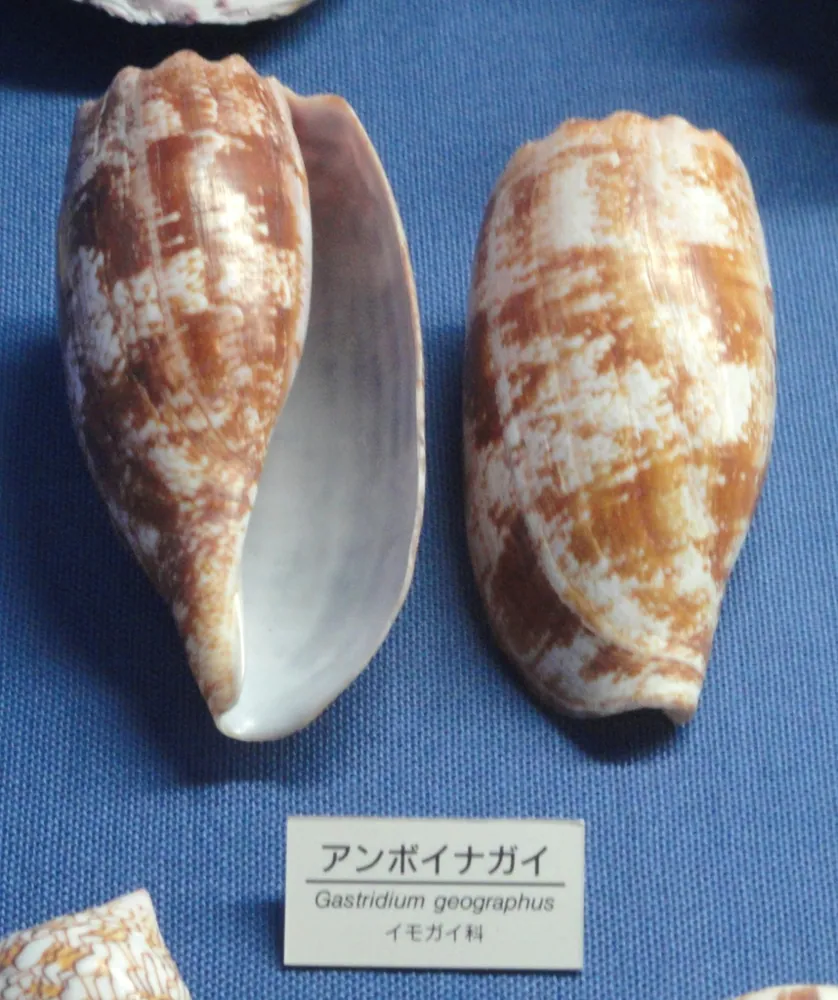
 So erkennst du es
- Broad, thin shell that is cylindrically inflated, usually 10 to 15 cm long1
- Ground colour is pink or violet-white, sometimes reddish1
- Mottled pattern of chestnut or chocolate brown, usually forming two irregular bands1
- Wide pink or violet-white opening and numerous shoulder ridges or spines1
Oft verwechselt mit: Compared with other cone shells of a similar size, the geography cone has a noticeably wider, more convex middle and a flattened spire. Its walls are also thinner and lighter.1
Giftkraft
Das Gift kommt durch einen Stachel heraus.
Was macht sein Gift, wenn es beißt oder sticht?
Its venom is a complex mix of hundreds of different toxins, delivered through the harpoon-like tooth. It has the most toxic sting known among cone snails. Even the most venomous cone snails take about one to five hours to kill a healthy adult, but medical care must still be prompt.1
Wie gefährlich ist es für Menschen?
Gefahr für Menschen: TödlichEines der gefährlichsten Tiere der Welt.There are reports of about 36 human deaths over the past 300 years. Live specimens should be handled with extreme caution.1
Was macht es, wenn es Angst hat?
Most of the venom's toxic compounds are believed to be used for defence rather than feeding.1
 Wenn es sticht
- There is no antivenom for a cone snail sting. Treatment consists of keeping the victim alive until the symptoms wear off, so prompt medical care is essential.1
- Druck-Immobilisation: Wickle eine feste elastische Binde über den Biss und dann über den ganzen Arm oder das ganze Bein, leg eine Schiene an und halte die Person völlig still, bis Hilfe kommt.
- Ein Blauring-Krake oder eine Kegelschnecke kann die Atmung eines Menschen stoppen, während er noch wach ist: Ruf Hilfe und sei bereit, Atemspende zu geben, bis der Rettungsdienst übernimmt.
Ruf immer zuerst deine Notrufnummer an (112, 000, 911). Das sind allgemeine Erste-Hilfe-Hinweise, keine ärztliche Beratung. Erste-Hilfe-Grundlagen
 Bleib sicher
- Fass ein wildes Tier niemals an, fang es nicht und ärgere es nicht, auch kein kleines, und auch nicht, wenn es schlafend aussieht oder tot.
- Halte Abstand. Wenn du einem begegnest, bleib ruhig, geh langsam zurück und lass es seiner Wege gehen.
- Wenn dich eines sticht: Bleib ruhig, halt still, ruf deine Notrufnummer an (112, 000, 911) oder fahr schnell in ein Krankenhaus. Merk dir, wie es aussah, ein Foto hilft.
Es hat es nicht auf dich abgesehen. Es benutzt sein Gift, um Futter zu fangen oder sich zu schützen, und versteckt sich viel lieber. Mehr über Sicherheit
Wo auf der Welt?
Wie groß ist es?
Wie lang ist es?
 so lang wie 5 Bausteine in einer Reihe
 langsamer als eine Weinbergschnecke
Wie groß ist Geography cone im Vergleich zu DIR?
Nur Rechnen in deinem Browser. Nichts wird gespeichert oder irgendwohin geschickt.
Wie schnell ist es?

Fakten
Its venom contains a form of insulin, which it uses to stun fish. Once the venom passes through a fish's gills, the fish goes into hypoglycaemic shock (a dangerous drop in blood sugar).1
Apart from the tulip cone snail, no other known living thing is known to use its own biological insulin as a weapon.1
Research shows that some proteins from cone snail venom can be up to 10,000 times more effective than morphine as painkillers, without morphine's addictive properties and side effects.1
Of the venom's 100 to 200 toxic peptides, only 15 to 20 are used for feeding.1
Adult geography cones can fall prey to sea turtles, rays, birds and human shell collectors.1
Mythen-Check
Mythos: The nickname 'cigarette snail' means a sting gives you just enough time to smoke a cigarette before you die.
Wahrheit: This is a gallows humour exaggeration. Even the most venomous cone snails take about one to five hours to kill a healthy human.1
Woher die Fakten kommen
- Conus geographus (Wikipedia (CC BY-SA 4.0))
- Conus geographus (iNaturalist): Namen und Klassifikation.
- Venom Wiki: die Gefahrenstufe, die typische Größe und die geschätzte Geschwindigkeit sind von uns. So berechnen wir sie: So bewerten wir die Gefahr.
Jeder Fakt auf dieser Seite hat eine Nummer, die auf seine Quelle zeigt. Wenn wir etwas falsch haben: Entschuldigung, wir sind Tierfans, keine Fachzeitschrift. Schreib uns an [email protected] und wir korrigieren es.
 Der Skorpion hat Hunger! Venom Wiki ist ein Ein-Mann-Projekt: kostenlos, ohne Werbung und ohne Tracker. Ein kleines Trinkgeld hilft, es online zu halten.Füttere den Skorpion
Mehr aus derselben Gruppe: Kegelschnecken & Kraken
 Greater blue-ringed octopusKegelschnecken & KrakenTödlich
 Southern blue-ringed octopusKegelschnecken & KrakenTödlich
 Blue sea dragonKegelschnecken & KrakenTut nur weh
 Common octopusKegelschnecken & KrakenHarmlos
 Giant Pacific octopusKegelschnecken & KrakenHarmlos
 Blue-lined octopusKegelschnecken & KrakenTödlich
Lebt auch in: Indischer Ozean
 Australian box jellyfishQuallen & Nesseltiere im MeerTödlichNicht anfassen
 Hawksbill sea turtleAndere passiv giftige TiereKann töten
 Irukandji jellyfishQuallen & Nesseltiere im MeerKann tötenNicht anfassen
 Reef stonefishGiftfischeKann tötenNicht anfassen
 Crown-of-thorns starfishSeeigel, Seesterne & WürmerBraucht einen ArztNicht anfassen
 Portuguese man o' warQuallen & Nesseltiere im MeerBraucht einen ArztNicht anfassen