
 Afrika
 Asien
Asien Europa
 Südamerika
 Australien & Ozeanien
 Antarktis
 Pazifischer Ozean
 Atlantischer Ozean
 Indischer Ozean
 Nordpolarmeer
 Mittelmeer
 Rotes Meer
 Karibisches Meer
 Korallenmeer
 Südchinesisches Meer
 Philippinensee
 Andamanensee
 Nordsee
 Timorsee & Arafurasee
 Golf von Bengalen
 Golf von Kalifornien
Yellow-bellied sea snake
 Bisse
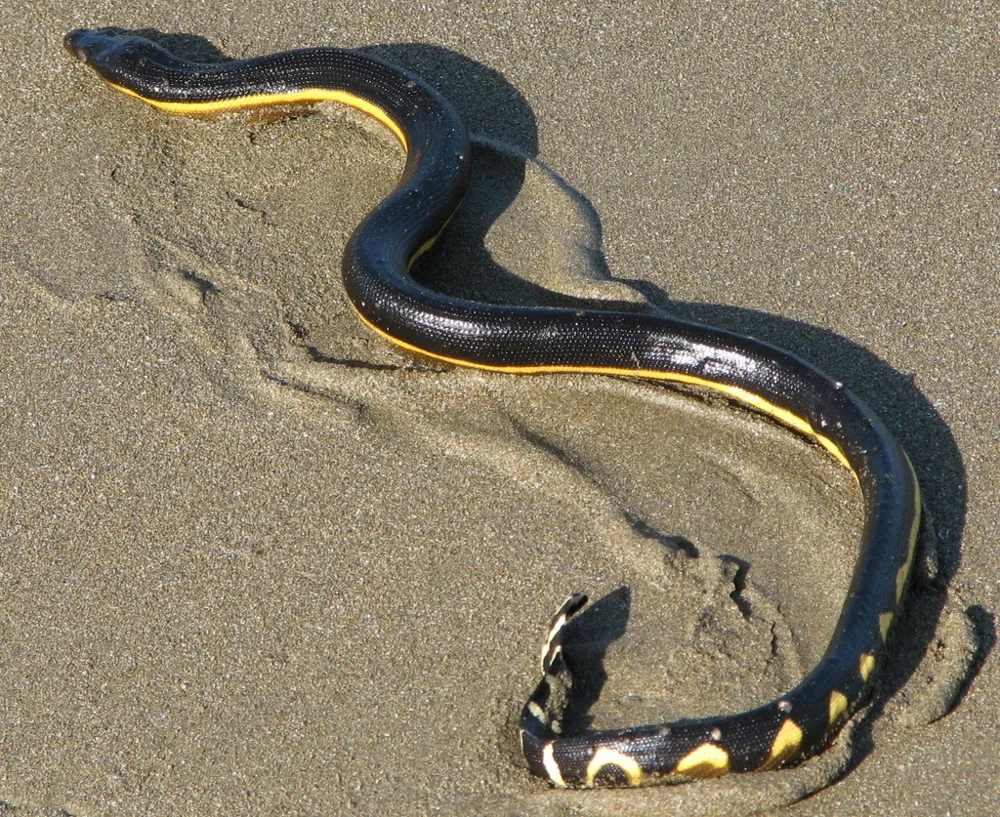
BisseThe yellow-bellied sea snake is a sea snake with a strongly venomous bite. It lives in warm tropical oceans and spends its whole life at sea, floating on the surface. Its yellow belly and brown back make it easy to tell apart from most other sea snakes.1

 So erkennst du es
- Sharply bicoloured: black or dark brown on the back, with a yellow or brown underside.1
- The yellow belly may have black spots, bars or crossbars, or a narrow black stripe along the back.1
- Has a flattened, paddle-shaped tail for swimming.1
- Adults are usually up to about 72 cm (males) or 88 cm (females) long.1
Giftkraft
Das Gift kommt beim Beißen durch die Giftzähne oder Zähne heraus.
Was macht sein Gift, wenn es beißt oder sticht?
The venom is highly potent and contains several different neurotoxins, which attack the nerves, along with two other isotoxins. Sea snake venom can damage skeletal muscle, which may release myoglobin into the urine (myoglobinuria), and can cause neuromuscular paralysis or direct kidney damage. Juvenile venom is on average less concentrated than adult venom.1
Wie gefährlich ist es für Menschen?
Gefahr für Menschen: ErnstEin Biss gehört zum Arzt. Todesfälle sind sehr selten.Bites are rare. The most common victims are fishermen who try to remove the snakes from fishing nets. No deaths have been recorded from bites in Australian waters.1
 Gute Nachricht: Ärzte haben dafür ein Medikament (Gegengift) oder eine Behandlung.1
Was macht es, wenn es Angst hat?
It is not considered aggressive but will defend itself if threatened.1
 Wenn es beißt
- The venom is neutralised with sea snake antivenom (Enhydrina schistosa). If that is not available, tiger snake or polyvalent antivenom should be used.1
- Druck-Immobilisation: Wickle eine feste elastische Binde über den Biss und dann über den ganzen Arm oder das ganze Bein, leg eine Schiene an und halte die Person völlig still, bis Hilfe kommt.
- Hol die Person aus dem Wasser und bring sie schnell in ein Krankenhaus.
Ruf immer zuerst deine Notrufnummer an (112, 000, 911). Das sind allgemeine Erste-Hilfe-Hinweise, keine ärztliche Beratung. Erste-Hilfe-Grundlagen
 Bleib sicher
- Fass ein wildes Tier niemals an, fang es nicht und ärgere es nicht, auch kein kleines, und auch nicht, wenn es schlafend aussieht oder tot.
- Halte Abstand. Wenn du einem begegnest, bleib ruhig, geh langsam zurück und lass es seiner Wege gehen.
- Wenn dich eines beißt: Bleib ruhig, halt still, ruf deine Notrufnummer an (112, 000, 911) oder fahr schnell in ein Krankenhaus. Merk dir, wie es aussah, ein Foto hilft.
Es hat es nicht auf dich abgesehen. Es benutzt sein Gift, um Futter zu fangen oder sich zu schützen, und versteckt sich viel lieber. Mehr über Sicherheit
Wo auf der Welt?
Wie groß ist es?
Wie lang ist es?
 so lang wie 2 Hauskatzen von Nase bis Schwanz
 so lang wie 5 Bananen hintereinander
 könnte die Länge eines großen Schwimmbeckens (50 m) in 49 Sekunden schwimmen
Wie groß ist Yellow-bellied sea snake im Vergleich zu DIR?
Nur Rechnen in deinem Browser. Nichts wird gespeichert oder irgendwohin geschickt.
Wie schnell ist es?
Fakten
It can swim backwards, which is an unusual ability and a distinguishing feature of this species.1
It breathes partly through its skin, taking oxygen from seawater while diving and swimming at the surface.1
It can survive severe dehydration for up to 7 months during seasonal drought.1
Large groups of thousands have been seen floating together on the surface in oceanic drift lines.1
It is the only sea snake known to have reached the Hawaiian Islands.1
Strays wash up so often on New Zealand's coasts that it is considered native to the country and protected under the Wildlife Act 1953.1
Mythen-Check
Mythos: Sea snakes drink seawater and filter out the salt through a special salt gland in the lower jaw.
Wahrheit: Sea snakes drink only fresh water. The salt gland was once thought to filter salt, but it is not used for that purpose. The yellow-bellied sea snake likely drinks from freshwater lenses that form on the sea surface after heavy rain.1
Für Giftexperten
- Wissenschaftlicher Name
- Hydrophis platurus
- Gruppe
- Seeschlangen
- Familie
- Elapidae2
- Ordnung
- Squamata
- Kontinente
- Pazifischer Ozean, Indischer Ozean, Korallenmeer, Südchinesisches Meer, Philippinensee, Andamanensee, Arabisches Meer & Persischer Golf, Timorsee & Arafurasee, Golf von Bengalen, Golf von Kalifornien, Die Ozeane
- Babys
- It gives birth to live young (ovoviviparous) after a gestation period of around 6 months, and females bear them in tidal pools.1
- Gefahr für Menschen
- 3 / 5: Ernst3
Woher die Fakten kommen
- Yellow-bellied sea snake (Wikipedia (CC BY-SA 4.0))
- Hydrophis platurus (iNaturalist): Namen und Klassifikation.
- Venom Wiki: die Gefahrenstufe, die typische Größe und die geschätzte Geschwindigkeit sind von uns. So berechnen wir sie: So bewerten wir die Gefahr.
Jeder Fakt auf dieser Seite hat eine Nummer, die auf seine Quelle zeigt. Wenn wir etwas falsch haben: Entschuldigung, wir sind Tierfans, keine Fachzeitschrift. Schreib uns an [email protected] und wir korrigieren es.
 Der Skorpion hat Hunger! Venom Wiki ist ein Ein-Mann-Projekt: kostenlos, ohne Werbung und ohne Tracker. Ein kleines Trinkgeld hilft, es online zu halten.Füttere den Skorpion
Mehr aus derselben Gruppe: Seeschlangen
 Beaked sea snake
 Belcher's sea snake
 Black-banded sea krait
 Blue-lipped sea krait
 Dubois' sea snake
 Olive sea snake
Lebt auch in: Pazifischer Ozean
 Australische WürfelqualleQuallen & Nesseltiere im MeerTödlichNicht anfassen
 Landkarten-KegelschneckeKegelschnecken & KrakenTödlich
 Großer BlauringkrakeKegelschnecken & KrakenTödlich
 TigerkugelfischAndere passiv giftige TiereTödlich
 Südlicher BlauringkrakeKegelschnecken & KrakenTödlich
 Hawksbill sea turtleAndere passiv giftige TiereKann töten