
 África
 Asia
Asia Europa
 Sudamérica
 Australia y Oceanía
 Antártida
 Océano Pacífico
 Océano Atlántico
 Océano Índico
 Océano Ártico
 Mar Mediterráneo
 Mar Rojo
 Mar Caribe
 Mar del Coral
 Mar de China Meridional
 Mar de Filipinas
 Mar de Andamán
 Mar del Norte
 Mar de Timor y de Arafura
 Golfo de Bengala
 Golfo de California
Banded krait
 Mordeduras
The banded krait is a venomous snake with black and yellow bands around its body. It lives across much of Asia, from India through Southeast Asia to southern China. It matters because its venom is strongly neurotoxic, which means it attacks the nerves, and it can be lethal to people.1



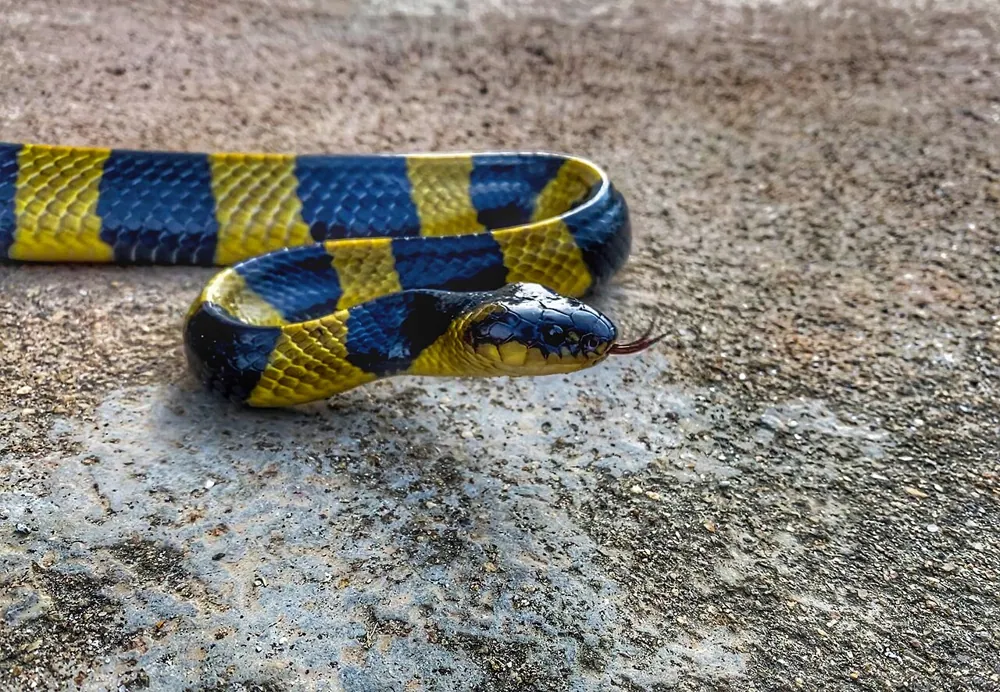
 Cómo reconocerlo
Poder del veneno
El veneno sale por sus colmillos o dientes cuando muerde.
¿Qué hace su veneno?
The venom mainly contains neurotoxins, which attack the nerves. The major effects include vomiting, abdominal pain, diarrhoea and dizziness. Severe envenomation can cause respiratory failure, and death may occur through suffocation. The venom can also damage the kidneys if injected.1
¿Qué peligro tiene para las personas?
Peligro para las personas: Muy peligrosoPuede matar a una persona que no recibe tratamiento.A clinical toxicology study gives an untreated mortality rate of 1 to 10 per cent. Contact with humans is rare, and defensive bites are thought to result in very low envenomation. At night the snake is more active and is widely considered more dangerous.1
 Buena noticia: los médicos tienen un medicamento (antídoto) o un tratamiento para esto.1
¿Qué hace cuando se asusta?
When harassed, it usually hides its head under its coils and does not generally attempt to bite.1
 Si muerde
- Polyvalent antivenoms are available in India and Indonesia.1
- Mantén a la persona quieta y tranquila, quítale anillos y cosas apretadas y llévala rápido a un hospital: el tratamiento es el antídoto.
Llama siempre primero a tu número de emergencias (112, 000, 911). Esto son pautas generales de primeros auxilios, no consejo médico. Primeros auxilios básicos
 Mantente a salvo
- Nunca toques, atrapes ni molestes a un animal salvaje, aunque sea pequeño y aunque parezca dormido o muerto.
- Déjale espacio. Si te encuentras uno, mantén la calma, retrocede despacio y deja que siga su camino.
- Si te muerde: mantén la calma, no te muevas, llama a tu número de emergencias (112, 000, 911) o ve rápido a un hospital. Recuerda cómo era, una foto ayuda.
No va a por ti. Usa su veneno para cazar o defenderse, y prefiere mil veces esconderse. Más sobre cómo protegerte
¿En qué parte del mundo?
¿Qué tamaño tiene?
¿Cuánto mide?
 mide como 4 gatos domésticos de la nariz a la cola
 mide como 12 plátanos puestos en fila
 podría recorrer 100 metros en 46 segundos (el humano más rápido necesita 9,6)
¿Qué tamaño tiene Banded krait comparado contigo?
Solo cálculos en tu navegador. No se guarda ni se envía nada a ningún sitio.
¿Qué velocidad alcanza?


Datos
The banded krait's venom yield is the highest of any krait because of its size, even though its toxicity is lower than that of many other kraits.1
It is the longest krait with a distinguishable gold and black pattern.1
It is generally considered timid and docile, and it is shy and rarely seen.1
Banded kraits are mainly nocturnal, and during the day they lie up in grass, pits or drains.1
It is believed to become adult in its third year, at a length of about 914 mm.1
Para expertos en veneno
De dónde salen los datos
- Banded krait (Wikipedia (CC BY-SA 4.0))
- Bungarus fasciatus (iNaturalist): nombres y clasificación.
- Venom Wiki: el nivel de peligro, el tamaño típico y la velocidad estimada son nuestros. Mira cómo los calculamos: Cómo valoramos el peligro.
Cada dato de esta página tiene un número que lleva a su fuente. Si nos hemos equivocado en algo, perdón, somos fans de los animales, no una revista científica. Escríbenos a [email protected] y lo arreglamos.
 ¡El escorpión tiene hambre! Venom Wiki es un proyecto de una sola persona: gratis, sin anuncios y sin rastreadores. Una pequeña propina ayuda a mantenerlo en línea.Alimenta al escorpión
 Indian cobra
 King cobra
 Caspian cobra
 Common krait
 Malayan krait
 Many-banded krait
 Deathstalker
 Indian saw-scaled viper
 Víbora bufadora
 Víbora de Russell
 Asian giant hornet
 Komodo dragon