
 África
 Asia
Asia Europa
 Sudamérica
 Australia y Oceanía
 Antártida
 Océano Pacífico
 Océano Atlántico
 Océano Índico
 Océano Ártico
 Mar Mediterráneo
 Mar Rojo
 Mar Caribe
 Mar del Coral
 Mar de China Meridional
 Mar de Filipinas
 Mar de Andamán
 Mar del Norte
 Mar de Timor y de Arafura
 Golfo de Bengala
 Golfo de California
Black-necked spitting cobra
 Rocía o escupe
The black-necked spitting cobra is a venomous snake found mostly in sub-Saharan Africa. It can squirt venom from its fangs at a threat, and that venom can cause permanent blindness if it gets into the eyes. Its colours vary a lot from place to place.1



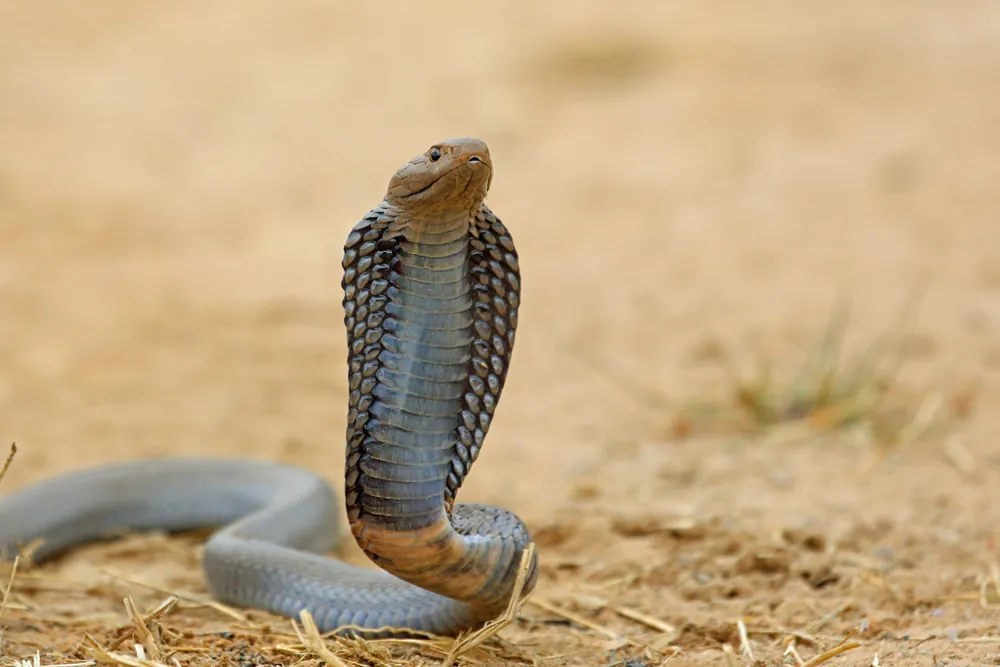
 Cómo reconocerlo
- Moderately sized, with a moderately distinct head, and grows to 1.2 to 2.2 metres.1
- Many specimens have a broad black neck band, often with an orange or pinkish bar on the neck.1
- Colours vary by region: black or pale grey, yellowish-brown, deep reddish-brown, olive brown, striped black and white, or totally white with dark eyes.1
- Some have a yellow or reddish belly, while others lack the neck bands and belly colour.1
Poder del veneno
Rocía o escupe un líquido irritante a sus atacantes.
¿Qué hace su veneno?
Its venom is mostly cytotoxic, meaning it destroys cells, and it also has typical elapid neurotoxic (nerve-attacking) effects and cardiotoxic (heart-damaging) components. A bite causes severe bleeding from the wound, tissue death around the bite, and difficulty breathing. Venom in the eyes causes extreme burning pain, loss of coordination, partial loss of vision, and permanent blindness.1
¿Qué peligro tiene para las personas?
Peligro para las personas: Muy peligrosoPuede matar a una persona que no recibe tratamiento.Its venom is medically significant. The death rate for untreated bites is about 5 to 10%, and under 1% in areas where it is common. When death occurs, it is usually from paralysis of the diaphragm, the muscle used for breathing.1
¿Qué hace cuando se asusta?
It spits venom from its fangs at a threat, reaching up to 7 metres with good accuracy. It also bites readily, even with only slight provocation.1
 Si muerde o escupe
- If venom gets into the eyes, it should be washed off, because permanent blindness can follow if it is not. Anyone bitten should get medical treatment, as untreated bites carry a much higher risk of death.1
- Mantén a la persona quieta y tranquila, quítale anillos y cosas apretadas y llévala rápido a un hospital: el tratamiento es el antídoto.
- Si le escupieron veneno en los ojos, lávalos enseguida con mucha agua limpia.
Llama siempre primero a tu número de emergencias (112, 000, 911). Esto son pautas generales de primeros auxilios, no consejo médico. Primeros auxilios básicos
 Mantente a salvo
- Nunca toques, atrapes ni molestes a un animal salvaje, aunque sea pequeño y aunque parezca dormido o muerto.
- Déjale espacio. Si te encuentras uno, mantén la calma, retrocede despacio y deja que siga su camino.
- Si te muerde o te escupe veneno en los ojos: mantén la calma, no te muevas, llama a tu número de emergencias (112, 000, 911) o ve rápido a un hospital. Recuerda cómo era, una foto ayuda.
No va a por ti. Usa su veneno para cazar o defenderse, y prefiere mil veces esconderse. Más sobre cómo protegerte
¿En qué parte del mundo?
¿Qué tamaño tiene?
¿Cuánto mide?
 mide como 4 gatos domésticos de la nariz a la cola
 mide como 12 plátanos puestos en fila
 podría recorrer 100 metros en 46 segundos (el humano más rápido necesita 9,6)
¿Qué tamaño tiene Black-necked spitting cobra comparado contigo?
Solo cálculos en tu navegador. No se guarda ni se envía nada a ningún sitio.
¿Qué velocidad alcanza?


Datos
It can spit venom accurately more than 7 metres away.1
In 1944, a British eye surgeon, Major Harold Ridley, described eye damage from a spit from this cobra in Ghana. He treated the man and followed his case until the eye fully recovered.1
A single bite can deliver 200 to 350 mg of venom (dry weight), according to a 1974 study by Minton.1
It is an excellent tree climber and can live in trees at times.1
Wild-caught individuals tend to be nervous and spit readily, while captive-bred animals are much calmer.1
It can be active at night or during the day, depending on the season, location and temperature.1
Cazamitos
Mito: Spitting cobras only spit venom and do not bite.
Verdad: The black-necked spitting cobra also bites, and it will do so with only slight provocation.1
Para expertos en veneno
- Nombre científico
- Naja nigricollis
- Grupo
- Cobras, mambas y kraits
- Familia
- Elapidae2
- Orden
- Squamata
- Continentes
- África
- Crías
- Females usually lay 10 to 15 eggs, though they can lay between 8 and 22. The young are about 20 to 25 cm long at birth and are fully independent.1
- Peligro para las personas
- 4 / 5: Muy peligroso3
De dónde salen los datos
- Black-necked spitting cobra (Wikipedia (CC BY-SA 4.0))
- Naja nigricollis (iNaturalist): nombres y clasificación.
- Venom Wiki: el nivel de peligro, el tamaño típico y la velocidad estimada son nuestros. Mira cómo los calculamos: Cómo valoramos el peligro.
Cada dato de esta página tiene un número que lleva a su fuente. Si nos hemos equivocado en algo, perdón, somos fans de los animales, no una revista científica. Escríbenos a [email protected] y lo arreglamos.
 ¡El escorpión tiene hambre! Venom Wiki es un proyecto de una sola persona: gratis, sin anuncios y sin rastreadores. Una pequeña propina ayuda a mantenerlo en línea.Alimenta al escorpión
 Mamba negra
 Cobra egipcia
 Cape cobra
 Eastern green mamba
 Jameson's mamba
 Western green mamba
 Escorpión amarillo de Palestina
 Víbora bufadora
 Boomslang
 Fat-tailed scorpion
 Gaboon viper
 Western honey bee