
 África
 Asia
Asia Europa
 Sudamérica
 Australia y Oceanía
 Antártida
 Océano Pacífico
 Océano Atlántico
 Océano Índico
 Océano Ártico
 Mar Mediterráneo
 Mar Rojo
 Mar Caribe
 Mar del Coral
 Mar de China Meridional
 Mar de Filipinas
 Mar de Andamán
 Mar del Norte
 Mar de Timor y de Arafura
 Golfo de Bengala
 Golfo de California
Darevsky's viper
 Mordeduras
Darevsky's viper is a small venomous snake that lives high in the mountains of northwestern Armenia, northeastern Turkey and southern Georgia. Its bite is painful and causes swelling, but it does not appear to be life-threatening to adults. It is a rare animal, classed as critically endangered.1



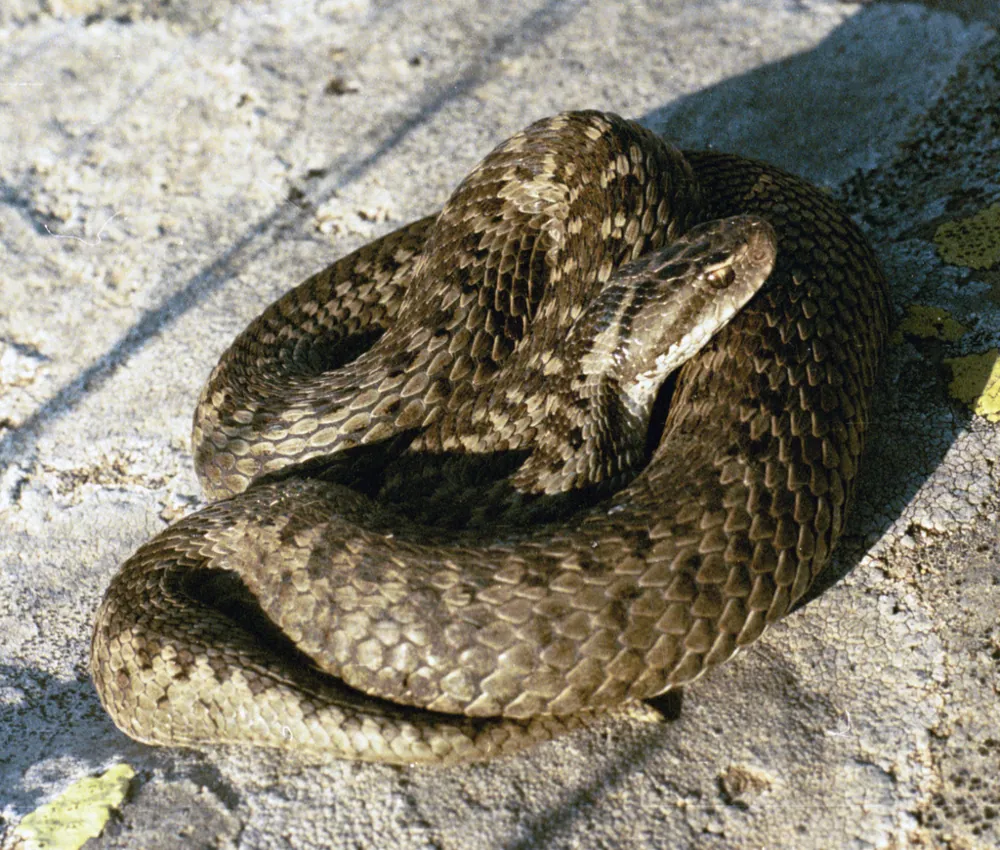
 Cómo reconocerlo
- Light brown to grey background colour with a dark brown to black zigzag pattern along the back, often broken into pieces.1
- A single row of small dark blotches on each side of the body.1
- Belly with many grey or black dots. Females have a greyer belly, while males' bellies are almost black.1
- Chin shields and lip scales are white, with a few dark fang-shaped marks on the lip scales.1
- Adult males are brighter, with a yellow tint and a dark, often black, pattern. Females are browner, with a fainter pattern. Females reach up to 42.1 cm in total length.1
Se confunde a menudo con: It is often compared with Vipera eriwanensis. That species has a pinkish tint on its lip scales, while Darevsky's viper has white lip scales with dark fang-shaped marks.1
Poder del veneno
El veneno sale por sus colmillos o dientes cuando muerde.
¿Qué hace su veneno?
Its venom is potent, and it is a relatively small venomous snake. A bite causes pain and local swelling around the wound. The bite does not appear to be life-threatening to adult humans.1
¿Qué peligro tiene para las personas?
Peligro para las personas: DolorosoPuede doler de verdad, pero casi nunca es grave.The bite is painful and causes local swelling, but it appears not to be life-threatening to adult humans.1
 Si muerde
- Mantén a la persona quieta y tranquila, la extremidad mordida a la altura del corazón, quítale anillos y cosas apretadas y llévala rápido a un hospital.
Llama siempre primero a tu número de emergencias (112, 000, 911). Esto son pautas generales de primeros auxilios, no consejo médico. Primeros auxilios básicos
 Mantente a salvo
- Nunca toques, atrapes ni molestes a un animal salvaje, aunque sea pequeño y aunque parezca dormido o muerto.
- Déjale espacio. Si te encuentras uno, mantén la calma, retrocede despacio y deja que siga su camino.
- Si te muerde: mantén la calma, no te muevas, llama a tu número de emergencias (112, 000, 911) o ve rápido a un hospital. Recuerda cómo era, una foto ayuda.
No va a por ti. Usa su veneno para cazar o defenderse, y prefiere mil veces esconderse. Más sobre cómo protegerte
¿En qué parte del mundo?
¿Qué tamaño tiene?
¿Cuánto mide?
¿Cuánto pesa?
 mide como 2,5 plátanos puestos en fila
 mide como 13 piezas de construcción de juguete en fila
 tan ligero que no lo notarías en la mano
 podría recorrer 100 metros en 120 segundos (el humano más rápido necesita 9,6)
¿Qué tamaño tiene Darevsky's viper comparado contigo?
Solo cálculos en tu navegador. No se guarda ni se envía nada a ningún sitio.
¿Qué velocidad alcanza?


Datos
Its digestion is very fast. In captive tests at 4 to 7 °C, a meal of fuzzy rat was digested in only 3 days.1
Remains of this snake have been found in the droppings of a beech marten, although little is known about its natural enemies.1
Newborns feed on the yolk left inside them for their first two weeks, and they grow without eating before their first shed.1
It is active during the day and moves into rocky deposits to keep its body at about 26 to 28 °C.1
Para expertos en veneno
- Nombre científico
- Vipera darevskii
- Grupo
- Víboras
- Familia
- Viperidae2
- Orden
- Squamata
- Continentes
- Asia
- Crías
- It is ovoviviparous, meaning the eggs hatch inside the mother and she gives birth to live young. She has 4 to 8 babies between September and early October.1
- Cómo le va en la naturaleza
- Critically endangered (IUCN Red List)1
- Peligro para las personas
- 2 / 5: Doloroso3
De dónde salen los datos
- Vipera darevskii (Wikipedia (CC BY-SA 4.0))
- Vipera darevskii (iNaturalist): nombres y clasificación.
- Venom Wiki: el nivel de peligro, el tamaño típico y la velocidad estimada son nuestros. Mira cómo los calculamos: Cómo valoramos el peligro.
Cada dato de esta página tiene un número que lleva a su fuente. Si nos hemos equivocado en algo, perdón, somos fans de los animales, no una revista científica. Escríbenos a [email protected] y lo arreglamos.
 ¡El escorpión tiene hambre! Venom Wiki es un proyecto de una sola persona: gratis, sin anuncios y sin rastreadores. Una pequeña propina ayuda a mantenerlo en línea.Alimenta al escorpión
 Víbora de escamas aserradas india
 Víbora bufadora
 Víbora de Russell
 Common European adder
 Eastern Russell's viper
 Northeast African carpet viper
 Escorpión amarillo de Palestina
 Cobra india
 Cobra real
 Asian giant hornet
 Komodo dragon
 Spanish fly