
 África
 Asia
Asia Europa
 Sudamérica
 Australia y Oceanía
 Antártida
 Océano Pacífico
 Océano Atlántico
 Océano Índico
 Océano Ártico
 Mar Mediterráneo
 Mar Rojo
 Mar Caribe
 Mar del Coral
 Mar de China Meridional
 Mar de Filipinas
 Mar de Andamán
 Mar del Norte
 Mar de Timor y de Arafura
 Golfo de Bengala
 Golfo de California
Golden tree snake
 Mordeduras
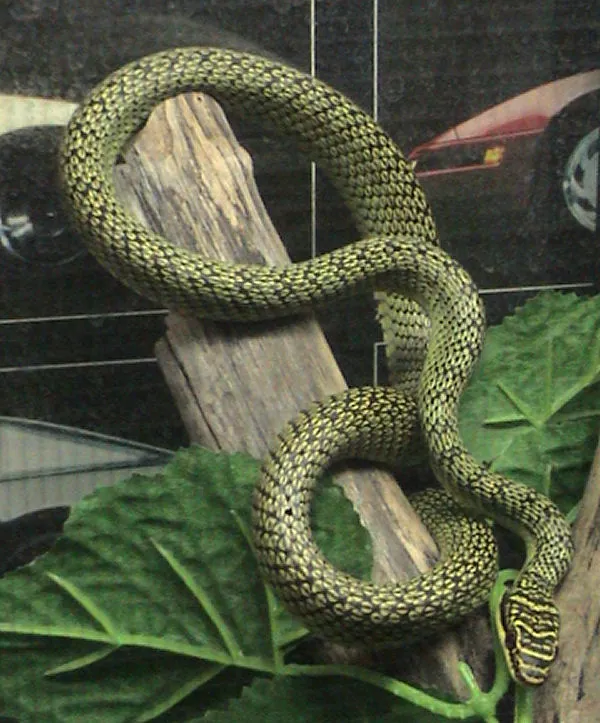
The golden tree snake is a slim, green snake with gold and black markings that lives in trees across South and Southeast Asia. It is famous for its ability to glide from tree to tree, which it does by launching itself into the air and steering with its body. It is mildly venomous, but it is not considered dangerous to people.1



 Cómo reconocerlo
- Usually green, with black cross-hatching and yellow or gold accents1
- Slender body with a flattened head, a blunt nose and large eyes with round pupils1
- In Sri Lanka and southern India it is mainly greenish yellow or pale green, often with reddish or orange flower-shaped spots on its back1
- In Southeast Asia it lacks the reddish spots and has less prominent black crossbars1
- Nervous and fast-moving, it climbs trees and vertical rock faces in graceful curves1
Se confunde a menudo con: The paradise flying snake (C. paradisi) is a close relative that also glides. Its gliding is more impressive than that of the golden tree snake, which is still able to move easily from tree to tree.1
Poder del veneno
El veneno sale por sus colmillos o dientes cuando muerde.
¿Qué hace su veneno?
It is mildly venomous. Its two small fangs are at the back of the upper jaw, so it must chew to get venom into prey. The venom is meant to subdue fast-moving tree-living animals and is not considered dangerous to humans.1
¿Qué peligro tiene para las personas?
Peligro para las personas: LeveComo una picadura de abeja o menos. Prácticamente inofensivo para las personas.It is not considered dangerous to humans and is not of medical importance. It generally does not hesitate to bite if handled.1
¿Qué hace cuando se asusta?
When disturbed it tries to flee, and it can glide away from predators such as birds or other reptiles.1
 Si muerde
- Lava la mordedura, mantén tranquila a la persona y busca ayuda médica. Algunas especies (como la boomslang) pueden ser mortales horas después.
Llama siempre primero a tu número de emergencias (112, 000, 911). Esto son pautas generales de primeros auxilios, no consejo médico. Primeros auxilios básicos
 Mantente a salvo
- Nunca toques, atrapes ni molestes a un animal salvaje, aunque sea pequeño y aunque parezca dormido o muerto.
- Déjale espacio. Si te encuentras uno, mantén la calma, retrocede despacio y deja que siga su camino.
- Si te muerde: mantén la calma, no te muevas, llama a tu número de emergencias (112, 000, 911) o ve rápido a un hospital. Recuerda cómo era, una foto ayuda.
No va a por ti. Usa su veneno para cazar o defenderse, y prefiere mil veces esconderse. Más sobre cómo protegerte
¿En qué parte del mundo?
¿Qué tamaño tiene?
¿Cuánto mide?
 mide como 2,5 gatos domésticos de la nariz a la cola
 mide como 7 plátanos puestos en fila
 podría recorrer 100 metros en 64 segundos (el humano más rápido necesita 9,6)
¿Qué tamaño tiene Golden tree snake comparado contigo?
Solo cálculos en tu navegador. No se guarda ni se envía nada a ningún sitio.
¿Qué velocidad alcanza?


Datos
It can glide, or parachute, across distances of as much as 100 m from tree to tree.1
To glide, it curves its belly into a U-shape that acts like a parachute, then undulates through the air like it is swimming.1
It balances in the air by twisting its tail from side to side, with the tail held rigidly upwards.1
Its striking looks and gliding have made it a sought-after choice for captivity, though it often struggles in captivity.1
It is sometimes cooked for food.1
Cazamitos
Mito: Many locals assume that all snakes are venomous and kill them on sight.
Verdad: The golden tree snake is only mildly venomous and is not considered dangerous to humans.1
Para expertos en veneno
- Nombre científico
- Chrysopelea ornata
- Grupo
- Serpientes de colmillos traseros
- Familia
- Colubridae2
- Orden
- Squamata
- Continentes
- Asia
- Crías
- It lays eggs. Six to 12 elongated eggs are laid, and hatchlings measure 114–152 mm long.1
- Cómo le va en la naturaleza
- Not known to be endangered1
- Peligro para las personas
- 1 / 5: Leve3
De dónde salen los datos
- Chrysopelea ornata (Wikipedia (CC BY-SA 4.0))
- Chrysopelea ornata (iNaturalist): nombres y clasificación.
- Venom Wiki: el nivel de peligro, el tamaño típico y la velocidad estimada son nuestros. Mira cómo los calculamos: Cómo valoramos el peligro.
Cada dato de esta página tiene un número que lleva a su fuente. Si nos hemos equivocado en algo, perdón, somos fans de los animales, no una revista científica. Escríbenos a [email protected] y lo arreglamos.
 ¡El escorpión tiene hambre! Venom Wiki es un proyecto de una sola persona: gratis, sin anuncios y sin rastreadores. Una pequeña propina ayuda a mantenerlo en línea.Alimenta al escorpión
Más del mismo grupo: Serpientes de colmillos traseros
 Brown tree snakeSerpientes de colmillos traserosSolo duele
 Tiger keelbackSerpientes de colmillos traserosPuede matar
 Red-necked keelbackSerpientes de colmillos traserosNecesita médico
 Green cat snakeSerpientes de colmillos traserosSolo duele
 Mangrove snakeSerpientes de colmillos traserosSolo duele
 Asian vine snakeSerpientes de colmillos traserosInofensivo
 Escorpión amarillo de Palestina
 Cobra india
 Víbora de escamas aserradas india
 Cobra real
 Víbora bufadora
 Víbora de Russell