
 África
 Asia
Asia Europa
 Sudamérica
 Australia y Oceanía
 Antártida
 Océano Pacífico
 Océano Atlántico
 Océano Índico
 Océano Ártico
 Mar Mediterráneo
 Mar Rojo
 Mar Caribe
 Mar del Coral
 Mar de China Meridional
 Mar de Filipinas
 Mar de Andamán
 Mar del Norte
 Mar de Timor y de Arafura
 Golfo de Bengala
 Golfo de California
Paraguayan three-striped scorpion
 Picaduras
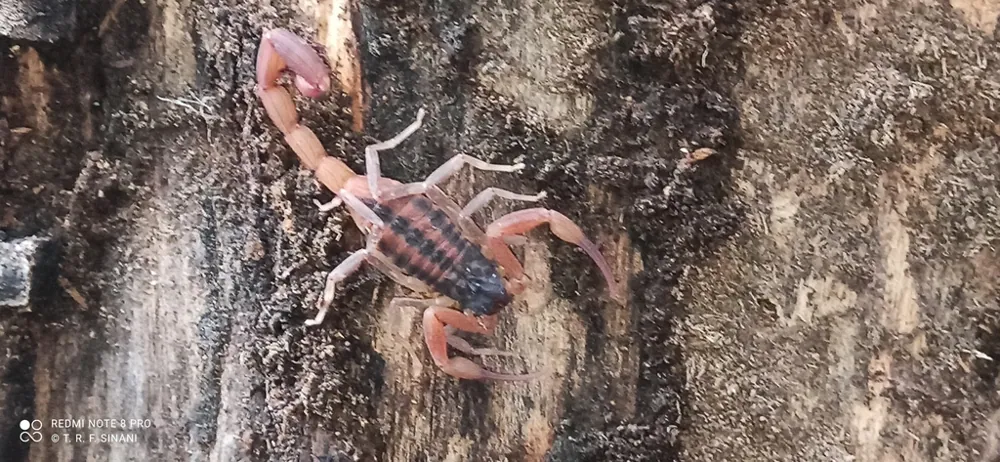
This is a scorpion from South America, also called the Brazilian red house scorpion. It lives in Brazil, Argentina, Paraguay and Uruguay, and it is often found in people's homes. Its sting can cause serious symptoms, so it is important to know what it looks like.1

 Cómo reconocerlo
- The back of the body is yellow or reddish-yellow.1
- The legs, pedipalps (the front limbs used like tweezers) and tail are pale yellow or yellow-brown.1
- The legs and pedipalps may have dark segmented marks.1
- Young scorpions are reddish, with dark spots on the legs.1
- It is nocturnal, so it is mostly active at night.1
Poder del veneno
El veneno sale por un aguijón.
¿Qué hace su veneno?
The venom causes pain in most cases, and swelling, burning, redness and itching around the sting are also common. Neurological symptoms include tingling, cramps, excitement and headache. Other reported symptoms include pale skin, a fast heartbeat, difficulty breathing, low blood pressure, an irregular heartbeat and chest pain, along with low body temperature in some cases. Vomiting, nausea and sweating can also occur.1
¿Qué peligro tiene para las personas?
Peligro para las personas: GraveUna picadura necesita médico. Las muertes son muy raras.It is the main cause of more serious scorpion accidents in Argentina. It is not usually aggressive. How severe a sting is depends on the age of the person stung and the amount of venom injected.1
¿Qué hace cuando se asusta?
It can sting to defend itself when it is handled, stepped on, or hidden in clothing when someone is getting dressed.1
 Si pica
- Enfría la picadura con hielo y mantén quieta a la persona. Busca ayuda médica rápido, sobre todo para niños: algunos escorpiones son mortales para los niños.
Llama siempre primero a tu número de emergencias (112, 000, 911). Esto son pautas generales de primeros auxilios, no consejo médico. Primeros auxilios básicos
 Mantente a salvo
- Nunca toques, atrapes ni molestes a un animal salvaje, aunque sea pequeño y aunque parezca dormido o muerto.
- Déjale espacio. Si te encuentras uno, mantén la calma, retrocede despacio y deja que siga su camino.
- Si te pica: mantén la calma, no te muevas, llama a tu número de emergencias (112, 000, 911) o ve rápido a un hospital. Recuerda cómo era, una foto ayuda.
No va a por ti. Usa su veneno para cazar o defenderse, y prefiere mil veces esconderse. Más sobre cómo protegerte
¿En qué parte del mundo?
¿Qué tamaño tiene?
¿Cuánto mide?
 mide como 2 piezas de construcción de juguete en fila
 podría recorrer 100 metros en 260 segundos (el humano más rápido necesita 9,6)
¿Qué tamaño tiene Paraguayan three-striped scorpion comparado contigo?
Solo cálculos en tu navegador. No se guarda ni se envía nada a ningún sitio.
¿Qué velocidad alcanza?


Datos
In Argentina it is the species behind most of the more serious scorpion stings.1
It uses its pedipalps like tweezers to hold prey before it stings.1
It is found only in South America, where it is common in houses.1
It hides in small gaps such as cracks, pipes, under floors and behind baseboards.1
Its young are reddish with dark spots on their legs, unlike the yellow-brown adults.1
De dónde salen los datos
- Tityus trivittatus (Wikipedia (CC BY-SA 4.0))
- Tityus trivittatus (iNaturalist): nombres y clasificación.
- Venom Wiki: el nivel de peligro, el tamaño típico y la velocidad estimada son nuestros. Mira cómo los calculamos: Cómo valoramos el peligro.
Cada dato de esta página tiene un número que lleva a su fuente. Si nos hemos equivocado en algo, perdón, somos fans de los animales, no una revista científica. Escríbenos a [email protected] y lo arreglamos.
 ¡El escorpión tiene hambre! Venom Wiki es un proyecto de una sola persona: gratis, sin anuncios y sin rastreadores. Una pequeña propina ayuda a mantenerlo en línea.Alimenta al escorpión
 Brazilian yellow scorpion
 Amazonian black scorpion
 Caracas scorpion
 Panamanian black scorpion
 Zulia scorpion
 Amazon forest scorpion
 Rana dardo dorada
 Terciopelo
 Brazilian wandering spider
 Eyelash viper
 Golden lancehead
 South American bushmaster