
 África
 Asia
Asia Europa
 Sudamérica
 Australia y Oceanía
 Antártida
 Océano Pacífico
 Océano Atlántico
 Océano Índico
 Océano Ártico
 Mar Mediterráneo
 Mar Rojo
 Mar Caribe
 Mar del Coral
 Mar de China Meridional
 Mar de Filipinas
 Mar de Andamán
 Mar del Norte
 Mar de Timor y de Arafura
 Golfo de Bengala
 Golfo de California
Golden lancehead
 Mordeduras
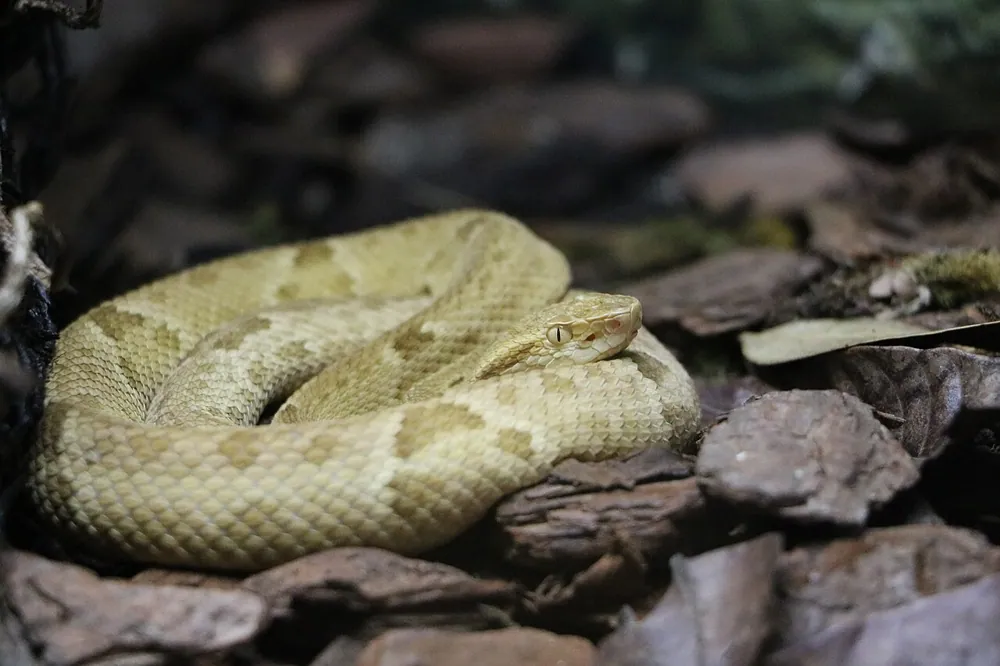
The golden lancehead is an extremely venomous pit viper that lives only on one small Brazilian island, Ilha da Queimada Grande. It is one of the most venomous snakes in Latin America. Because the island is uninhabited and closed to visitors, it is very unlikely that people will ever meet one.1
 Cómo reconocerlo
- Pale yellowish-brown body with a series of dorsal blotches that may be triangular or square.1
- Belly is a uniform pale yellow or cream.1
- Lance-shaped head that comes to a point at the nose.1
- No well-defined stripe running behind the eye.1
- Has a longer tail than its closest relative, B. jararaca.1
Se confunde a menudo con: Its closest relative is B. jararaca, which lives in southern Brazil, Paraguay and northern Argentina. The golden lancehead can be told apart from it mainly by its longer tail.1
Poder del veneno
El veneno sale por sus colmillos o dientes cuando muerde.
¿Qué hace su veneno?
Its venom is adapted to the animals of the island, mainly reptiles, arthropods and migrating birds, so it works better on these than on mammals. Chemical analysis suggests it is five times as potent as the venom of B. jararaca and is the fastest-acting venom in the genus Bothrops. Its venom becomes more potent as the snake matures. Effects reported in envenomations include swelling, pain, nausea, vomiting, blood blisters, bruising, bleeding into the gut and brain, kidney failure and severe muscle damage.1
¿Qué peligro tiene para las personas?
Peligro para las personas: Muy peligrosoPuede matar a una persona que no recibe tratamiento.No official report of a human bite from this species has been made, because the island is uninhabited. Other lanceheads cause more human deaths than any other group of snakes in North or South America. One researcher reports four human envenomations by this species, three of which were fatal. For lanceheads in general, the mortality rate is 0.5 to 3.0% with treatment and 7.0% without it.1
 Si muerde
- Mantén a la persona quieta y tranquila, la extremidad mordida a la altura del corazón, quítale anillos y cosas apretadas y llévala rápido a un hospital.
Llama siempre primero a tu número de emergencias (112, 000, 911). Esto son pautas generales de primeros auxilios, no consejo médico. Primeros auxilios básicos
 Mantente a salvo
- Nunca toques, atrapes ni molestes a un animal salvaje, aunque sea pequeño y aunque parezca dormido o muerto.
- Déjale espacio. Si te encuentras uno, mantén la calma, retrocede despacio y deja que siga su camino.
- Si te muerde: mantén la calma, no te muevas, llama a tu número de emergencias (112, 000, 911) o ve rápido a un hospital. Recuerda cómo era, una foto ayuda.
No va a por ti. Usa su veneno para cazar o defenderse, y prefiere mil veces esconderse. Más sobre cómo protegerte
¿En qué parte del mundo?
¿Qué tamaño tiene?
¿Cuánto mide?
 mide como 2,5 gatos domésticos de la nariz a la cola
 mide como 7 plátanos puestos en fila
 podría recorrer 100 metros en 100 segundos (el humano más rápido necesita 9,6)
¿Qué tamaño tiene Golden lancehead comparado contigo?
Solo cálculos en tu navegador. No se guarda ni se envía nada a ningún sitio.
¿Qué velocidad alcanza?


Datos
Its venom is thought to be five times as potent as that of its closest relative, B. jararaca.1
Its venom has evolved to suit the animals of its island, which has no native mammals.1
Its tail is longer than that of its closest relative, which may help it climb through trees and catch larger birds from a younger age.1
The island's population was estimated at between 2,414 and 2,899 snakes in 2021.1
Travel to the island is strictly prohibited by the Brazilian government.1
It is found only on Ilha da Queimada Grande, an island of about 43 hectares, and nowhere else in the wild.1
Para expertos en veneno
- Nombre científico
- Bothrops insularis
- Grupo
- Víboras de foseta
- Familia
- Viperidae2
- Orden
- Squamata
- Continentes
- Sudamérica
- Crías
- Like most vipers, it gives birth to live young. The average number of young per pregnancy is 6.5.1
- Cómo le va en la naturaleza
- Critically Endangered (IUCN Red List)1
- Peligro para las personas
- 4 / 5: Muy peligroso3
De dónde salen los datos
- Golden lancehead (Wikipedia (CC BY-SA 4.0))
- Bothrops insularis (iNaturalist): nombres y clasificación.
- Venom Wiki: el nivel de peligro, el tamaño típico y la velocidad estimada son nuestros. Mira cómo los calculamos: Cómo valoramos el peligro.
Cada dato de esta página tiene un número que lleva a su fuente. Si nos hemos equivocado en algo, perdón, somos fans de los animales, no una revista científica. Escríbenos a [email protected] y lo arreglamos.
 ¡El escorpión tiene hambre! Venom Wiki es un proyecto de una sola persona: gratis, sin anuncios y sin rastreadores. Una pequeña propina ayuda a mantenerlo en línea.Alimenta al escorpión
 Terciopelo
 Eyelash viper
 South American bushmaster
 Common lancehead
 Jararaca
 Jararacussu
 Golden poison frog
 Brazilian wandering spider
 Cane toad
 Peruvian giant centipede
 Bullet ant
 Common vampire bat