
 África
 Asia
Asia Europa
 Sudamérica
 Australia y Oceanía
 Antártida
 Océano Pacífico
 Océano Atlántico
 Océano Índico
 Océano Ártico
 Mar Mediterráneo
 Mar Rojo
 Mar Caribe
 Mar del Coral
 Mar de China Meridional
 Mar de Filipinas
 Mar de Andamán
 Mar del Norte
 Mar de Timor y de Arafura
 Golfo de Bengala
 Golfo de California
Red-headed krait
 Mordeduras
The red-headed krait is a large, highly venomous snake with a striking look: a bright red head and tail and a glossy black body. It lives in lowland rain forests across Southeast Asia, including on some islands, and it is uncommon. It is a night-time hunter, and people rarely meet it.1



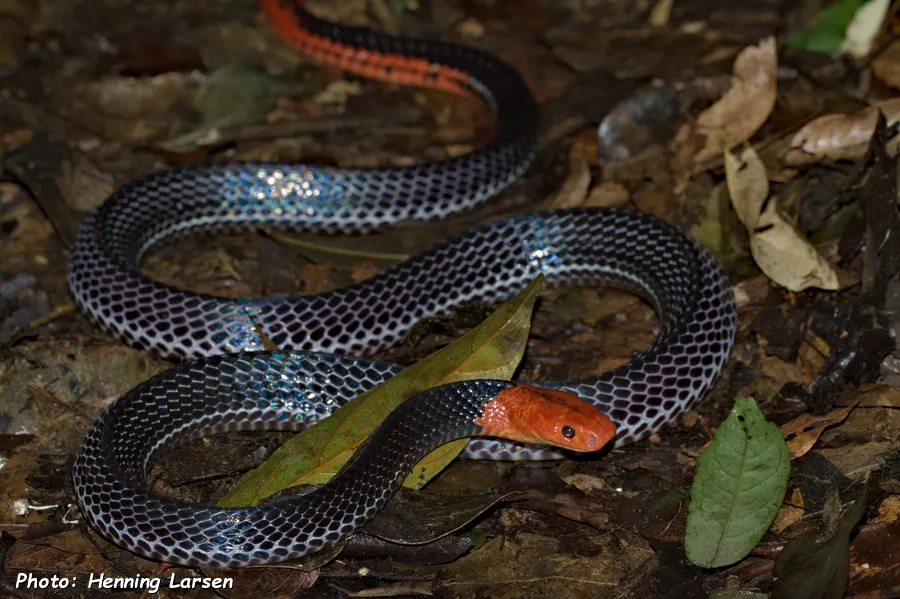
 Cómo reconocerlo
- A bright red head and tail1
- A black body with a narrow bluish white stripe along the side1
- Large, smooth, glossy scales1
- Adults can reach 2.1 metres, with an average of 1.2 to 1.5 metres1
Se confunde a menudo con: It is similar to the blue Malayan coral snake, which is also venomous, and to the nonvenomous red-headed reed snake.1
Poder del veneno
El veneno sale por sus colmillos o dientes cuando muerde.
¿Qué hace su veneno?
Its venom is a neurotoxin, which attacks the nerves. It blocks signals between nerves and muscles, causing paralysis. Victims can stop breathing, which can lead to death by asphyxiation. Between 20 minutes and several hours after a bite, drooping eyelids may appear, along with double vision, difficulty swallowing, vomiting, headache and excess saliva. Symptoms can then worsen as more muscles, including the jaw, become paralysed, and breathing can become difficult.1
¿Qué peligro tiene para las personas?
Peligro para las personas: Muy peligrosoPuede matar a una persona que no recibe tratamiento.Bites are reported rarely, and the venom is little studied for this reason. It is not usually considered high risk to people in the daytime, because it is sluggish and hides. At night it is active and extremely dangerous.1
 Buena noticia: los médicos tienen un medicamento (antídoto) o un tratamiento para esto.1
¿Qué hace cuando se asusta?
When disturbed, it presses its head into the ground or hides its head within its flattened or rolled coils. Captives will generally refuse to strike until they have been teased for a long time.1
 Si muerde
- Get to a hospital fast. Neurotoxic symptoms can be treated in hospital with antivenin or with drugs that inactivate acetylcholinesterase, an enzyme that breaks down the chemical messenger between nerves and muscles. Symptoms may also settle on their own.1
- Mantén a la persona quieta y tranquila, quítale anillos y cosas apretadas y llévala rápido a un hospital: el tratamiento es el antídoto.
Llama siempre primero a tu número de emergencias (112, 000, 911). Esto son pautas generales de primeros auxilios, no consejo médico. Primeros auxilios básicos
 Mantente a salvo
- Nunca toques, atrapes ni molestes a un animal salvaje, aunque sea pequeño y aunque parezca dormido o muerto.
- Déjale espacio. Si te encuentras uno, mantén la calma, retrocede despacio y deja que siga su camino.
- Si te muerde: mantén la calma, no te muevas, llama a tu número de emergencias (112, 000, 911) o ve rápido a un hospital. Recuerda cómo era, una foto ayuda.
No va a por ti. Usa su veneno para cazar o defenderse, y prefiere mil veces esconderse. Más sobre cómo protegerte
¿En qué parte del mundo?
¿Qué tamaño tiene?
¿Cuánto mide?
 mide como 4 gatos domésticos de la nariz a la cola
 mide como 12 plátanos puestos en fila
 podría recorrer 100 metros en 46 segundos (el humano más rápido necesita 9,6)
¿Qué tamaño tiene Red-headed krait comparado contigo?
Solo cálculos en tu navegador. No se guarda ni se envía nada a ningún sitio.
¿Qué velocidad alcanza?


Datos
Its venom contains a novel toxin called κ-flavitoxin, which blocks nicotinic transmission in autonomic ganglia, clusters of nerve cells that control automatic body functions.1
It has short, hollow fangs at the front of its upper jaw, and venom is forced out through a hole near the tip of each fang.1
It is partly aquatic and mainly active at night.1
It was once thought to eat mainly other snakes, but its diet is now known to be much wider.1
Cazamitos
Mito: It only eats other snakes.
Verdad: Its diet includes skinks, lizards, frogs, caecilians, small mammals and snake eggs, as well as snakes.1
De dónde salen los datos
- Red-headed krait (Wikipedia (CC BY-SA 4.0))
- Bungarus flaviceps (iNaturalist): nombres y clasificación.
- Venom Wiki: el nivel de peligro, el tamaño típico y la velocidad estimada son nuestros. Mira cómo los calculamos: Cómo valoramos el peligro.
Cada dato de esta página tiene un número que lleva a su fuente. Si nos hemos equivocado en algo, perdón, somos fans de los animales, no una revista científica. Escríbenos a [email protected] y lo arreglamos.
 ¡El escorpión tiene hambre! Venom Wiki es un proyecto de una sola persona: gratis, sin anuncios y sin rastreadores. Una pequeña propina ayuda a mantenerlo en línea.Alimenta al escorpión
 Indian cobra
 King cobra
 Caspian cobra
 Common krait
 Malayan krait
 Many-banded krait
 Deathstalker
 Indian saw-scaled viper
 Víbora bufadora
 Víbora de Russell
 Asian giant hornet
 Komodo dragon