
 África
 Asia
Asia Europa
 Sudamérica
 Australia y Oceanía
 Antártida
 Océano Pacífico
 Océano Atlántico
 Océano Índico
 Océano Ártico
 Mar Mediterráneo
 Mar Rojo
 Mar Caribe
 Mar del Coral
 Mar de China Meridional
 Mar de Filipinas
 Mar de Andamán
 Mar del Norte
 Mar de Timor y de Arafura
 Golfo de Bengala
 Golfo de California
Red widow
 Mordeduras
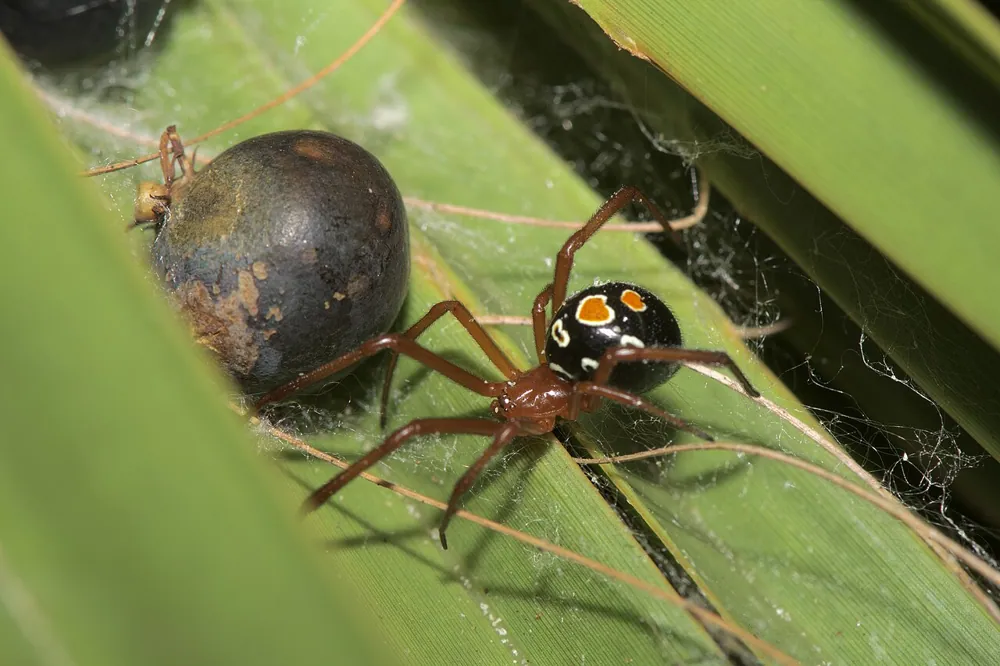
The red widow is a venomous spider that lives only in Florida, in the dry, sandy scrub where sand pine trees grow. It is a close relative of the black widow, but it rarely comes into contact with people, so it is not often met. Its bright red colours make it easy to recognise.1
 Cómo reconocerlo
- The cephalothorax (the front part of the body) is red-orange.1
- The abdomen is black, with yellow rings outlining rows of red spots.1
- The legs are vermilion red.1
- The underside does not have the familiar hourglass marking. It usually has one or two small red marks instead.1
- Females are almost double the size of males.1
Se confunde a menudo con: It is closely related to the black widow (Latrodectus mactans). The two can be told apart by features of the male and female genitalia, which are examined under magnification. The red widow's male embolus has one fewer loop, and the female's connecting ducts to the spermatheca also have one fewer loop.1
Poder del veneno
El veneno sale por sus colmillos o dientes cuando muerde.
¿Qué hace su veneno?
The red widow is venomous like other members of the genus Latrodectus. In a documented bite, the main effect was a mildly painful throbbing sensation that lasted several hours. The median lethal dose (LD50) of its venom in mice is 2.20 mg/kg, and each spider contains about 0.157 mg of venom.1
¿Qué peligro tiene para las personas?
Peligro para las personas: DolorosoPuede doler de verdad, pero casi nunca es grave.No bites from this spider are recorded in the medical literature. It seldom comes into contact with humans, unlike the black and brown widows, which live close to people. One documented bite caused a mildly painful throbbing that lasted several hours.1
 Si muerde
- Lava la mordedura y ponle hielo para el dolor. Busca ayuda médica si el dolor es fuerte, se extiende o la persona se encuentra mal.
Llama siempre primero a tu número de emergencias (112, 000, 911). Esto son pautas generales de primeros auxilios, no consejo médico. Primeros auxilios básicos
 Mantente a salvo
- Nunca toques, atrapes ni molestes a un animal salvaje, aunque sea pequeño y aunque parezca dormido o muerto.
- Déjale espacio. Si te encuentras uno, mantén la calma, retrocede despacio y deja que siga su camino.
- Si te muerde: mantén la calma, no te muevas, llama a tu número de emergencias (112, 000, 911) o ve rápido a un hospital. Recuerda cómo era, una foto ayuda.
No va a por ti. Usa su veneno para cazar o defenderse, y prefiere mil veces esconderse. Más sobre cómo protegerte
¿En qué parte del mundo?
¿Qué tamaño tiene?
¿Cuánto mide?
 más o menos lo que mide un clip
¿Qué tamaño tiene Red widow comparado contigo?
Solo cálculos en tu navegador. No se guarda ni se envía nada a ningún sitio.
¿Qué velocidad alcanza?


Datos
A bite was filmed and documented in 2023 by biologist Spencer Hoffman, one of the few recorded bites from this species.1
Females are almost double the size of males.1
Its predators are thought to include sphecid wasps and the Florida scrub jay.1
It lives in sand-pine scrub, a habitat found only in Florida and coastal Alabama.1
Cazamitos
Mito: All widow spiders have the hourglass marking on the underside.
Verdad: The red widow does not have the familiar hourglass marking. It usually has one or two small red marks instead.1
De dónde salen los datos
- Latrodectus bishopi (Wikipedia (CC BY-SA 4.0))
- Latrodectus bishopi (iNaturalist): nombres y clasificación.
- Venom Wiki: el nivel de peligro, el tamaño típico y la velocidad estimada son nuestros. Mira cómo los calculamos: Cómo valoramos el peligro.
Cada dato de esta página tiene un número que lleva a su fuente. Si nos hemos equivocado en algo, perdón, somos fans de los animales, no una revista científica. Escríbenos a [email protected] y lo arreglamos.
 ¡El escorpión tiene hambre! Venom Wiki es un proyecto de una sola persona: gratis, sin anuncios y sin rastreadores. Una pequeña propina ayuda a mantenerlo en línea.Alimenta al escorpión
 Brown recluse
 Southern black widow
 Northern black widow
 Western black widow
 Bold jumping spider
 Golden silk orb-weaver
 Terciopelo
 Eastern coral snake
 Eastern diamondback rattlesnake
 Eyelash viper
 Timber rattlesnake
 Western diamondback rattlesnake