
 África
 Asia
Asia Europa
 Sudamérica
 Australia y Oceanía
 Antártida
 Océano Pacífico
 Océano Atlántico
 Océano Índico
 Océano Ártico
 Mar Mediterráneo
 Mar Rojo
 Mar Caribe
 Mar del Coral
 Mar de China Meridional
 Mar de Filipinas
 Mar de Andamán
 Mar del Norte
 Mar de Timor y de Arafura
 Golfo de Bengala
 Golfo de California
Eastern diamondback rattlesnake
 Mordeduras
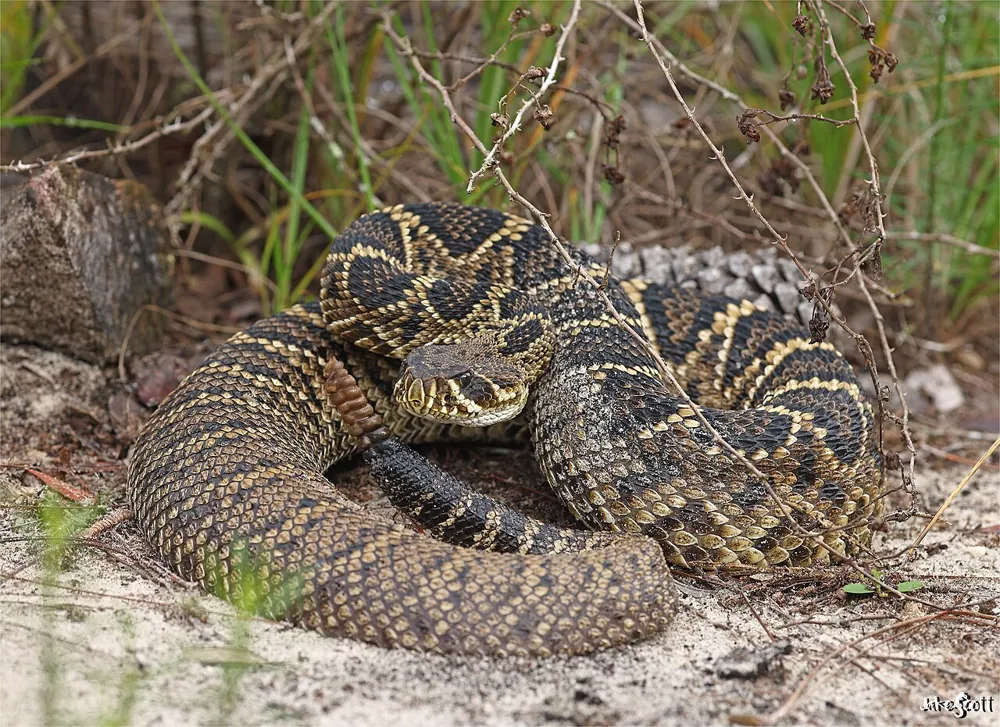
The eastern diamondback rattlesnake is a pit viper that lives in the southeastern United States. It is the largest rattlesnake species and one of the heaviest venomous snakes in the Americas. Its diamond-patterned back and loud rattle make it easy to recognise, and it is widely regarded as one of the most dangerous venomous snakes in North America.1



 Cómo reconocerlo
- Dark brown to black diamond-shaped blotches on a brownish, grey or olive background, each outlined with cream or yellowish scales1
- A dark stripe runs from behind each eye to the mouth corner, edged above and below by white or yellow stripes1
- A rattle of hollow segments at the tail tip, which break off and are replaced when the snake sheds1
- Five to ten bands around the tail, below the diamond pattern1
- A large, heavy body, with adults often around 1.1 to 1.7 m long1
Poder del veneno
El veneno sale por sus colmillos o dientes cuando muerde.
¿Qué hace su veneno?
Its venom contains more than 100 different toxins, and about 40 have been identified, making it one of the most studied snake venoms. The venom contains a thrombin-like enzyme called crotalase, which clots fibrinogen, a protein needed for blood clotting. The estimated human lethal dose is 100 to 150 mg.1
¿Qué peligro tiene para las personas?
Peligro para las personas: Muy peligrosoPuede matar a una persona que no recibe tratamiento.It has a reputation as the most dangerous venomous snake in North America. It is not usually aggressive, but it is large and powerful. Reported mortality from untreated bites is 10 to 20% in some studies and 30% in another, and it is a major cause of fatal snakebites within its range.1
¿Qué hace cuando se asusta?
When threatened, it raises the front half of its body in an S-shaped coil, rattles loudly, and can strike to at least a third of its body length.1
 Si muerde
- Mantén a la persona quieta y tranquila, la extremidad mordida a la altura del corazón, quítale anillos y cosas apretadas y llévala rápido a un hospital.
Llama siempre primero a tu número de emergencias (112, 000, 911). Esto son pautas generales de primeros auxilios, no consejo médico. Primeros auxilios básicos
 Mantente a salvo
- Nunca toques, atrapes ni molestes a un animal salvaje, aunque sea pequeño y aunque parezca dormido o muerto.
- Déjale espacio. Si te encuentras uno, mantén la calma, retrocede despacio y deja que siga su camino.
- Si te muerde: mantén la calma, no te muevas, llama a tu número de emergencias (112, 000, 911) o ve rápido a un hospital. Recuerda cómo era, una foto ayuda.
No va a por ti. Usa su veneno para cazar o defenderse, y prefiere mil veces esconderse. Más sobre cómo protegerte
¿En qué parte del mundo?
¿Qué tamaño tiene?
¿Cuánto mide?
¿Cuánto pesa?
 mide como 5 gatos domésticos de la nariz a la cola
 mide como 13 plátanos puestos en fila
 podría recorrer 100 metros en 86 segundos (el humano más rápido necesita 9,6)
¿Qué tamaño tiene Eastern diamondback rattlesnake comparado contigo?
Solo cálculos en tu navegador. No se guarda ni se envía nada a ningún sitio.
¿Qué velocidad alcanza?


Datos
It is the largest rattlesnake species. One specimen shot in 1946 measured 2.4 m and weighed 15.4 kg.1
In proportion to its length, it has the longest fangs of any rattlesnake, with fangs of over 25 mm expected in a 2.4 m adult.1
It can strike its prey within a tenth of a second.1
It can swim well and has been seen crossing water sometimes miles from land.1
Although mainly ground-dwelling, it has been spotted up to 10 m above the ground in bushes and trees.1
Males are usually larger than females, which is a rare pattern called reverse sexual size dimorphism.1
Cazamitos
Mito: The eastern diamondback must rattle before it strikes.
Verdad: It can strike while completely silent. Some individuals stay quiet even when approached closely.1
Para expertos en veneno
- Nombre científico
- Crotalus adamanteus
- Grupo
- Serpientes de cascabel
- Familia
- Viperidae2
- Orden
- Squamata
- Continentes
- Norteamérica
- Crías
- It gives birth to live young, between 4 and 28 at a time, usually from July to early October. The newborns are 30 to 36 cm long and look like adults, except they have a small button instead of a rattle.1
- Cómo le va en la naturaleza
- Least Concern on the IUCN Red List (2001), but its population trend is down. It is under review for the US Endangered Species List, and it is considered endangered in North Carolina.1
- Peligro para las personas
- 4 / 5: Muy peligroso3
De dónde salen los datos
- Eastern diamondback rattlesnake (Wikipedia (CC BY-SA 4.0))
- Crotalus adamanteus (iNaturalist): nombres y clasificación.
- Venom Wiki: el nivel de peligro, el tamaño típico y la velocidad estimada son nuestros. Mira cómo los calculamos: Cómo valoramos el peligro.
Cada dato de esta página tiene un número que lleva a su fuente. Si nos hemos equivocado en algo, perdón, somos fans de los animales, no una revista científica. Escríbenos a [email protected] y lo arreglamos.
 ¡El escorpión tiene hambre! Venom Wiki es un proyecto de una sola persona: gratis, sin anuncios y sin rastreadores. Una pequeña propina ayuda a mantenerlo en línea.Alimenta al escorpión
Más del mismo grupo: Serpientes de cascabel
 Timber rattlesnakeSerpientes de cascabelPuede matar
 Western diamondback rattlesnakeSerpientes de cascabelPuede matar
 SidewinderSerpientes de cascabelNecesita médico
 Mojave rattlesnakeSerpientes de cascabelPuede matar
 Aruba rattlesnakeSerpientes de cascabelNecesita médico
 Black-tailed rattlesnakeSerpientes de cascabelNecesita médico
 Terciopelo
 Eastern coral snake
 Eyelash viper
 Arizona bark scorpion
 Brown recluse
 Cane toad