
 África
 Asia
Asia Europa
 Sudamérica
 Australia y Oceanía
 Antártida
 Océano Pacífico
 Océano Atlántico
 Océano Índico
 Océano Ártico
 Mar Mediterráneo
 Mar Rojo
 Mar Caribe
 Mar del Coral
 Mar de China Meridional
 Mar de Filipinas
 Mar de Andamán
 Mar del Norte
 Mar de Timor y de Arafura
 Golfo de Bengala
 Golfo de California
Rhombic night adder
 Mordeduras
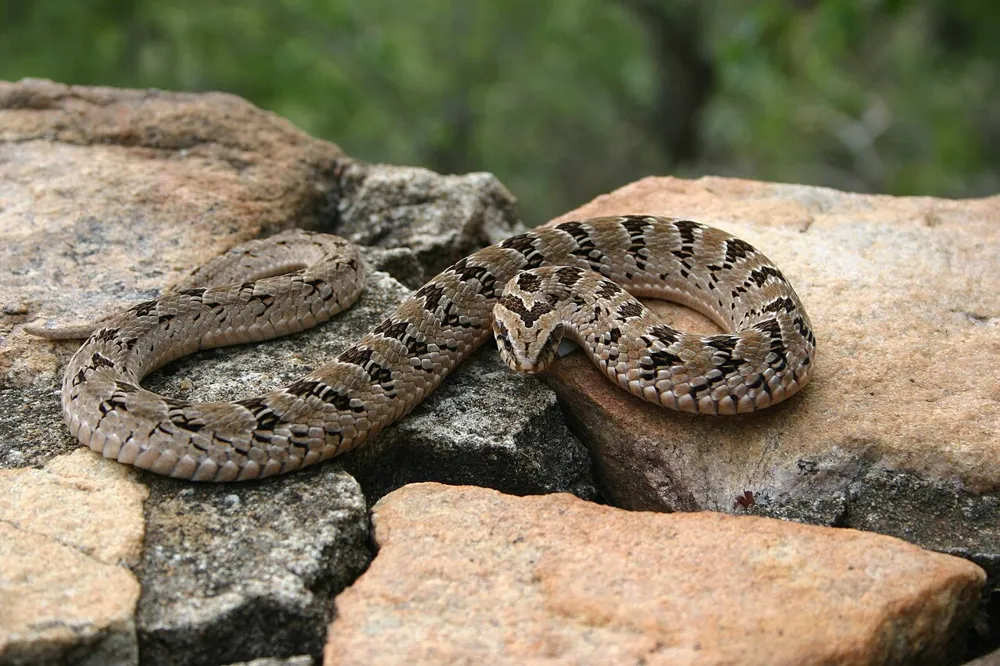
The rhombic night adder is a venomous snake found across much of Sub-Saharan Africa. It is the largest snake in its genus, Causus, and it has a striking threat display that makes it look more dangerous than its venom usually makes it.1


 Cómo reconocerlo
- The main colour is usually a shade of brown, sometimes pinkish or greyish, and occasionally olive green.1
- It has 20 to 30 rhombic (diamond-shaped) blotches with pale edges running along its back.1
- Oblique black bars on its sides are each topped by one or two black spots with pale centres, which look like eyes.1
- The head has a V-shaped mark that may be solid black, or brown with a black outline.1
- Northern populations may have no pattern at all, which makes them harder to identify.1
Se confunde a menudo con: The common egg-eater (Dasypeltis scabra) is compared with this snake. Its colour pattern and behaviour may be a form of defensive mimicry, meaning it may resemble another animal to stay safe.1
Poder del veneno
El veneno sale por sus colmillos o dientes cuando muerde.
¿Qué hace su veneno?
The venom is low in toxicity. Bites usually cause pain and minor swelling, with little tissue death (necrosis), and these symptoms usually fade within 2 to 3 days. Bites can still be serious, as in at least one case where a child needed a fasciotomy, a surgical operation to relieve pressure in a limb.1
¿Qué peligro tiene para las personas?
Peligro para las personas: DolorosoPuede doler de verdad, pero casi nunca es grave.Most individuals are docile and seldom bite unless severely provoked. Bites can be serious, but there are no modern, well-documented cases of deaths from this species.1
¿Qué hace cuando se asusta?
When seriously disturbed, it coils up, inflates its body so the dark markings stand out, hisses and puffs loudly, flattens the front of its body and neck, and strikes frantically.1
 Si muerde
- Mantén a la persona quieta y tranquila, la extremidad mordida a la altura del corazón, quítale anillos y cosas apretadas y llévala rápido a un hospital.
Llama siempre primero a tu número de emergencias (112, 000, 911). Esto son pautas generales de primeros auxilios, no consejo médico. Primeros auxilios básicos
 Mantente a salvo
- Nunca toques, atrapes ni molestes a un animal salvaje, aunque sea pequeño y aunque parezca dormido o muerto.
- Déjale espacio. Si te encuentras uno, mantén la calma, retrocede despacio y deja que siga su camino.
- Si te muerde: mantén la calma, no te muevas, llama a tu número de emergencias (112, 000, 911) o ve rápido a un hospital. Recuerda cómo era, una foto ayuda.
No va a por ti. Usa su veneno para cazar o defenderse, y prefiere mil veces esconderse. Más sobre cómo protegerte
¿En qué parte del mundo?
¿Qué tamaño tiene?
¿Cuánto mide?
 mide como 2 gatos domésticos de la nariz a la cola
 mide como 5 plátanos puestos en fila
 podría recorrer 100 metros en 110 segundos (el humano más rápido necesita 9,6)
¿Qué tamaño tiene Rhombic night adder comparado contigo?
Solo cálculos en tu navegador. No se guarda ni se envía nada a ningún sitio.
¿Qué velocidad alcanza?


Datos
Cazamitos
Mito: Its bite is deadly.
Verdad: There are no modern, well-documented cases of deaths from this species. Bites usually cause pain and minor swelling that fade within 2 to 3 days, although bites can still be serious.1
Para expertos en veneno
De dónde salen los datos
- Causus rhombeatus (Wikipedia (CC BY-SA 4.0))
- Causus rhombeatus (iNaturalist): nombres y clasificación.
- Venom Wiki: el nivel de peligro, el tamaño típico y la velocidad estimada son nuestros. Mira cómo los calculamos: Cómo valoramos el peligro.
Cada dato de esta página tiene un número que lleva a su fuente. Si nos hemos equivocado en algo, perdón, somos fans de los animales, no una revista científica. Escríbenos a [email protected] y lo arreglamos.
 ¡El escorpión tiene hambre! Venom Wiki es un proyecto de una sola persona: gratis, sin anuncios y sin rastreadores. Una pequeña propina ayuda a mantenerlo en línea.Alimenta al escorpión
 Víbora bufadora
 Gaboon viper
 Northeast African carpet viper
 West African carpet viper
 Rhinoceros viper
 West African Gaboon viper
 Black mamba
 Deathstalker
 Egyptian cobra
 Boomslang
 Fat-tailed scorpion
 Western honey bee