
 África
 Asia
Asia Europa
 Sudamérica
 Australia y Oceanía
 Antártida
 Océano Pacífico
 Océano Atlántico
 Océano Índico
 Océano Ártico
 Mar Mediterráneo
 Mar Rojo
 Mar Caribe
 Mar del Coral
 Mar de China Meridional
 Mar de Filipinas
 Mar de Andamán
 Mar del Norte
 Mar de Timor y de Arafura
 Golfo de Bengala
 Golfo de California
Spiny bush viper
 Mordeduras
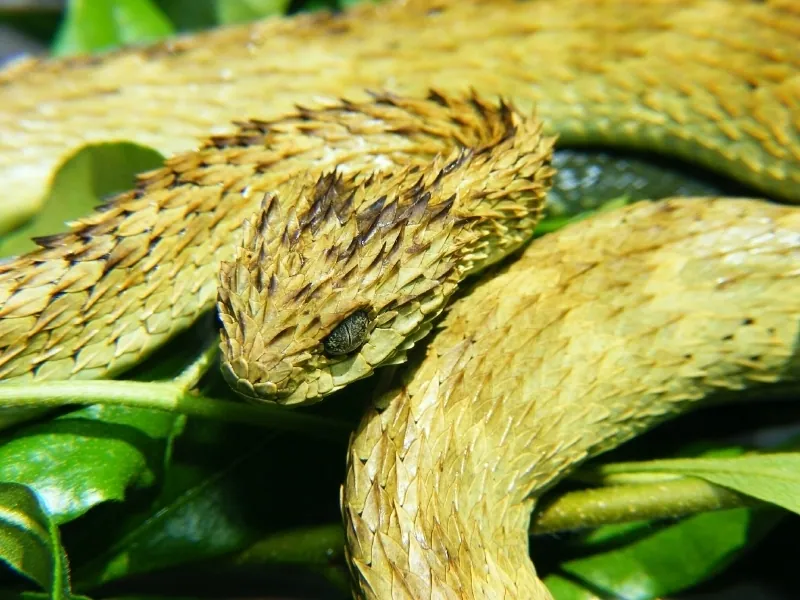
The spiny bush viper is a venomous snake with a bristly, shaggy look caused by spiky scales along its body. It lives in parts of Central and East Africa, mostly in forests and reedy places. Its venom can be dangerous to people, so it is important to know what it looks like.1



 Cómo reconocerlo
- Its body is covered in long, heavily keeled scales (scales with a raised ridge), which make it look shaggy and bristly.1
- The scales around the head and neck are the longest, and they get shorter towards the tail.1
- It has a short snout, more so in males than in females.1
- Males are surprisingly long and slender compared with females.1
Poder del veneno
El veneno sale por sus colmillos o dientes cuando muerde.
¿Qué hace su veneno?
Its venom is mainly neurotoxic, meaning it attacks the nerves. It also contains cytotoxins, which damage cells, and fasciculins, which affect nerve signals. The strength of the venom varies between individual snakes and can be influenced by region, weather and altitude. Reports of bites show severe bleeding of internal organs.1
¿Qué peligro tiene para las personas?
Peligro para las personas: GraveUna mordedura necesita médico. Las muertes son muy raras.A bite can be fatal to people who do not get proper first aid and antivenom treatment. Its venom was once thought to be weaker than that of many other snakes, possibly because bites are uncommon, but recent reports show this is not the case.1
 Buena noticia: los médicos tienen un medicamento (antídoto) o un tratamiento para esto.1
 Si muerde
- A bite needs proper first aid, followed by antivenom treatment. Without these, a bite can be fatal.1
- Mantén a la persona quieta y tranquila, la extremidad mordida a la altura del corazón, quítale anillos y cosas apretadas y llévala rápido a un hospital.
Llama siempre primero a tu número de emergencias (112, 000, 911). Esto son pautas generales de primeros auxilios, no consejo médico. Primeros auxilios básicos
 Mantente a salvo
- Nunca toques, atrapes ni molestes a un animal salvaje, aunque sea pequeño y aunque parezca dormido o muerto.
- Déjale espacio. Si te encuentras uno, mantén la calma, retrocede despacio y deja que siga su camino.
- Si te muerde: mantén la calma, no te muevas, llama a tu número de emergencias (112, 000, 911) o ve rápido a un hospital. Recuerda cómo era, una foto ayuda.
No va a por ti. Usa su veneno para cazar o defenderse, y prefiere mil veces esconderse. Más sobre cómo protegerte
¿En qué parte del mundo?
¿Qué tamaño tiene?
¿Cuánto mide?
 mide como 4 plátanos puestos en fila
 podría recorrer 100 metros en 110 segundos (el humano más rápido necesita 9,6)
¿Qué tamaño tiene Spiny bush viper comparado contigo?
Solo cálculos en tu navegador. No se guarda ni se envía nada a ningún sitio.
¿Qué velocidad alcanza?


Datos
Its venom can vary greatly between individuals of the same species, even depending on the weather and altitude.1
Its scales are heavily keeled, meaning each has a raised ridge, and these are often called spikes.1
It can climb reeds and stalks and often rests on top of flowers.1
Males are much longer and more slender than females.1
Cazamitos
Mito: Its venom is weaker than that of many other snakes.
Verdad: Its venom was once thought to be less toxic, but there are now reports of bites causing severe bleeding of internal organs.1
De dónde salen los datos
- Atheris hispida (Wikipedia (CC BY-SA 4.0))
- Atheris hispida (iNaturalist): nombres y clasificación.
- Venom Wiki: el nivel de peligro, el tamaño típico y la velocidad estimada son nuestros. Mira cómo los calculamos: Cómo valoramos el peligro.
Cada dato de esta página tiene un número que lleva a su fuente. Si nos hemos equivocado en algo, perdón, somos fans de los animales, no una revista científica. Escríbenos a [email protected] y lo arreglamos.
 ¡El escorpión tiene hambre! Venom Wiki es un proyecto de una sola persona: gratis, sin anuncios y sin rastreadores. Una pequeña propina ayuda a mantenerlo en línea.Alimenta al escorpión
 Víbora bufadora
 Gaboon viper
 Northeast African carpet viper
 West African carpet viper
 Rhinoceros viper
 West African Gaboon viper
 Mamba negra
 Escorpión amarillo de Palestina
 Cobra egipcia
 Boomslang
 Fat-tailed scorpion
 Western honey bee