
 África
 Asia
Asia Europa
 Sudamérica
 Australia y Oceanía
 Antártida
 Océano Pacífico
 Océano Atlántico
 Océano Índico
 Océano Ártico
 Mar Mediterráneo
 Mar Rojo
 Mar Caribe
 Mar del Coral
 Mar de China Meridional
 Mar de Filipinas
 Mar de Andamán
 Mar del Norte
 Mar de Timor y de Arafura
 Golfo de Bengala
 Golfo de California
Sri Lankan ornamental tarantula
 Mordeduras
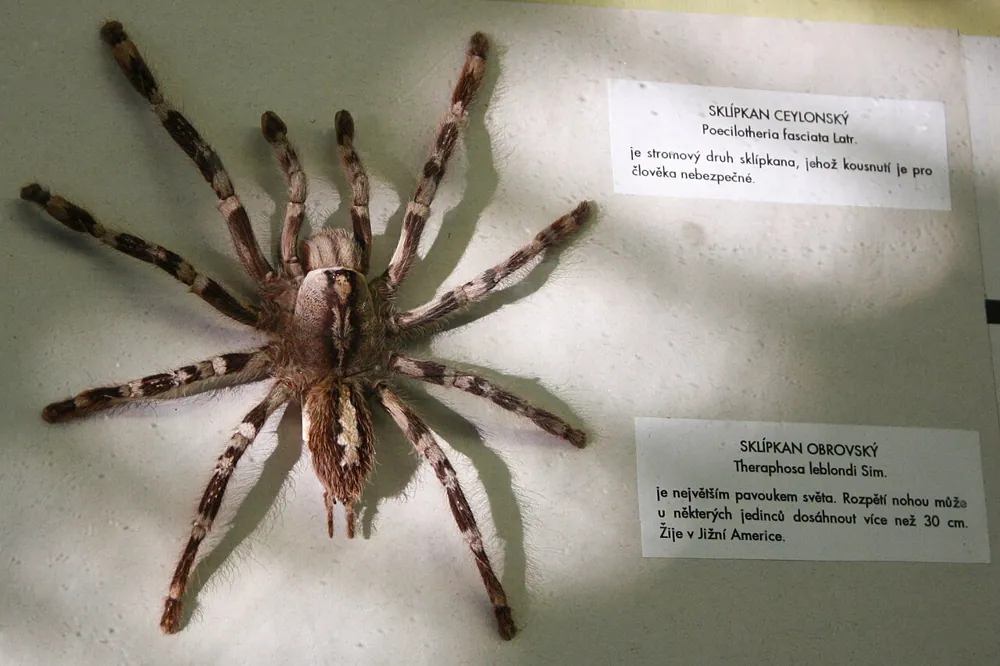
The Sri Lankan ornamental tarantula is a large spider that lives in trees. It is found only in central Sri Lanka, in dry and intermediate zones of the island. It is special because it is rare: its small range has shrunk, and it is now listed as endangered.1
 Cómo reconocerlo
- Females are black, white and grey, with cryptic markings on the legs and body.1
- Females have a narrow dark band on the thigh (femur) of the first pair of legs, and a thin broken band on the thigh of the fourth pair.1
- Males are a uniform brown with less intense markings.1
- Males have a dark black line down the abdomen, divided by diamond-shaped chevrons.1
Se confunde a menudo con: It is often grouped with other tiger spiders. It can be told apart by the very narrow dark band on the thigh of the first pair of legs, and by the thin broken band on the thigh of the fourth pair.1
Poder del veneno
El veneno sale por sus colmillos o dientes cuando muerde.
¿Qué peligro tiene para las personas?
Peligro para las personas: GraveUna mordedura necesita médico. Las muertes son muy raras.¿Qué hace cuando se asusta?
When disturbed, it becomes very defensive and quick to move.1
 Si muerde
- Lava la mordedura y enfríala. Busca ayuda médica si el dolor es fuerte o la persona se encuentra mal.
Llama siempre primero a tu número de emergencias (112, 000, 911). Esto son pautas generales de primeros auxilios, no consejo médico. Primeros auxilios básicos
 Mantente a salvo
- Nunca toques, atrapes ni molestes a un animal salvaje, aunque sea pequeño y aunque parezca dormido o muerto.
- Déjale espacio. Si te encuentras uno, mantén la calma, retrocede despacio y deja que siga su camino.
- Si te muerde: mantén la calma, no te muevas, llama a tu número de emergencias (112, 000, 911) o ve rápido a un hospital. Recuerda cómo era, una foto ayuda.
No va a por ti. Usa su veneno para cazar o defenderse, y prefiere mil veces esconderse. Más sobre cómo protegerte
¿En qué parte del mundo?
¿Qué tamaño tiene?
¿Cuánto mide?
 más corto que tu dedo meñique
 podría recorrer 100 metros en 180 segundos (el humano más rápido necesita 9,6)
¿Qué tamaño tiene Sri Lankan ornamental tarantula comparado contigo?
Solo cálculos en tu navegador. No se guarda ni se envía nada a ningún sitio.
¿Qué velocidad alcanza?


Datos
Males are nomadic, moving from place to place, while females stay in one home.1
In 2018 it was listed as an endangered species under the U.S. Endangered Species Act.1
Habitat loss is the main threat, and collection for the pet trade, pesticides and killing out of fear add to the pressure.1
Females are larger than males, and only males wander.1
Its natural range is small, with less than 500 square kilometres of area occupied.1
De dónde salen los datos
- Poecilotheria fasciata (Wikipedia (CC BY-SA 4.0))
- Poecilotheria fasciata (iNaturalist): nombres y clasificación.
- Venom Wiki: el nivel de peligro, el tamaño típico y la velocidad estimada son nuestros. Mira cómo los calculamos: Cómo valoramos el peligro.
Cada dato de esta página tiene un número que lleva a su fuente. Si nos hemos equivocado en algo, perdón, somos fans de los animales, no una revista científica. Escríbenos a [email protected] y lo arreglamos.
 ¡El escorpión tiene hambre! Venom Wiki es un proyecto de una sola persona: gratis, sin anuncios y sin rastreadores. Una pequeña propina ayuda a mantenerlo en línea.Alimenta al escorpión
Más del mismo grupo: Tarántulas y arañas de tela en embudo
 Gooty sapphire tarantulaTarántulas y arañas de tela en embudoNecesita médico
 Indian ornamental tarantulaTarántulas y arañas de tela en embudoNecesita médico
 Cobalt blue tarantulaTarántulas y arañas de tela en embudoSolo duele
 Chinese bird spiderTarántulas y arañas de tela en embudoNecesita médico
 Chinese black earth tiger tarantulaTarántulas y arañas de tela en embudoNecesita médico
 Fringed ornamental tarantulaTarántulas y arañas de tela en embudoNecesita médico
 Escorpión amarillo de Palestina
 Cobra india
 Víbora de escamas aserradas india
 Cobra real
 Víbora bufadora
 Víbora de Russell