
 Afrika
 Asia
Asia Europa
 Hego Amerika
 Australia eta Ozeania
 Antartika
 Ozeano Barea
 Ozeano Atlantikoa
 Ozeano Indikoa
 Ozeano Artikoa
 Mediterraneo itsasoa
 Itsaso Gorria
 Karibe itsasoa
 Koralen itsasoa
 Hego Txinako itsasoa
 Filipinetako itsasoa
 Andaman itsasoa
 Ipar itsasoa
 Timor eta Arafura itsasoak
 Bengalako golkoa
 Kaliforniako golkoa
Black long-spined urchin
 Arantza pozoitsuak
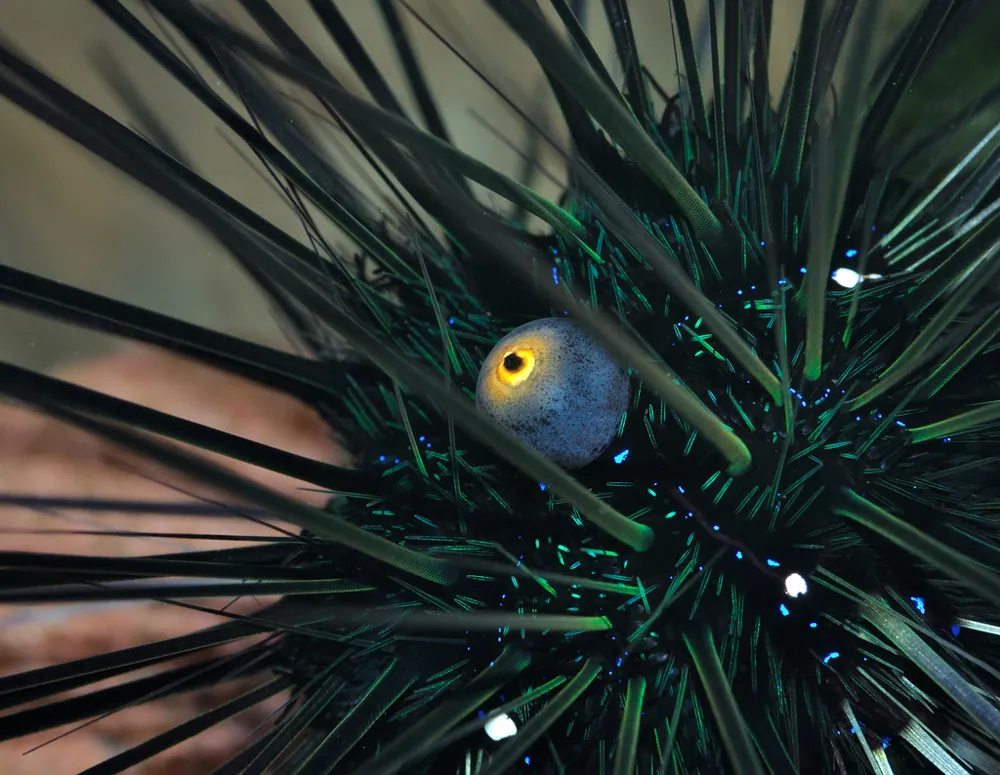
The black long-spined urchin is a sea urchin with very long, hollow spines. It lives on coral reefs, sand flats and seagrass beds across the Indo-Pacific, and it is one of the most widespread sea urchins in that region. Its spines can deliver a mild venom, so it is best to watch where you put your feet.1


 Nola ezagutu
- Black, near-spherical body (test) with extremely long, narrow, hollow spines, often black but sometimes brown-banded1
- Five white spots on the body, which separate it from other Diadema species1
- A bright orange ring around the periproctal cone (the 'anal cone'), which is often mistaken for an eye1
- Bluish spots on the genital plates and a line of blue spots along the body1
- Adults are no more than 70 mm across the body and about 40 mm high1
Askotan honekin nahasten da: Other Diadema species are similar in shape and spines, but they lack the five white spots that mark this species. Its orange ring and blue spots also help to tell it apart.1
Pozoi-ahalmena
Arantza zorrotzek daramate pozoia. Zapaltzeak edo heltzeak min ematen du.
Zer egiten du bere pozoiak?
The spines are hollow and contain a mild venom. The toxin mostly causes swelling and pain, which spreads gradually over several hours. The venom is not fatal to humans. The spines themselves are a bigger problem, because they are brittle and needle-like, break off in flesh and are difficult to remove.1
Zein arriskutsua da pertsonentzat?
Arriskua pertsonentzat: MingarriaBenetan min handia eman dezake, baina ia inoiz ez da larria.The venom is only mild, and the species is not considered a serious threat to humans. Stepping on it can cause painful stings.1
Zer egiten du beldurtzen denean?
When threatened by a sudden impact or by spines snapping, it rapidly flips its body over and 'runs' on the tips of its longest spines.1
 Bere arantzek zulatzen bazaituzte
- Sartu zauria ur beroan, pertsonak erre gabe jasan dezakeen bezain beroan, eta lortu mediku-laguntza arantzak kentzeko. Ez saiatu zuk zeuk ateratzen.
Deitu beti lehenik zure larrialdi-zenbakira (112, 000, 911). Lehen sorospenei buruzko orientabide orokorra da hau, ez mediku-aholkua. Lehen sorospenen oinarriak
 Egon seguru
- Ez ukitu, ez harrapatu eta ez zirikatu inoiz animalia basati bat, txikia izan arren, eta lo edo hilda dagoela badirudi ere.
- Utzi tartea. Bat aurkitzen baduzu, egon lasai, egin atzera poliki eta utzi bere bidetik joaten.
- Bere arantzek zulatzen bazaituzte: egon lasai, egon geldi, deitu zure larrialdi-zenbakira (112, 000, 911) edo joan ospitalera azkar. Gogoratu nolakoa zen, argazki batek laguntzen du.
Ez dabil zure atzetik. Pozoia janaria harrapatzeko edo bere burua babesteko erabiltzen du, eta askoz nahiago du ezkutatu. Seguru egoteari buruz gehiago
Munduko zein tokitan?
Zein handia da?
Zein luzea da?
Zein astuna da?

 2 eraikuntza-bloke ilaran jarrita bezain luzea
 lorategiko barraskilo bat baino motelagoa
Zein handia da Black long-spined urchin ZUREKIN alderatuta?
Matematika hutsa zure nabigatzailean. Ez da ezer gordetzen, ezta inora bidaltzen ere.
Zein azkarra da?

Datuak
It can move 760 mm in just 7 seconds by rolling and walking on the tips of its spines.1
It has no eye, but it has a diffuse light-sensing system that lets it detect light levels and the size and colour of objects.1
In 2006, living specimens were found off Turkey, making it the first invasive Erythrean sea urchin recorded in the Mediterranean.1
Goose barnacles of the genus Microlepas are known to live on it as parasites.1
It is considered one of the oldest living species in its genus, Diadema.1
Mito-hauslea
Mitoa: Black long-spined urchins are deadly and their stings can kill people.
Egia: Their venom is mild and is not fatal to humans. The main problems are pain, swelling and spines that break off in the skin.1
Pozoi-adituentzat
- Izen zientifikoa
- Diadema setosum
- Taldea
- Trikuak, izarrak eta harrak
- Familia
- Diadematidae2
- Ordena
- Diadematoida
- Kontinenteak
- Ozeano Indikoa, Ozeano Barea, Itsaso Gorria, Koralen itsasoa, Filipinetako itsasoa, Arabiako itsasoa eta Persiar golkoa, Timor eta Arafura itsasoak, Bengalako golkoa, Ozeanoak
- Kumeak
- It is a broadcast spawner, releasing eggs and sperm into the water. Spawning happens seasonally or year-round depending on the location, and in some places it follows the full moon.1
- Arriskua pertsonentzat
- 2 / 5: Mingarria3
Datuak nondik datozen
- Diadema setosum (Wikipedia (CC BY-SA 4.0))
- Diadema setosum (iNaturalist): izenak eta sailkapena.
- Venom Wiki: arrisku-maila, ohiko tamaina eta abiadura-kalkulua geureak dira. Ikusi nola kalkulatzen ditugun: Nola baloratzen dugun arriskua.
Orrialde honetako datu bakoitzak zenbaki bat du, bere iturrira eramaten zaituena. Zerbait gaizki badugu, barkatu, animalien zaleak gara, ez zientzia-aldizkari bat. Esaiguzu [email protected] helbidean eta konponduko dugu.
 Eskorpioia gose da! Venom Wiki pertsona bakar baten proiektua da: doakoa, iragarkirik eta jarraitzailerik gabe. Eskupeko txiki batek sarean mantentzen laguntzen du.Elikatu eskorpioia
Talde bereko gehiago: Trikuak, izarrak eta harrak
 Crown-of-thorns starfishTrikuak, izarrak eta harrakMedikua behar duEz ukitu
 Flower urchinTrikuak, izarrak eta harrakHil dezake
 Fire urchinTrikuak, izarrak eta harrakMedikua behar duEz ukitu
 Bearded firewormTrikuak, izarrak eta harrakMin ematen du, besterik ezEz ukitu
 BloodwormTrikuak, izarrak eta harrakMin ematen du, besterik ez
 Bobbit wormTrikuak, izarrak eta harrakMin ematen du, besterik ez
Hemen ere bizi da: Ozeano Indikoa
 Australian box jellyfishMarmokak eta itsasoko izaki ziztatzaileakHilgarriaEz ukitu
 Geography coneKono-barraskiloak eta olagarroakHilgarria
 Greater blue-ringed octopusKono-barraskiloak eta olagarroakHilgarria
 Southern blue-ringed octopusKono-barraskiloak eta olagarroakHilgarria
 Hawksbill sea turtleBeste animalia toxiko batzukHil dezake
 Irukandji jellyfishMarmokak eta itsasoko izaki ziztatzaileakHil dezakeEz ukitu