
 Afrika
 Asia
Asia Europa
 Hego Amerika
 Australia eta Ozeania
 Antartika
 Ozeano Barea
 Ozeano Atlantikoa
 Ozeano Indikoa
 Ozeano Artikoa
 Mediterraneo itsasoa
 Itsaso Gorria
 Karibe itsasoa
 Koralen itsasoa
 Hego Txinako itsasoa
 Filipinetako itsasoa
 Andaman itsasoa
 Ipar itsasoa
 Timor eta Arafura itsasoak
 Bengalako golkoa
 Kaliforniako golkoa
Geography cone
 Ziztadak
The geography cone is a predatory sea snail that lives on shallow tropical reefs in the Indo-Pacific. It hunts small fish. Its venom is strong enough to kill a person, which makes it one of the most dangerous cone snails.1


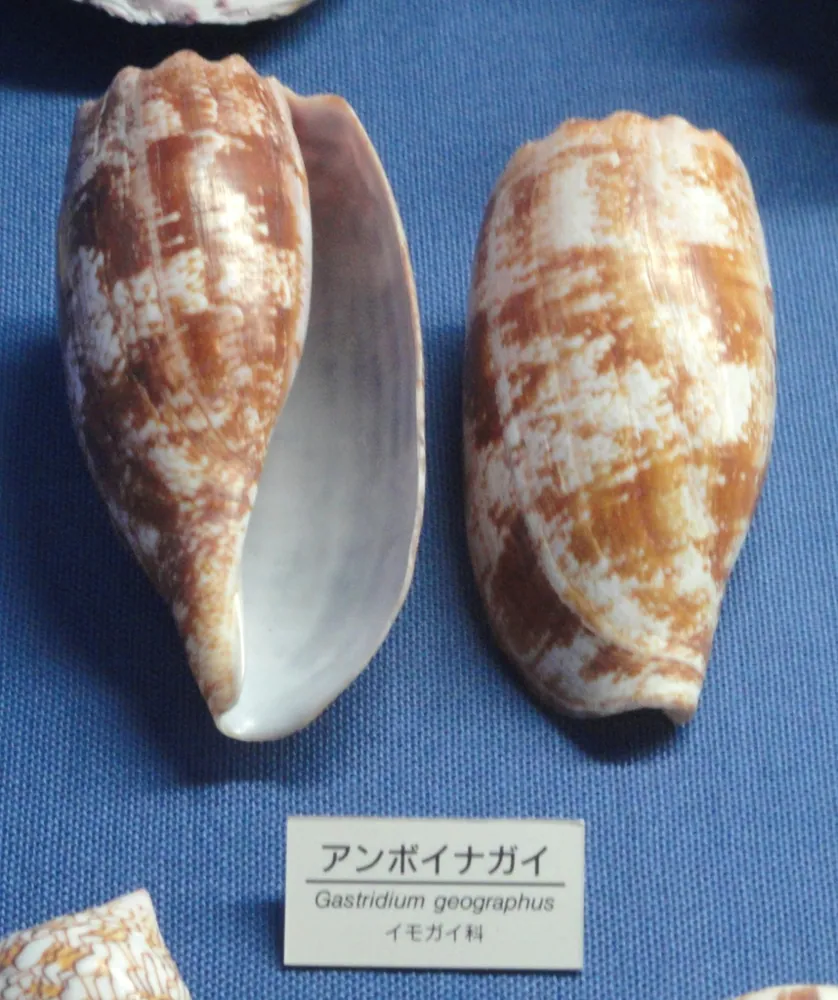
 Nola ezagutu
- Broad, thin shell that is cylindrically inflated, usually 10 to 15 cm long1
- Ground colour is pink or violet-white, sometimes reddish1
- Mottled pattern of chestnut or chocolate brown, usually forming two irregular bands1
- Wide pink or violet-white opening and numerous shoulder ridges or spines1
Askotan honekin nahasten da: Compared with other cone shells of a similar size, the geography cone has a noticeably wider, more convex middle and a flattened spire. Its walls are also thinner and lighter.1
Pozoi-ahalmena
Pozoia ezten batetik ateratzen da.
Zer egiten du bere pozoiak?
Its venom is a complex mix of hundreds of different toxins, delivered through the harpoon-like tooth. It has the most toxic sting known among cone snails. Even the most venomous cone snails take about one to five hours to kill a healthy adult, but medical care must still be prompt.1
Zein arriskutsua da pertsonentzat?
Arriskua pertsonentzat: HilgarriaMunduko animaliarik arriskutsuenetako bat.There are reports of about 36 human deaths over the past 300 years. Live specimens should be handled with extreme caution.1
Zer egiten du beldurtzen denean?
Most of the venom's toxic compounds are believed to be used for defence rather than feeding.1
 Ziztatzen badu
- There is no antivenom for a cone snail sting. Treatment consists of keeping the victim alive until the symptoms wear off, so prompt medical care is essential.1
- Presio-immobilizazioa: bildu benda elastiko sendo bat koskaren gainean eta gero gorputz-adar osoan gora, immobilizatu ferula batekin, eta eutsi pertsona guztiz geldi laguntza iritsi arte.
- Eraztun urdineko olagarro batek edo kono-barraskilo batek pertsona baten arnasketa gelditu dezake, pertsona hori oraindik esna dagoela: eskatu laguntza eta egon prest erreskate-arnasketak emateko anbulantziak ardura hartu arte.
Deitu beti lehenik zure larrialdi-zenbakira (112, 000, 911). Lehen sorospenei buruzko orientabide orokorra da hau, ez mediku-aholkua. Lehen sorospenen oinarriak
 Egon seguru
- Ez ukitu, ez harrapatu eta ez zirikatu inoiz animalia basati bat, txikia izan arren, eta lo edo hilda dagoela badirudi ere.
- Utzi tartea. Bat aurkitzen baduzu, egon lasai, egin atzera poliki eta utzi bere bidetik joaten.
- Batek ziztatzen bazaitu: egon lasai, egon geldi, deitu zure larrialdi-zenbakira (112, 000, 911) edo joan ospitalera azkar. Gogoratu nolakoa zen, argazki batek laguntzen du.
Ez dabil zure atzetik. Pozoia janaria harrapatzeko edo bere burua babesteko erabiltzen du, eta askoz nahiago du ezkutatu. Seguru egoteari buruz gehiago
Munduko zein tokitan?
Zein handia da?
Zein luzea da?
 5 eraikuntza-bloke ilaran jarrita bezain luzea
 lorategiko barraskilo bat baino motelagoa
Zein handia da Geography cone ZUREKIN alderatuta?
Matematika hutsa zure nabigatzailean. Ez da ezer gordetzen, ezta inora bidaltzen ere.
Zein azkarra da?

Datuak
Its venom contains a form of insulin, which it uses to stun fish. Once the venom passes through a fish's gills, the fish goes into hypoglycaemic shock (a dangerous drop in blood sugar).1
Apart from the tulip cone snail, no other known living thing is known to use its own biological insulin as a weapon.1
Research shows that some proteins from cone snail venom can be up to 10,000 times more effective than morphine as painkillers, without morphine's addictive properties and side effects.1
Of the venom's 100 to 200 toxic peptides, only 15 to 20 are used for feeding.1
Adult geography cones can fall prey to sea turtles, rays, birds and human shell collectors.1
Mito-hauslea
Mitoa: The nickname 'cigarette snail' means a sting gives you just enough time to smoke a cigarette before you die.
Egia: This is a gallows humour exaggeration. Even the most venomous cone snails take about one to five hours to kill a healthy human.1
Datuak nondik datozen
- Conus geographus (Wikipedia (CC BY-SA 4.0))
- Conus geographus (iNaturalist): izenak eta sailkapena.
- Venom Wiki: arrisku-maila, ohiko tamaina eta abiadura-kalkulua geureak dira. Ikusi nola kalkulatzen ditugun: Nola baloratzen dugun arriskua.
Orrialde honetako datu bakoitzak zenbaki bat du, bere iturrira eramaten zaituena. Zerbait gaizki badugu, barkatu, animalien zaleak gara, ez zientzia-aldizkari bat. Esaiguzu [email protected] helbidean eta konponduko dugu.
 Eskorpioia gose da! Venom Wiki pertsona bakar baten proiektua da: doakoa, iragarkirik eta jarraitzailerik gabe. Eskupeko txiki batek sarean mantentzen laguntzen du.Elikatu eskorpioia
Talde bereko gehiago: Kono-barraskiloak eta olagarroak
 Greater blue-ringed octopusKono-barraskiloak eta olagarroakHilgarria
 Southern blue-ringed octopusKono-barraskiloak eta olagarroakHilgarria
 Blue sea dragonKono-barraskiloak eta olagarroakMin ematen du, besterik ez
 Common octopusKono-barraskiloak eta olagarroakKaltegabea
 Giant Pacific octopusKono-barraskiloak eta olagarroakKaltegabea
 Blue-lined octopusKono-barraskiloak eta olagarroakHilgarria
Hemen ere bizi da: Ozeano Indikoa
 Australian box jellyfishMarmokak eta itsasoko izaki ziztatzaileakHilgarriaEz ukitu
 Hawksbill sea turtleBeste animalia toxiko batzukHil dezake
 Irukandji jellyfishMarmokak eta itsasoko izaki ziztatzaileakHil dezakeEz ukitu
 Reef stonefishArrain pozoitsuakHil dezakeEz ukitu
 Crown-of-thorns starfishTrikuak, izarrak eta harrakMedikua behar duEz ukitu
 Portuguese man o' warMarmokak eta itsasoko izaki ziztatzaileakMedikua behar duEz ukitu