
 Afrika
 Asia
Asia Europa
 Hego Amerika
 Australia eta Ozeania
 Antartika
 Ozeano Barea
 Ozeano Atlantikoa
 Ozeano Indikoa
 Ozeano Artikoa
 Mediterraneo itsasoa
 Itsaso Gorria
 Karibe itsasoa
 Koralen itsasoa
 Hego Txinako itsasoa
 Filipinetako itsasoa
 Andaman itsasoa
 Ipar itsasoa
 Timor eta Arafura itsasoak
 Bengalako golkoa
 Kaliforniako golkoa
Reef stonefish
 Arantza pozoitsuak
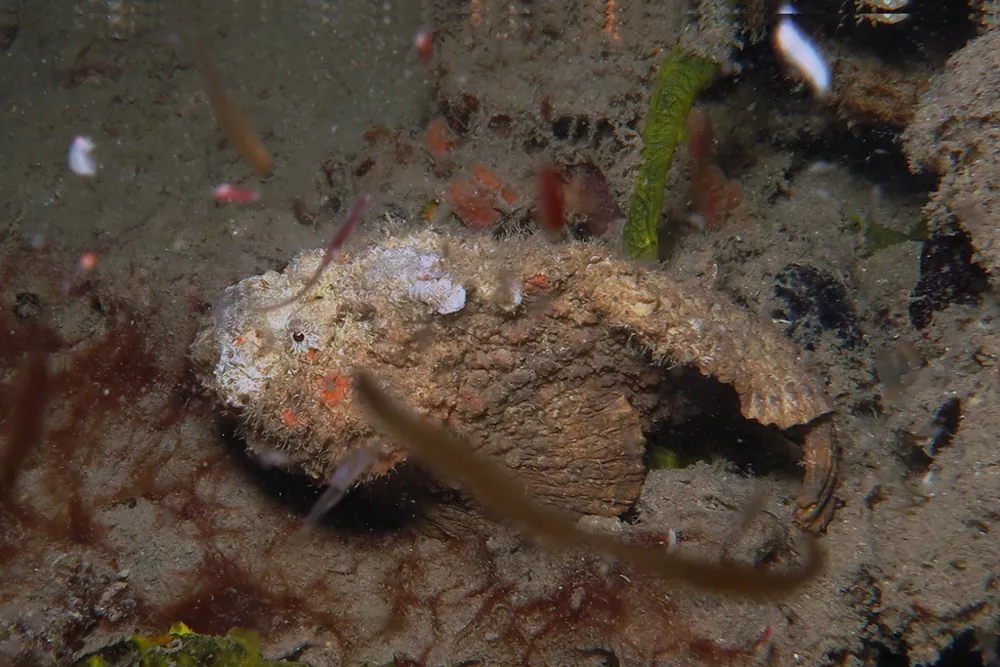
The reef stonefish is a fish that hides on coral reefs and looks like a rock or piece of coral. It is the most venomous fish in the world, and its venom can kill people. It lives in shallow warm seas across the Red Sea, the Indian Ocean and the western Pacific.1



 Nola ezagutu
- Usually brown or grey, sometimes with patches of yellow, orange or red.1
- Rough, tough skin covered in warts, with no scales.1
- Wide, flattened head with small eyes that point upwards.1
- Back fin with 12 to 14 spines, all of equal length.1
- Its colour and skin texture help it blend in among rocks and corals.1
Pozoi-ahalmena
Arantza zorrotzek daramate pozoia. Zapaltzeak edo heltzeak min ematen du.
Zer egiten du bere pozoiak?
Its venom is a mixture of proteins. Effects include severe pain, shock, paralysis and tissue death. A large dose can be fatal, and the fatal protein in this species is verrucotoxin. Stonefish venom can be fatal at a dose of only 18 mg, which six of its thirteen spines can release.1
Zein arriskutsua da pertsonentzat?
Arriskua pertsonentzat: Oso arriskutsuaTratamendurik jasotzen ez duen pertsona bat hil dezake.It is the most venomous fish in the world and its venom can kill humans. A large dose can be fatal, and young children, the elderly and people with weakened immune systems are at greatest risk.1
 Albiste ona: medikuek badute sendagai bat (antipozoia) edo tratamendu bat honetarako.1
Zer egiten du beldurtzen denean?
It relies on camouflage to stay hidden and, when necessary, on its back spines, each with venom sacs at its base.1
 Bere arantzek zulatzen bazaituzte
- Immerse the affected limb in hot water, which is thought to help break down the venom proteins. A local anaesthetic can reduce the pain, and medical treatment includes antivenom. A tourniquet or firm constrictive bandage is no longer recommended.1
- Sartu zauria ur beroan, pertsonak erre gabe jasan dezakeen bezain beroan (probatu zure eskuarekin), 30 eta 90 minutu artean. Lortu mediku-laguntza, batez ere harri-arrain eta bastangen kasuan.
Deitu beti lehenik zure larrialdi-zenbakira (112, 000, 911). Lehen sorospenei buruzko orientabide orokorra da hau, ez mediku-aholkua. Lehen sorospenen oinarriak
 Egon seguru
- Ez ukitu, ez harrapatu eta ez zirikatu inoiz animalia basati bat, txikia izan arren, eta lo edo hilda dagoela badirudi ere.
- Utzi tartea. Bat aurkitzen baduzu, egon lasai, egin atzera poliki eta utzi bere bidetik joaten.
- Bere arantzek zulatzen bazaituzte: egon lasai, egon geldi, deitu zure larrialdi-zenbakira (112, 000, 911) edo joan ospitalera azkar. Gogoratu nolakoa zen, argazki batek laguntzen du.
Ez dabil zure atzetik. Pozoia janaria harrapatzeko edo bere burua babesteko erabiltzen du, eta askoz nahiago du ezkutatu. Seguru egoteari buruz gehiago
Munduko zein tokitan?
Zein handia da?
Zein luzea da?
 2 banana bata bestearen atzetik jarrita bezain luzea
 12 eraikuntza-bloke ilaran jarrita bezain luzea
 igerileku handi baten luzera (50 m) igerian egin lezake 90 segundotan
Zein handia da Reef stonefish ZUREKIN alderatuta?
Matematika hutsa zure nabigatzailean. Ez da ezer gordetzen, ezta inora bidaltzen ere.
Zein azkarra da?

Datuak
It is the most venomous fish in the world.1
It strikes its prey in as little as 0.015 seconds.1
Its spines are sharp and stiff enough to pierce boot soles.1
Only six of its thirteen spines can release a fatal dose of venom.1
It is sold as an aquarium pet and as meat in some markets in southern China, the Philippines and Japan.1
Mito-hauslea
Mitoa: Tying a tight tourniquet or bandage above a stonefish sting is the best first aid.
Egia: This is no longer recommended. Hot water on the affected limb and medical treatment with antivenom are the advised steps.1
Pozoi-adituentzat
- Izen zientifikoa
- Synanceia verrucosa
- Taldea
- Arrain pozoitsuak
- Familia
- Synanceiidae2
- Ordena
- Perciformes
- Kontinenteak
- Ozeano Barea, Ozeano Indikoa, Itsaso Gorria, Andaman itsasoa, Hego Txinako itsasoa, Filipinetako itsasoa, Koralen itsasoa, Arabiako itsasoa eta Persiar golkoa, Timor eta Arafura itsasoak, Bengalako golkoa, Ozeanoak
- Kumeak
- Females lay large, unfertilised eggs on the reef floor, and a male fertilises them by releasing sperm over the eggs. The young hatch well developed.1
- Arriskua pertsonentzat
- 4 / 5: Oso arriskutsua3
Datuak nondik datozen
- Synanceia verrucosa (Wikipedia (CC BY-SA 4.0))
- Synanceia verrucosa (iNaturalist): izenak eta sailkapena.
- Venom Wiki: arrisku-maila, ohiko tamaina eta abiadura-kalkulua geureak dira. Ikusi nola kalkulatzen ditugun: Nola baloratzen dugun arriskua.
Orrialde honetako datu bakoitzak zenbaki bat du, bere iturrira eramaten zaituena. Zerbait gaizki badugu, barkatu, animalien zaleak gara, ez zientzia-aldizkari bat. Esaiguzu [email protected] helbidean eta konponduko dugu.
 Eskorpioia gose da! Venom Wiki pertsona bakar baten proiektua da: doakoa, iragarkirik eta jarraitzailerik gabe. Eskupeko txiki batek sarean mantentzen laguntzen du.Elikatu eskorpioia
Talde bereko gehiago: Arrain pozoitsuak
 Red lionfishArrain pozoitsuakMedikua behar duEz ukitu
 Estuarine stonefishArrain pozoitsuakHil dezakeEz ukitu
 Short-tail stingrayArrain pozoitsuakHil dezake
 Striped eel catfishArrain pozoitsuakHil dezakeEz ukitu
 Bluespotted ribbontail rayArrain pozoitsuakMedikua behar du
 Common stingrayArrain pozoitsuakMedikua behar du
Hemen ere bizi da: Ozeano Barea
 Australian box jellyfishMarmokak eta itsasoko izaki ziztatzaileakHilgarriaEz ukitu
 Geography coneKono-barraskiloak eta olagarroakHilgarria
 Greater blue-ringed octopusKono-barraskiloak eta olagarroakHilgarria
 Japanese pufferfishBeste animalia toxiko batzukHilgarria
 Southern blue-ringed octopusKono-barraskiloak eta olagarroakHilgarria
 Hawksbill sea turtleBeste animalia toxiko batzukHil dezake