
 Afrika
 Asia
Asia Europa
 Hego Amerika
 Australia eta Ozeania
 Antartika
 Ozeano Barea
 Ozeano Atlantikoa
 Ozeano Indikoa
 Ozeano Artikoa
 Mediterraneo itsasoa
 Itsaso Gorria
 Karibe itsasoa
 Koralen itsasoa
 Hego Txinako itsasoa
 Filipinetako itsasoa
 Andaman itsasoa
 Ipar itsasoa
 Timor eta Arafura itsasoak
 Bengalako golkoa
 Kaliforniako golkoa
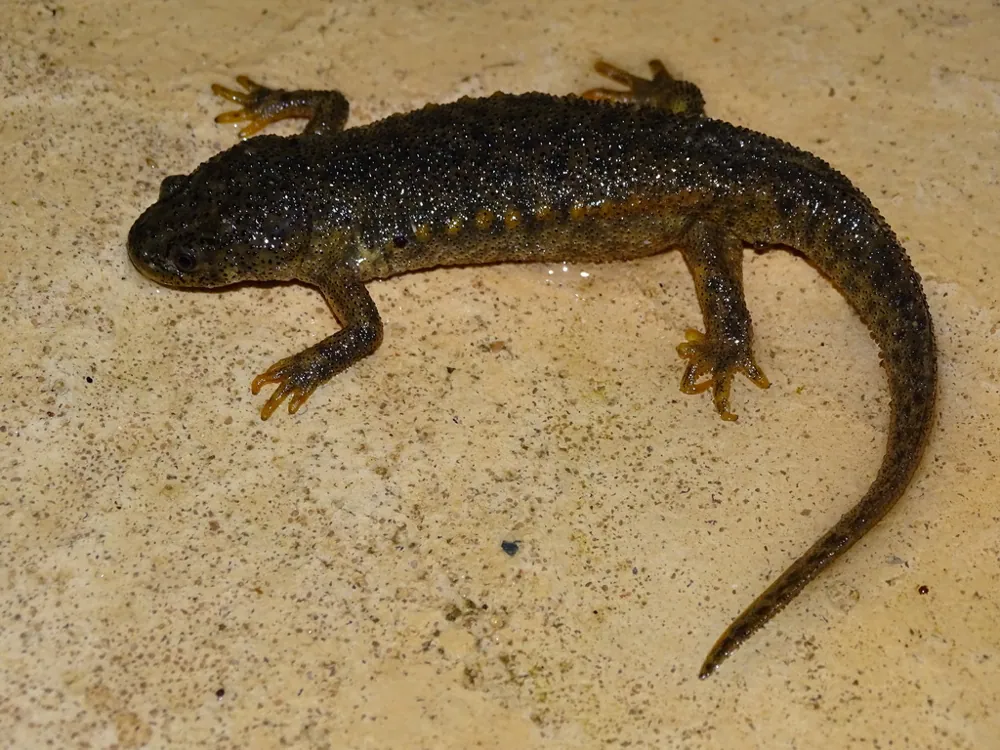
Iberian ribbed newt
 Arantza pozoitsuak
The Iberian ribbed newt is a salamander that lives in ponds and wells in Spain, Portugal and northern Morocco. It is the largest European newt species. When threatened, it can push its sharp ribs out through its skin, which gives it a way to defend itself against predators.1



 Nola ezagutu
- Dark grey on its back and lighter grey on its belly, with small rust-coloured spots1
- Usually 8 to 10 orange, wart-like bumps (tubercles) running down each side of the body1
- Flat, spade-shaped head and a long tail, about half of its body length1
- Males are more slender and usually smaller than females1
- Larvae have bushy external gills and paler colours than adults1
Askotan honekin nahasten da: It is sometimes confused with the Iberian newt (Lissotriton boscai), a different species with a similar common name.1
Pozoi-ahalmena
Arantza zorrotzek daramate pozoia. Zapaltzeak edo heltzeak min ematen du.
Zer egiten du bere pozoiak?
When threatened, the newt releases a milky, thick poison from glands on its neck, back, sides and tail as its ribs push out. The poison coats the ribs, which can pierce the skin of a predator's mouth and inject toxins.1
Zein arriskutsua da pertsonentzat?
Arriskua pertsonentzat: ArinaErle-ziztada bat bezala edo gutxiago. Ia kaltegabea pertsonentzat.The rib defence is completely harmless to humans. The ribs cause only little harm to the newt itself, and its skin quickly heals without infection.1
Zer egiten du beldurtzen denean?
It tries to run away from predators first. If it cannot escape, it pushes its sharp ribs through its sides and releases poison.1
 Bere arantzek zulatzen bazaituzte
- Norbaitek bat ukitu badu: garbitu eskuak ondo eta ez ukitu begiak edo ahoa. Haur edo maskota batek bat miazkatu edo jan badu: deitu zure intoxikazio-zentrora edo larrialdi-zenbakira.
Deitu beti lehenik zure larrialdi-zenbakira (112, 000, 911). Lehen sorospenei buruzko orientabide orokorra da hau, ez mediku-aholkua. Lehen sorospenen oinarriak
 Egon seguru
- Ez ukitu, ez harrapatu eta ez zirikatu inoiz animalia basati bat, txikia izan arren, eta lo edo hilda dagoela badirudi ere.
- Utzi tartea. Bat aurkitzen baduzu, egon lasai, egin atzera poliki eta utzi bere bidetik joaten.
- Bere arantzek zulatzen bazaituzte: egon lasai, egon geldi, deitu zure larrialdi-zenbakira (112, 000, 911) edo joan ospitalera azkar. Gogoratu nolakoa zen, argazki batek laguntzen du.
Ez dabil zure atzetik. Pozoia janaria harrapatzeko edo bere burua babesteko erabiltzen du, eta askoz nahiago du ezkutatu. Seguru egoteari buruz gehiago
Munduko zein tokitan?
Zein handia da?
Zein luzea da?
 9 eraikuntza-bloke ilaran jarrita bezain luzea
Zein handia da Iberian ribbed newt ZUREKIN alderatuta?
Matematika hutsa zure nabigatzailean. Ez da ezer gordetzen, ezta inora bidaltzen ere.
Zein azkarra da?


Datuak
Its ribs can push through its skin to act as a defence, a primitive and rudimentary form of envenomation.1
It is a model animal for regeneration research. It can regrow lost limbs, injured heart tissue, brain cells, eye lenses and parts of its spinal cord.1
This newt has been sent into space on at least six missions, starting in 1985.1
In genetic males and females, temperature can override sex chromosomes. Some ZW larvae reared at 32 °C (90 °F) become functional males.1
Its immune system, rib-coated collagen and antimicrobial peptides let the pierced skin heal quickly without infection.1
Females can keep live sperm in their cloaca for up to five months.1
Mito-hauslea
Mitoa: The newt's ribs and poison are dangerous to people.
Egia: The ribs and poison are a defence against predators. The rib defence is completely harmless to humans.1
Pozoi-adituentzat
- Izen zientifikoa
- Pleurodeles waltl
- Taldea
- Igel toxikoak, apoak eta uhandreak
- Familia
- Salamandridae2
- Ordena
- Caudata
- Kontinenteak
- Europa, Afrika
- Kumeak
- The young are born in water as larvae, breathing through gills. They lose their gills as their limbs grow and can then live on land as well as in water.1
- Nola dagoen naturan
- Least Concern (IUCN, assessed October 2020)1
- Arriskua pertsonentzat
- 1 / 5: Arina3
Datuak nondik datozen
- Iberian ribbed newt (Wikipedia (CC BY-SA 4.0))
- Pleurodeles waltl (iNaturalist): izenak eta sailkapena.
- Venom Wiki: arrisku-maila, ohiko tamaina eta abiadura-kalkulua geureak dira. Ikusi nola kalkulatzen ditugun: Nola baloratzen dugun arriskua.
Orrialde honetako datu bakoitzak zenbaki bat du, bere iturrira eramaten zaituena. Zerbait gaizki badugu, barkatu, animalien zaleak gara, ez zientzia-aldizkari bat. Esaiguzu [email protected] helbidean eta konponduko dugu.
 Eskorpioia gose da! Venom Wiki pertsona bakar baten proiektua da: doakoa, iragarkirik eta jarraitzailerik gabe. Eskupeko txiki batek sarean mantentzen laguntzen du.Elikatu eskorpioia
Talde bereko gehiago: Igel toxikoak, apoak eta uhandreak
 Fire salamanderIgel toxikoak, apoak eta uhandreakMin ematen du, besterik ezEz ukitu
 Common toadIgel toxikoak, apoak eta uhandreakMin ematen du, besterik ezEz ukitu
 European fire-bellied toadIgel toxikoak, apoak eta uhandreakKaltegabea
 Golden mantellaIgel toxikoak, apoak eta uhandreakKaltegabea
 Natterjack toadIgel toxikoak, apoak eta uhandreakKaltegabea
 Tomato frogIgel toxikoak, apoak eta uhandreakKaltegabea
Hemen ere bizi da: Europa
 Common European adderSugegorriak eta biperakMedikua behar du
 Spanish flyBeste animalia toxiko batzukMedikua behar duEz ukitu
 Common waspErleak, liztorrak eta erlastarrakMin ematen du, besterik ez
 European hornetErleak, liztorrak eta erlastarrakMin ematen du, besterik ez
 Western honey beeErleak, liztorrak eta erlastarrakMin ematen du, besterik ez
 Blunt-nosed viperSugegorriak eta biperakHil dezake