
 Afrika
 Asia
Asia Europa
 Hego Amerika
 Australia eta Ozeania
 Antartika
 Ozeano Barea
 Ozeano Atlantikoa
 Ozeano Indikoa
 Ozeano Artikoa
 Mediterraneo itsasoa
 Itsaso Gorria
 Karibe itsasoa
 Koralen itsasoa
 Hego Txinako itsasoa
 Filipinetako itsasoa
 Andaman itsasoa
 Ipar itsasoa
 Timor eta Arafura itsasoak
 Bengalako golkoa
 Kaliforniako golkoa
Rhinoceros viper
 Koska
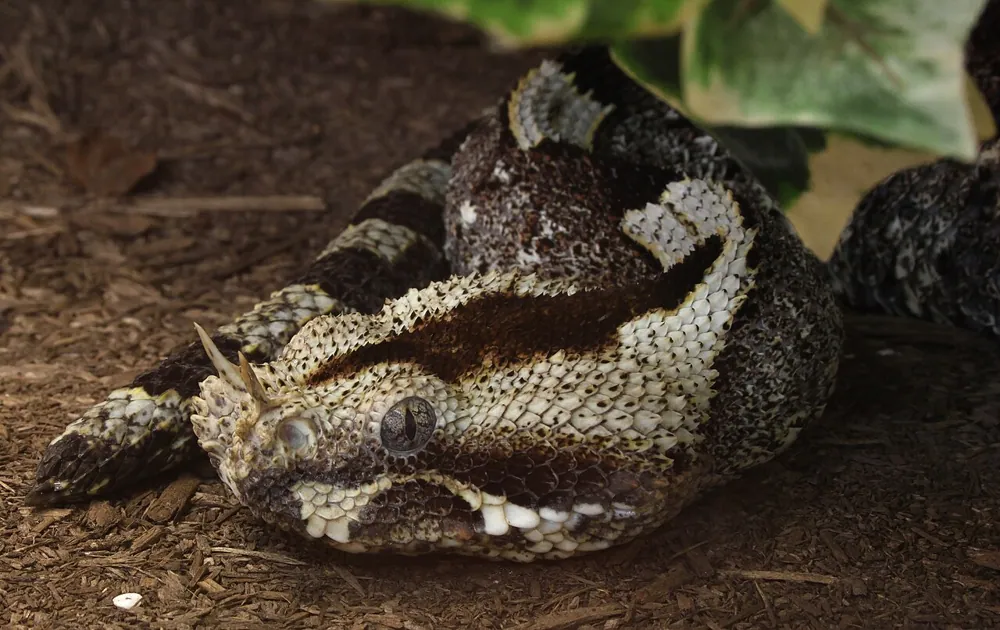
KoskaThe rhinoceros viper is a large, stout snake with bright colours and two or three horn-like scales on its nose. It lives in forests across West and Central Africa. It is venomous, and its venom is mainly hemotoxic, meaning it attacks the blood and circulation.1



 Nola ezagutu
- Large and stout, with rough, heavily keeled scales1
- Two or three horn-like scales on the end of the nose, the front pair often long1
- Series of blue or blue-green oblong markings, each with a lemon-yellow line down the centre, set within black blotches1
- Dark crimson triangles down the flanks, bordered with green or blue1
- Top of the head blue or green, with a black arrow mark1
Askotan honekin nahasten da: The name horned puff adder is also used for Bitis caudalis (horned adder), which is a different species. Because of this, names can cause confusion, so the name butterfly viper is preferred.1
Pozoi-ahalmena
Pozoia letaginetatik edo hortzetatik ateratzen da kosk egiten duenean.
Zer egiten du bere pozoiak?
Its venom is mainly hemotoxic, which attacks the circulatory system, destroying tissue and blood vessels and causing internal bleeding. It also has a neurotoxic component, which attacks the nerves. Small doses of the venom can be deadly. In the few detailed reports of human bites, massive swelling was described, which may lead to necrosis (death of tissue).1
Zein arriskutsua da pertsonentzat?
Arriskua pertsonentzat: Oso arriskutsuaTratamendurik jasotzen ez duen pertsona bat hil dezake.Because its range is restricted, few bites have been reported and no statistics are available. In 2003 a man in Dayton, Ohio, who kept one as a pet, was bitten and died.1
 Albiste ona: medikuek badute sendagai bat (antipozoia) edo tratamendu bat honetarako.1
Zer egiten du beldurtzen denean?
When approached it often reveals its presence with a very loud hiss, almost a shriek, and it can strike quickly forwards or sideways without coiling first or giving a warning.1
 Kosk egiten badu
- Eutsi pertsona geldi eta lasai, eduki koska jasotako gorputz-adarra bihotzaren mailan, kendu eraztunak eta gauza estuak, eta joan ospitalera azkar.
Deitu beti lehenik zure larrialdi-zenbakira (112, 000, 911). Lehen sorospenei buruzko orientabide orokorra da hau, ez mediku-aholkua. Lehen sorospenen oinarriak
 Egon seguru
- Ez ukitu, ez harrapatu eta ez zirikatu inoiz animalia basati bat, txikia izan arren, eta lo edo hilda dagoela badirudi ere.
- Utzi tartea. Bat aurkitzen baduzu, egon lasai, egin atzera poliki eta utzi bere bidetik joaten.
- Batek kosk egiten badizu: egon lasai, egon geldi, deitu zure larrialdi-zenbakira (112, 000, 911) edo joan ospitalera azkar. Gogoratu nolakoa zen, argazki batek laguntzen du.
Ez dabil zure atzetik. Pozoia janaria harrapatzeko edo bere burua babesteko erabiltzen du, eta askoz nahiago du ezkutatu. Seguru egoteari buruz gehiago
Munduko zein tokitan?
Zein handia da?
Zein luzea da?
 2 etxeko katu muturretik buztanera jarrita bezain luzea
 6 banana bata bestearen atzetik jarrita bezain luzea
 100 metro 100 segundotan egin litzake (gizakirik azkarrenak 9,6 behar ditu)
Zein handia da Rhinoceros viper ZUREKIN alderatuta?
Matematika hutsa zure nabigatzailean. Ez da ezer gordetzen, ezta inora bidaltzen ere.
Zein azkarra da?


Datuak
Its scales are so rough that they can cut people who handle a snake that is struggling.1
Its vivid colours break up its outline in the dappled light of the forest floor, so it is very hard to see.1
Its fangs are not large, rarely more than 1.5 cm long, and when not in use they fold up into the roof of its mouth.1
Its bright colours fade quickly after it sheds its skin, as silt from its moist habitat builds up on its rough scales.1
At least one antivenom, called India Antiserum Africa Polyvalent, protects specifically against bites from this species.1
Mito-hauslea
Mitoa: Its bright colours make it easy to spot in the forest.
Egia: Its colours give it excellent camouflage in the dappled light of the forest floor, which can make it almost invisible.1
Datuak nondik datozen
- Bitis nasicornis (Wikipedia (CC BY-SA 4.0))
- Bitis nasicornis (iNaturalist): izenak eta sailkapena.
- Venom Wiki: arrisku-maila, ohiko tamaina eta abiadura-kalkulua geureak dira. Ikusi nola kalkulatzen ditugun: Nola baloratzen dugun arriskua.
Orrialde honetako datu bakoitzak zenbaki bat du, bere iturrira eramaten zaituena. Zerbait gaizki badugu, barkatu, animalien zaleak gara, ez zientzia-aldizkari bat. Esaiguzu [email protected] helbidean eta konponduko dugu.
 Eskorpioia gose da! Venom Wiki pertsona bakar baten proiektua da: doakoa, iragarkirik eta jarraitzailerik gabe. Eskupeko txiki batek sarean mantentzen laguntzen du.Elikatu eskorpioia
Talde bereko gehiago: Sugegorriak eta biperak
 Puff adderSugegorriak eta biperakHilgarria
 Gaboon viperSugegorriak eta biperakHil dezake
 Northeast African carpet viperSugegorriak eta biperakHilgarria
 West African carpet viperSugegorriak eta biperakHilgarria
 West African Gaboon viperSugegorriak eta biperakHil dezake
 Horned adderSugegorriak eta biperakMedikua behar du
 Black mamba
 Deathstalker
 Egyptian cobra
 Boomslang
 Fat-tailed scorpion
 Western honey bee
.jpg)