
 Afrika
 Asia
Asia Europa
 Hego Amerika
 Australia eta Ozeania
 Antartika
 Ozeano Barea
 Ozeano Atlantikoa
 Ozeano Indikoa
 Ozeano Artikoa
 Mediterraneo itsasoa
 Itsaso Gorria
 Karibe itsasoa
 Koralen itsasoa
 Hego Txinako itsasoa
 Filipinetako itsasoa
 Andaman itsasoa
 Ipar itsasoa
 Timor eta Arafura itsasoak
 Bengalako golkoa
 Kaliforniako golkoa
Russell's viper
 Koska
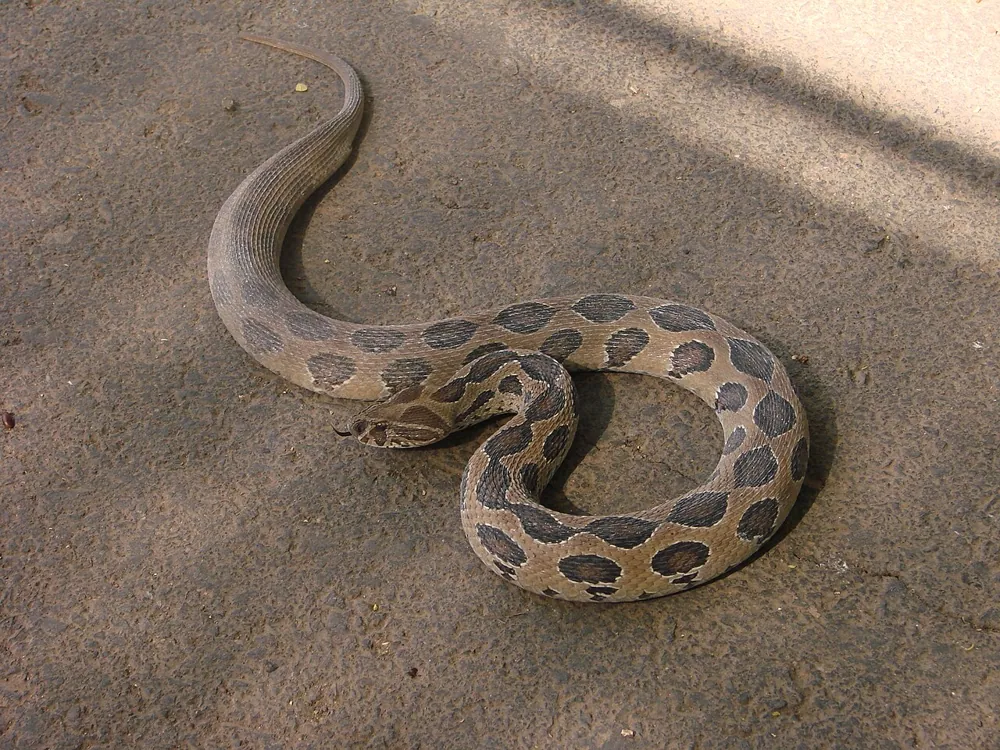
KoskaRussell's viper is a highly venomous snake of South Asia. It is one of the "Big Four" venomous snakes of the region, known for a bite that is extremely painful. It often lives close to people because it hunts the rodents found in farms and villages.1



 Nola ezagutu
- A deep yellow, tan or brown body with three rows of dark brown spots running along its length1
- Each dark spot has a black ring with a white or yellow rim around it1
- A pair of dark patches on the temples, and a pinkish, salmon or brownish V or X marking on the head1
- A flattened, triangular head that is clearly separate from the neck1
- A stout, rounded body with a short tail, about 14% of total length1
Askotan honekin nahasten da: The rough-scaled sand boa, Eryx conicus, often has a colour pattern similar to Russell's viper. It is completely harmless, so care is still needed with any snake that looks like this.1
Pozoi-ahalmena
Pozoia letaginetatik edo hortzetatik ateratzen da kosk egiten duenean.
Zer egiten du bere pozoiak?
Its fangs are long and hollow, and it produces a large amount of venom, with adults yielding about 130 to 250 mg in some reports. Bite symptoms begin with severe pain and swelling, followed by bleeding from the gums and in the urine, a drop in blood pressure and a slower heart rate. Blistering can spread along the limb, and kidney failure occurs in about 25 to 30 percent of untreated bites.1
Zein arriskutsua da pertsonentzat?
Arriskua pertsonentzat: HilgarriaMunduko animaliarik arriskutsuenetako bat.It is known for an extremely painful bite and is one of the "Big Four" venomous snakes of the region. The lethal dose for most humans is about 40 to 70 mg, which is within the amount one bite can deliver. Death can follow 1 to 14 days after the bite, or sometimes later, from infection, kidney failure, breathing failure or heart failure. In one study of people who survived bites, 29% suffered severe damage to the pituitary gland, which later caused hypopituitarism.1
 Albiste ona: medikuek badute sendagai bat (antipozoia) edo tratamendu bat honetarako.1
Zer egiten du beldurtzen denean?
When threatened, it forms a series of S-shaped loops, raises the front third of its body and hisses loudly.1
 Kosk egiten badu
- Early medical treatment and early access to antivenom can prevent severe complications and greatly reduce the chance of a fatal outcome. Seek medical care as soon as possible after any bite.1
- Eutsi pertsona geldi eta lasai, eduki koska jasotako gorputz-adarra bihotzaren mailan, kendu eraztunak eta gauza estuak, eta joan ospitalera azkar.
Deitu beti lehenik zure larrialdi-zenbakira (112, 000, 911). Lehen sorospenei buruzko orientabide orokorra da hau, ez mediku-aholkua. Lehen sorospenen oinarriak
 Egon seguru
- Ez ukitu, ez harrapatu eta ez zirikatu inoiz animalia basati bat, txikia izan arren, eta lo edo hilda dagoela badirudi ere.
- Utzi tartea. Bat aurkitzen baduzu, egon lasai, egin atzera poliki eta utzi bere bidetik joaten.
- Batek kosk egiten badizu: egon lasai, egon geldi, deitu zure larrialdi-zenbakira (112, 000, 911) edo joan ospitalera azkar. Gogoratu nolakoa zen, argazki batek laguntzen du.
Ez dabil zure atzetik. Pozoia janaria harrapatzeko edo bere burua babesteko erabiltzen du, eta askoz nahiago du ezkutatu. Seguru egoteari buruz gehiago
Munduko zein tokitan?
Zein handia da?
Zein luzea da?
 3 etxeko katu muturretik buztanera jarrita bezain luzea
 9 banana bata bestearen atzetik jarrita bezain luzea
 100 metro 92 segundotan egin litzake (gizakirik azkarrenak 9,6 behar ditu)
Zein handia da Russell's viper ZUREKIN alderatuta?
Matematika hutsa zure nabigatzailean. Ez da ezer gordetzen, ezta inora bidaltzen ere.
Zein azkarra da?


Datuak
When it strikes, it can exert so much force that large individuals lift off the ground.1
Its hiss is said to be louder than that of any other snake.1
Adults are usually slow and sluggish and rarely attack unless provoked, but they can strike very quickly.1
A harmless sand boa has evolved a colour pattern that looks like this viper, which may help it avoid predators.1
The mother can take nearly 4.5 hours to give birth, as one recorded birth of 11 young shows.1
Mito-hauslea
Mitoa: Russell's vipers chase people and bite them.
Egia: They usually do not attack unless provoked. Their threat display of S-shaped loops and hissing has led to the belief that they chase people, but they are strong and may react violently if picked up.1
Pozoi-adituentzat
- Izen zientifikoa
- Daboia russelii
- Taldea
- Sugegorriak eta biperak
- Familia
- Viperidae2
- Ordena
- Squamata
- Kontinenteak
- Asia
- Kumeak
- It gives birth to live young (ovoviviparous). Litters of 20 to 40 are common, though a litter may be as small as one, and the reported maximum is 75.1
- Arriskua pertsonentzat
- 5 / 5: Hilgarria3
Datuak nondik datozen
- Russell's viper (Wikipedia (CC BY-SA 4.0))
- Daboia russelii (iNaturalist): izenak eta sailkapena.
- Venom Wiki: arrisku-maila, ohiko tamaina eta abiadura-kalkulua geureak dira. Ikusi nola kalkulatzen ditugun: Nola baloratzen dugun arriskua.
Orrialde honetako datu bakoitzak zenbaki bat du, bere iturrira eramaten zaituena. Zerbait gaizki badugu, barkatu, animalien zaleak gara, ez zientzia-aldizkari bat. Esaiguzu [email protected] helbidean eta konponduko dugu.
 Eskorpioia gose da! Venom Wiki pertsona bakar baten proiektua da: doakoa, iragarkirik eta jarraitzailerik gabe. Eskupeko txiki batek sarean mantentzen laguntzen du.Elikatu eskorpioia
Talde bereko gehiago: Sugegorriak eta biperak
 Indian saw-scaled viperSugegorriak eta biperakHilgarria
 Puff adderSugegorriak eta biperakHilgarria
 Common European adderSugegorriak eta biperakMedikua behar du
 Eastern Russell's viperSugegorriak eta biperakHilgarria
 Northeast African carpet viperSugegorriak eta biperakHilgarria
 Armenian viperSugegorriak eta biperakHil dezake
 Deathstalker
 Indian cobra
 King cobra
 Asian giant hornet
 Komodo dragon
 Spanish fly