
 Afrika
 Asia
Asia Europa
 Hego Amerika
 Australia eta Ozeania
 Antartika
 Ozeano Barea
 Ozeano Atlantikoa
 Ozeano Indikoa
 Ozeano Artikoa
 Mediterraneo itsasoa
 Itsaso Gorria
 Karibe itsasoa
 Koralen itsasoa
 Hego Txinako itsasoa
 Filipinetako itsasoa
 Andaman itsasoa
 Ipar itsasoa
 Timor eta Arafura itsasoak
 Bengalako golkoa
 Kaliforniako golkoa
Indian cobra
 Koska
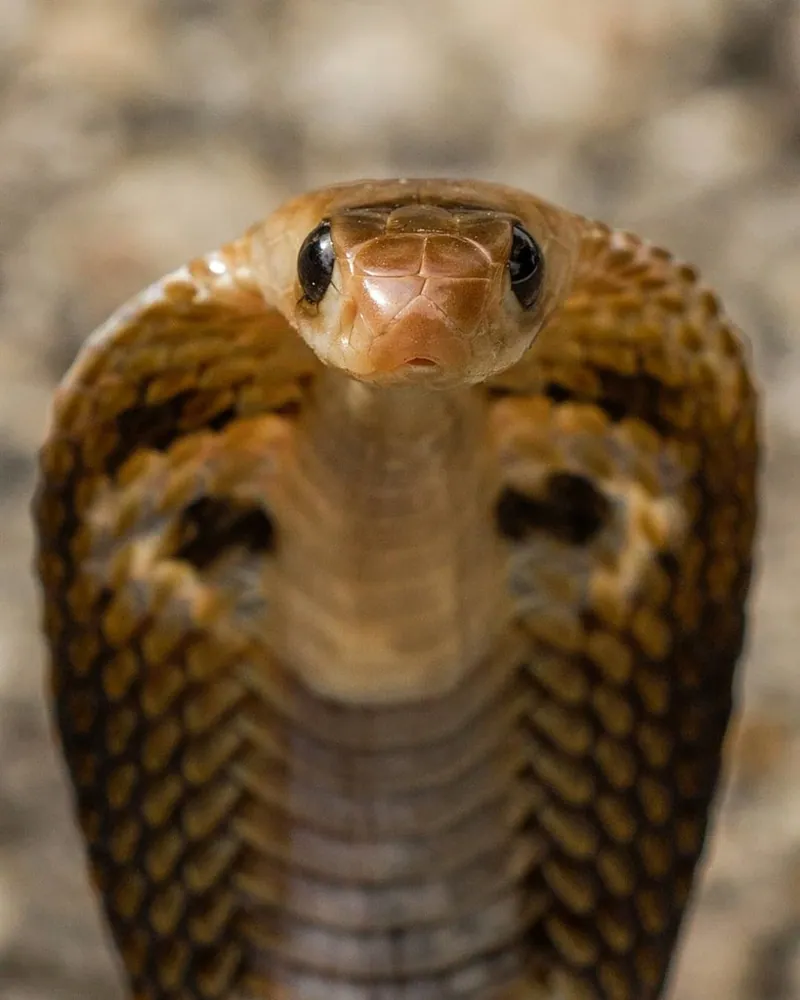
KoskaThe Indian cobra is a heavy-bodied venomous snake that lives across the Indian subcontinent. It is famous for the large hood it spreads when threatened. It is one of the four snakes responsible for the most snakebites in India and Sri Lanka, so knowing how to recognise it matters.1



 Nola ezagutu
- A relatively large hood, which it expands when threatened.1
- Many individuals have a hood mark on the back of the hood: two round eye-like patterns joined by a curved line, looking like a pair of spectacles.1
- Colour varies widely. The underside can be grey, yellow, tan, brown, reddish or black, and many adults have salt-and-pepper speckles on the upper scales.1
- Adults in southern Pakistan are often uniformly black on top, with a light underside.1
Askotan honekin nahasten da: The Oriental rat snake is often mistaken for this cobra, but it is much longer and has a more ridged-looking body. The monocled cobra has an O-shaped pattern on the back of its hood, while the Indian cobra has a spectacles-shaped pattern. The Caspian cobra can be confused with it where they share range in Pakistan and Afghanistan, but it is never fully black.1
Pozoi-ahalmena
Pozoia letaginetatik edo hortzetatik ateratzen da kosk egiten duenean.
Zer egiten du bere pozoiak?
Its venom mainly contains a powerful neurotoxin, which attacks the nerves, and a cardiotoxin, which harms the heart. The neurotoxin paralyses muscles, and severe bites can lead to respiratory failure (breathing failure) or cardiac arrest (the heart stopping). Symptoms may appear between 15 minutes and two hours after a bite. Early signs include severe local pain and swelling that spreads up the limb, followed by darkening and blistering of the skin, as well as headache, nausea, vomiting, dizziness and drowsiness.1
Zein arriskutsua da pertsonentzat?
Arriskua pertsonentzat: HilgarriaMunduko animaliarik arriskutsuenetako bat.It is responsible for many snakebites and most snakebite cases in Bangladesh. In one study, untreated bite victims had a mortality rate of about 20–30%. In another study of patients who received prompt medical treatment, the rate was 9%. The amount of venom delivered varies from bite to bite.1
 Albiste ona: medikuek badute sendagai bat (antipozoia) edo tratamendu bat honetarako.1
Zer egiten du beldurtzen denean?
When threatened, it spreads its large hood.1
 Kosk egiten badu
- Prompt medical treatment and antivenom reduce deaths from this snake's bites. Polyvalent serum, an antivenom that works against several snake species, is available for treating these bites.1
- Eutsi pertsona geldi eta lasai, kendu eraztunak eta gauza estuak, eta joan ospitalera azkar: antipozoia da tratamendua.
Deitu beti lehenik zure larrialdi-zenbakira (112, 000, 911). Lehen sorospenei buruzko orientabide orokorra da hau, ez mediku-aholkua. Lehen sorospenen oinarriak
 Egon seguru
- Ez ukitu, ez harrapatu eta ez zirikatu inoiz animalia basati bat, txikia izan arren, eta lo edo hilda dagoela badirudi ere.
- Utzi tartea. Bat aurkitzen baduzu, egon lasai, egin atzera poliki eta utzi bere bidetik joaten.
- Batek kosk egiten badizu: egon lasai, egon geldi, deitu zure larrialdi-zenbakira (112, 000, 911) edo joan ospitalera azkar. Gogoratu nolakoa zen, argazki batek laguntzen du.
Ez dabil zure atzetik. Pozoia janaria harrapatzeko edo bere burua babesteko erabiltzen du, eta askoz nahiago du ezkutatu. Seguru egoteari buruz gehiago
Munduko zein tokitan?
Zein handia da?
Zein luzea da?
 4 etxeko katu muturretik buztanera jarrita bezain luzea
 12 banana bata bestearen atzetik jarrita bezain luzea
 100 metro 46 segundotan egin litzake (gizakirik azkarrenak 9,6 behar ditu)
Zein handia da Indian cobra ZUREKIN alderatuta?
Matematika hutsa zure nabigatzailean. Ez da ezer gordetzen, ezta inora bidaltzen ere.
Zein azkarra da?


Datuak
Its venom is used as an intoxicant in India. Snake charmers have been paid to provide bites from their snakes, and the effects include loss of consciousness, euphoria and sedation.1
Hatchlings are independent from birth and have fully working venom glands, so even young snakes can deliver venom.1
It is revered in Hindu mythology and culture, and is often seen with snake charmers.1
It is protected under the Indian Wildlife Protection Act (1972).1
Datuak nondik datozen
- Indian cobra (Wikipedia (CC BY-SA 4.0))
- Naja naja (iNaturalist): izenak eta sailkapena.
- Venom Wiki: arrisku-maila, ohiko tamaina eta abiadura-kalkulua geureak dira. Ikusi nola kalkulatzen ditugun: Nola baloratzen dugun arriskua.
Orrialde honetako datu bakoitzak zenbaki bat du, bere iturrira eramaten zaituena. Zerbait gaizki badugu, barkatu, animalien zaleak gara, ez zientzia-aldizkari bat. Esaiguzu [email protected] helbidean eta konponduko dugu.
 Eskorpioia gose da! Venom Wiki pertsona bakar baten proiektua da: doakoa, iragarkirik eta jarraitzailerik gabe. Eskupeko txiki batek sarean mantentzen laguntzen du.Elikatu eskorpioia
 King cobra
 Caspian cobra
 Common krait
 Malayan krait
 Many-banded krait
 Monocled cobra
 Deathstalker
 Indian saw-scaled viper
 Puff adder
 Russell's viper
 Asian giant hornet
 Komodo dragon