
 Afirik
 Aazi
Aazi Orop
Orop Amerik Sud
 Ostarali e Oseyani
 Antarktik
 Geeci Pasifik
 Geeci Atlantik
 Geeci Enndo
 Geeci Arktik
 Geeci Mediteraane
 Geeci Boɗeewi
 Geeci Karayib
 Geeci Korayl
 Geeci Siin Sud
 Geeci Filipiin
 Geeci Andaman
 Geeci Nord
 Geeci Timor e Arafura
 Gulf Bengal
 Gulf Kaliforni
Spiny bush viper
 Ŋatgol
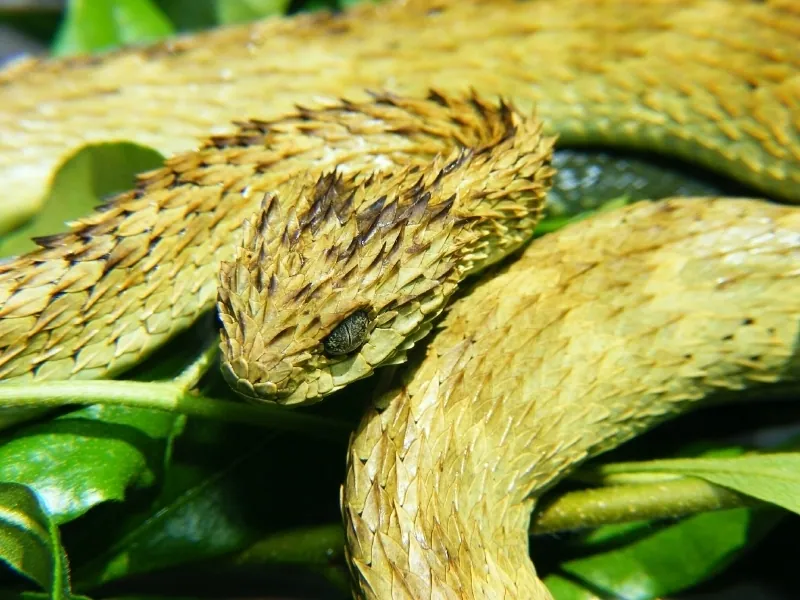
The spiny bush viper is a venomous snake with a bristly, shaggy look caused by spiky scales along its body. It lives in parts of Central and East Africa, mostly in forests and reedy places. Its venom can be dangerous to people, so it is important to know what it looks like.1



 Hono anndirtee ngal
- Its body is covered in long, heavily keeled scales (scales with a raised ridge), which make it look shaggy and bristly.1
- The scales around the head and neck are the longest, and they get shorter towards the tail.1
- It has a short snout, more so in males than in females.1
- Males are surprisingly long and slender compared with females.1
Doole tooke ŋatgol
Tooke no yaltira ñiiƴe mum tuma ngal ŋatata.
Ko honɗun tooke mum waɗata (ŋatgol walla jukkugol)?
Its venom is mainly neurotoxic, meaning it attacks the nerves. It also contains cytotoxins, which damage cells, and fasciculins, which affect nerve signals. The strength of the venom varies between individual snakes and can be influenced by region, weather and altitude. Reports of bites show severe bleeding of internal organs.1
Hono musiiba mum heewiri e yimɓe?
Musiiba e yimɓe: Musiiba mawɗoŊatgol no haani doktoro. Maayde no famɗi sanne.A bite can be fatal to people who do not get proper first aid and antivenom treatment. Its venom was once thought to be weaker than that of many other snakes, possibly because bites are uncommon, but recent reports show this is not the case.1
 Kabaaru moƴƴo: doktoroɓe no njogii lekki (sérum antivenimeux) walla safaara ngam ɗum.1
 Si no ŋata
- A bite needs proper first aid, followed by antivenom treatment. Without these, a bite can be fatal.1
- Haɗu neɗɗo on dillagol, deeƴnu mo, jogo koyngal walla jungo ŋataaɗo on e toownde ɓernde, ittu baagiiji e ko tiiɗi fow, yahra mo lopitaan law.
Adii fow noddu nimero ballal (112, 000, 911). Ɗum ko anndinal ballal adiingal, wanaa saaraangal doktoro. Ko adii nder ballal adiingal
 Reen hoore maa
- Wota a meem, wota a nanngu, wota a jalnu kullal ladde haa abada, hay si ko tokooso, hay si no yi'ee no ɗaanii walla maayii.
- Accu ngal nokku. Si a fotti e ngal, deeƴu, ruttu ɓaawo seeɗa seeɗa, accu ngal yaha laawol mum.
- Si gooto e majji ŋatii ma: deeƴu, wota a dillu, noddu nimero ballal (112, 000, 911) walla yahu lopitaan law. Jogo e hakkille no ngal nanndi, natal no walla.
Ngal faalaaka gaañugol ma. Ngal no huutora tooke mum ngam nanngugol ñaamdu walla reenugol hoore mum, ngal ɓuri yiɗugol suuɗaade. Ko ɓeydi fii reenugol hoore maa
Hoto nder aduna?
Hono mawniri?
Hono juutiri?
 juuti no banaanaaji 4 jokkondirɗi
 no waawi taccugol meeteruuji 100 nder segonde 110 (neɗɗo ɓurɗo yaawugol sokli 9,6)
Hono Spiny bush viper mawniri, si fooɗondiraama e AN?
Ko limoore tun nder navigateur maa. Alaa ko danndetee walla ko neldetee ka nokku woo.
Hono yaawiri?


Humpito
Its venom can vary greatly between individuals of the same species, even depending on the weather and altitude.1
Its scales are heavily keeled, meaning each has a raised ridge, and these are often called spikes.1
It can climb reeds and stalks and often rests on top of flowers.1
Males are much longer and more slender than females.1
Bonnoowo fenaandeeji
Fenaande: Its venom is weaker than that of many other snakes.
Goonga: Its venom was once thought to be less toxic, but there are now reports of bites causing severe bleeding of internal organs.1
Ɗo humpitooji ɗin iwri
- Atheris hispida (Wikipedia (CC BY-SA 4.0))
- Atheris hispida (iNaturalist): inɗe e ŋoordingol (classification).
- Venom Wiki: tolno musiiba, mawnugol aadaajo e miijo yaawugol ko amen. Ndaar no min ƴeewtirta ɗum: Hono min tolnirta musiiba.
Kala humpito nder ngoo hello no jogii limoore hollirnde iwdi mum. Si min juumii, yaafo, min ko yiɗɓe kulle, wanaa jaaynde ganndal. Haalan min e [email protected], min feewnitan.
 Yaare nden no weelaa! Venom Wiki ko golle neɗɗo gooto: ko yoɓetaake, alaa piiblisite, alaa reweteeɓe. Kopporde tokooso no walla heddingol ɗum e enternet.Ñaamnu yaare nden
 Wipeeri fuufoowndi
 Gaboon viper
 Northeast African carpet viper
 West African carpet viper
 Rhinoceros viper
 West African Gaboon viper
 Mamba ɓaleeri
 Yaare oolnde maayde
 Kobra Misra
 Boomslang
 Fat-tailed scorpion
 Western honey bee