
 Afrikka
 Aasia
Aasia Eurooppa
 Etelä-Amerikka
 Australia ja Oseania
 Etelämanner
 Tyynimeri
 Atlantti
 Intian valtameri
 Pohjoinen jäämeri
 Välimeri
 Punainenmeri
 Karibianmeri
 Korallimeri
 Etelä-Kiinan meri
 Filippiinienmeri
 Andamaanienmeri
 Pohjanmeri
 Timorinmeri ja Arafuranmeri
 Bengalinlahti
 Kalifornianlahti
Cane toad
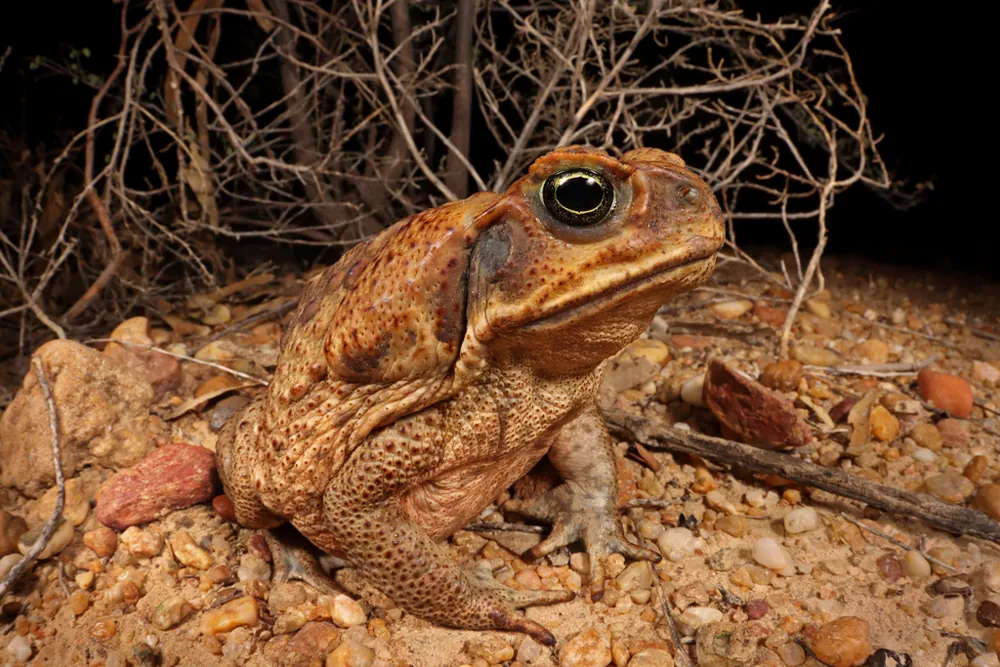
 Myrkkyä ihossaSyö: Vähän kaikkeaPassiivisesti myrkyllinen, ei aktiivisesti myrkyllinen
The cane toad is a large toad that is very poisonous to many animals. It is native to South and mainland Central America, but people have moved it to islands in Oceania and the Caribbean and to northern Australia. It matters because it spreads quickly and harms native wildlife and pets.1
 Näin tunnistat sen
- Very large, with adults usually 10 to 15 cm long1
- Dry, warty skin with distinct ridges above the eyes that run down the snout1
- A large parotoid gland (a swollen gland) behind each eye1
- Grey, yellowish, red-brown or olive-brown skin, often with patterns1
- Horizontal pupils and golden irises1
Sekoitetaan usein: In Australia, adults can be confused with large native frogs, but these lack the large parotoid glands and the ridge between the nostril and eye. The giant burrowing frog has vertical pupils and silver-grey irises, while the cane toad has horizontal pupils and golden irises. In the United States, the southern toad has two bulbs in front of the parotoid glands.1
Myrkkyvoima
Sen iho on myrkyllinen. Siihen on vaarallista koskea, sitä on vaarallista nuolla tai syödä.
Mitä sen myrkky tekee, jos siihen koskee tai sen syö?
The toad's glands secrete a milky-white fluid called bufotoxin when it is threatened. Components of bufotoxin are toxic to many animals. In dogs, signs of poisoning include excessive drooling, extremely red gums, head-shaking, crying and loss of coordination.1
Kuinka vaarallinen se on ihmisille?
Vaara ihmisille: VakavaJos joku koskee siihen tai syö sen, mene lääkäriin. Kuolemat ovat hyvin harvinaisia.The toxic skin can kill many wild and domestic animals. Dogs are especially at risk from licking or biting the toad. Human deaths have also been recorded after people ate cane toads.1
Mitä se tekee, kun se pelästyy?
When threatened, it releases bufotoxin from its glands.1
 Jos joku koski siihen tai söi sitä
- Jos joku on koskenut sellaiseen: pese kädet hyvin äläkä koske silmiin tai suuhun. Jos lapsi tai lemmikki on nuollut tai syönyt sellaisen: soita Myrkytystietokeskukseen tai hätänumeroon.
Soita aina ensin hätänumeroon (112, 000, 911). Nämä ovat yleisiä ensiapuohjeita, eivät lääketieteellisiä neuvoja. Ensiavun perusteet
 Pysy turvassa
- Älä koskaan koske villieläimeen, pyydystä sitä tai kiusaa sitä, ei edes pientä, eikä silloinkaan, kun se näyttää nukkuvan tai olevan kuollut.
- Anna sille tilaa. Jos kohtaat sellaisen, pysy rauhallisena, peräänny hitaasti ja anna sen mennä omaa tietään.
- Jos kosketit sitä tai söit sitä: älä hiero silmiäsi tai suutasi, pese kätesi ja hae lääkärin apua.
Se ei ole sinun perässäsi. Sen myrkky on olemassa vain siksi, ettei kukaan söisi sitä. Lisää turvallisuudesta
Missä päin maailmaa?
Kuinka iso se on?
Kuinka pitkä se on?
 yhtä pitkä kuin 8 rakennuspalikkaa rivissä
 voisi juosta 100 metriä 180 sekunnissa (nopein ihminen tarvitsee 9,6)
Kuinka iso Cane toad on SINUUN verrattuna?
Pelkkää matematiikkaa selaimessasi. Mitään ei tallenneta eikä lähetetä minnekään.
Kuinka nopea se on?


Faktat
Young toads lose the toxicity they had as eggs and tadpoles, and they only develop their poison glands later. Only an estimated 0.5% of cane toads reach adulthood.1
In Australia, tadpoles have evolved to be more likely to eat their siblings than tadpoles in South America.1
A female can lay thousands of eggs in one spawn, in strings up to 20 metres long.1
In the wild, cane toads can live 10 to 15 years, and one captive toad was reported to have lived 35 years.1
The cane toad is considered the largest species in the Bufonidae, the toad family.1
Cane toads eat both living and dead matter, which is unusual among frogs and toads.1
Myyttien murtaja
Myytti: The name 'marine toad' suggests that cane toads live in the sea.
Totuus: Cane toads do not live in the sea. The name came from a mistaken belief by an early naturalist.1
Myrkkyasiantuntijoille
- Tieteellinen nimi
- Rhinella marina
- Ryhmä
- Nuolimyrkkysammakot, konnat ja vesiliskot
- Perhe
- Bufonidae2
- Järjestys
- Anura
- Maanosat
- Pohjois-Amerikka, Etelä-Amerikka
- Vauvat
- A female lays 8,000 to 25,000 eggs at once, in long jelly strings that can stretch up to 20 metres.1
- Elinikä
- noin 15 vuotta1
- Vaara ihmisille
- 3 / 5: Vakava3
Mistä tiedot ovat peräisin
- Cane toad (Wikipedia (CC BY-SA 4.0))
- Rhinella marina (iNaturalist): nimet ja luokittelu.
- Venom Wiki: vaarataso, tyypillinen koko ja nopeusarvio ovat omia arvioitamme. Katso, miten laskemme ne: Näin arvioimme vaaran.
Jokaisella tämän sivun tiedolla on numero, joka viittaa sen lähteeseen. Jos jokin meni pieleen, anteeksi, olemme eläinfaneja emmekä tiedelehti. Kerro meille osoitteeseen [email protected], niin korjaamme sen.
 Skorpionilla on nälkä! Venom Wiki on yhden miehen projekti: ilmainen, ilman mainoksia ja ilman seurantaa. Pieni tippi auttaa pitämään sen verkossa.Ruoki skorpioni
Lisää samasta ryhmästä: Nuolimyrkkysammakot, konnat ja vesiliskot
 Golden poison frogNuolimyrkkysammakot, konnat ja vesiliskotTappavaÄlä koske
 Dyeing poison dart frogNuolimyrkkysammakot, konnat ja vesiliskotSattuu vainÄlä koske
 Strawberry poison-dart frogNuolimyrkkysammakot, konnat ja vesiliskotSattuu vainÄlä koske
 Black-legged poison frogNuolimyrkkysammakot, konnat ja vesiliskotVoi tappaaÄlä koske
 California newtNuolimyrkkysammakot, konnat ja vesiliskotVoi tappaaÄlä koske
 Rough-skinned newtNuolimyrkkysammakot, konnat ja vesiliskotVoi tappaaÄlä koske
 Terciopelo
 Eastern coral snake
 Eastern diamondback rattlesnake
 Eyelash viper
 Timber rattlesnake
 Western diamondback rattlesnake