
 Afrikka
 Aasia
Aasia Eurooppa
 Etelä-Amerikka
 Australia ja Oseania
 Etelämanner
 Tyynimeri
 Atlantti
 Intian valtameri
 Pohjoinen jäämeri
 Välimeri
 Punainenmeri
 Karibianmeri
 Korallimeri
 Etelä-Kiinan meri
 Filippiinienmeri
 Andamaanienmeri
 Pohjanmeri
 Timorinmeri ja Arafuranmeri
 Bengalinlahti
 Kalifornianlahti
Mexican redknee tarantula
 Puremat
The Mexican redknee tarantula is a large, hairy spider from the Pacific coast of Mexico. It lives in burrows under rocks and tree roots, and it is a popular pet among tarantula keepers. Its name has caused confusion, because for many years it was mixed up with a very similar species.1



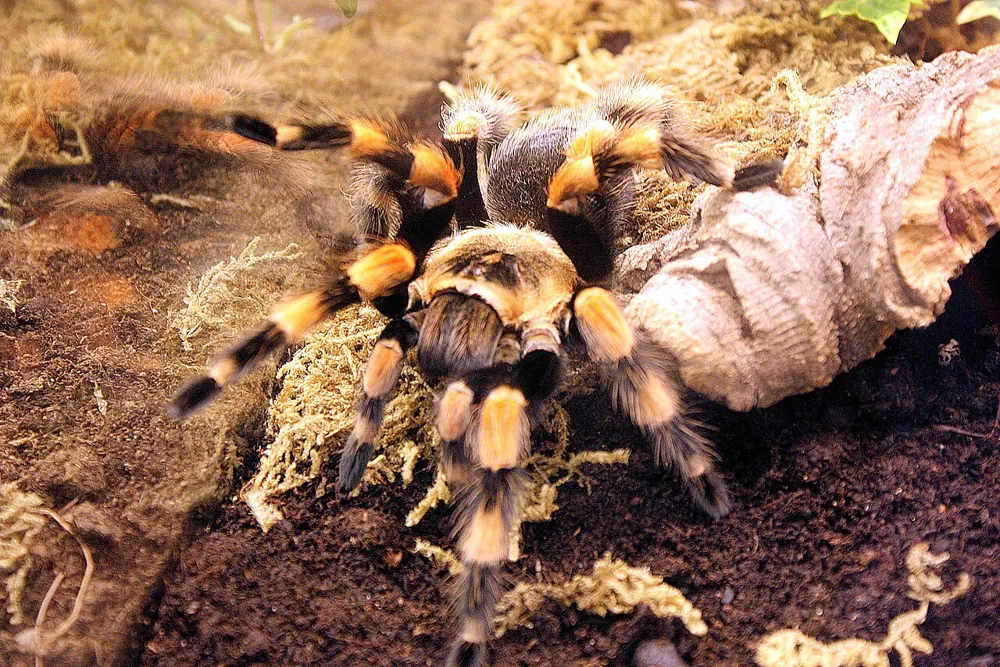
 Näin tunnistat sen
- Males and females are large, with bodies about 4 to 6 cm long, not counting the fangs and spinnerets.1
- Legs and palps (the short leg-like parts near the mouth) are bluish black with reddish orange and pale pink rings.1
- Adult males have a yellowish brown carapace (the hard top of the front body) and a black upper abdomen.1
- Adult females vary more. The carapace may be mostly bluish black with a light brown border, or have a dark starburst pattern.1
Sekoitetaan usein: It is often confused with Brachypelma hamorii, which has very similar colours. The two can be told apart by two brownish pink bands on the chelicerae (the fang-bearing parts), which are present in B. hamorii but absent in B. smithi. Mature males can also be told apart by the shape of the palpal bulb, which is straighter and spoon-shaped in B. smithi.1
Myrkkyvoima
Myrkky tulee ulos myrkkyhampaista tai hampaista, kun se puree.
Kuinka vaarallinen se on ihmisille?
Vaara ihmisille: LieväKuin mehiläisen pisto tai vähemmän. Käytännössä vaaraton ihmisille. Jos se puree
- Pese purema ja viilennä se. Hae lääkärin apua, jos kipu on kova tai henkilö voi huonosti.
Soita aina ensin hätänumeroon (112, 000, 911). Nämä ovat yleisiä ensiapuohjeita, eivät lääketieteellisiä neuvoja. Ensiavun perusteet
 Pysy turvassa
- Älä koskaan koske villieläimeen, pyydystä sitä tai kiusaa sitä, ei edes pientä, eikä silloinkaan, kun se näyttää nukkuvan tai olevan kuollut.
- Anna sille tilaa. Jos kohtaat sellaisen, pysy rauhallisena, peräänny hitaasti ja anna sen mennä omaa tietään.
- Jos sellainen puree sinua: pysy rauhallisena, pysy paikallasi, soita hätänumeroon (112, 000, 911) tai mene nopeasti sairaalaan. Muista, miltä se näytti, valokuva auttaa.
Se ei ole sinun perässäsi. Se käyttää myrkkyään saadakseen ruokaa tai suojellakseen itseään, ja se piiloutuu paljon mieluummin. Lisää turvallisuudesta
Missä päin maailmaa?
Kuinka iso se on?
Kuinka pitkä se on?
 lyhyempi kuin pikkusormesi
 voisi juosta 100 metriä 200 sekunnissa (nopein ihminen tarvitsee 9,6)
Kuinka iso Mexican redknee tarantula on SINUUN verrattuna?
Pelkkää matematiikkaa selaimessasi. Mitään ei tallenneta eikä lähetetä minnekään.
Kuinka nopea se on?


Faktat
Large numbers of wild-caught Mexican redknee tarantulas are still smuggled out of Mexico. At least 3,000 Mexican tarantulas were sent to the United States or Europe a few years before 2017, most of them this species.1
Its burrow has a single entrance, a tunnel about three times the spider's leg span long, and one or two chambers, one for moulting and one for resting and eating.1
Males have shorter bodies than females but longer legs.1
Myyttien murtaja
Myytti: The name Mexican redknee tarantula always refers to one single species.
Totuus: The name has been used for two very similar species, B. smithi and B. hamorii. Many older sources mixed them up, so earlier records may be about either species.1
Mistä tiedot ovat peräisin
- Brachypelma smithi (Wikipedia (CC BY-SA 4.0))
- Brachypelma smithi (iNaturalist): nimet ja luokittelu.
- Venom Wiki: vaarataso, tyypillinen koko ja nopeusarvio ovat omia arvioitamme. Katso, miten laskemme ne: Näin arvioimme vaaran.
Jokaisella tämän sivun tiedolla on numero, joka viittaa sen lähteeseen. Jos jokin meni pieleen, anteeksi, olemme eläinfaneja emmekä tiedelehti. Kerro meille osoitteeseen [email protected], niin korjaamme sen.
 Skorpionilla on nälkä! Venom Wiki on yhden miehen projekti: ilmainen, ilman mainoksia ja ilman seurantaa. Pieni tippi auttaa pitämään sen verkossa.Ruoki skorpioni
Lisää samasta ryhmästä: Lintuhämähäkit ja suppiloverkkohämähäkit
 Arizona blond tarantulaLintuhämähäkit ja suppiloverkkohämähäkitVaaraton
 Ravine trapdoor spiderLintuhämähäkit ja suppiloverkkohämähäkitVaaraton
 Trinidad chevron tarantulaLintuhämähäkit ja suppiloverkkohämähäkitSattuu vain
 Antilles pinktoe tarantulaLintuhämähäkit ja suppiloverkkohämähäkitVaaraton
 California trapdoor spiderLintuhämähäkit ja suppiloverkkohämähäkitVaaraton
 Costa Rican zebra tarantulaLintuhämähäkit ja suppiloverkkohämähäkitVaaraton
 Terciopelo
 Eastern coral snake
 Eastern diamondback rattlesnake
 Eyelash viper
 Timber rattlesnake
 Western diamondback rattlesnake