
 Afrique
 Asie
Asie Europe
 Amérique du Sud
 Australie et Océanie
 Antarctique
 Océan Pacifique
 Océan Atlantique
 Océan Indien
 Océan Arctique
 Mer Méditerranée
 Mer Rouge
 Mer des Caraïbes
 Mer de Corail
 Mer de Chine méridionale
 Mer des Philippines
 Mer d'Andaman
 Mer du Nord
 Mer de Timor et d'Arafura
 Golfe du Bengale
 Golfe de Californie
African lionfish
 Épines venimeuses
The African lionfish is a striking marine fish from the scorpionfish and lionfish family. It lives in the tropical Indian Ocean, where it is often found on soft, muddy sea floors. Its spines can harm people, so it is worth knowing what it looks like.1
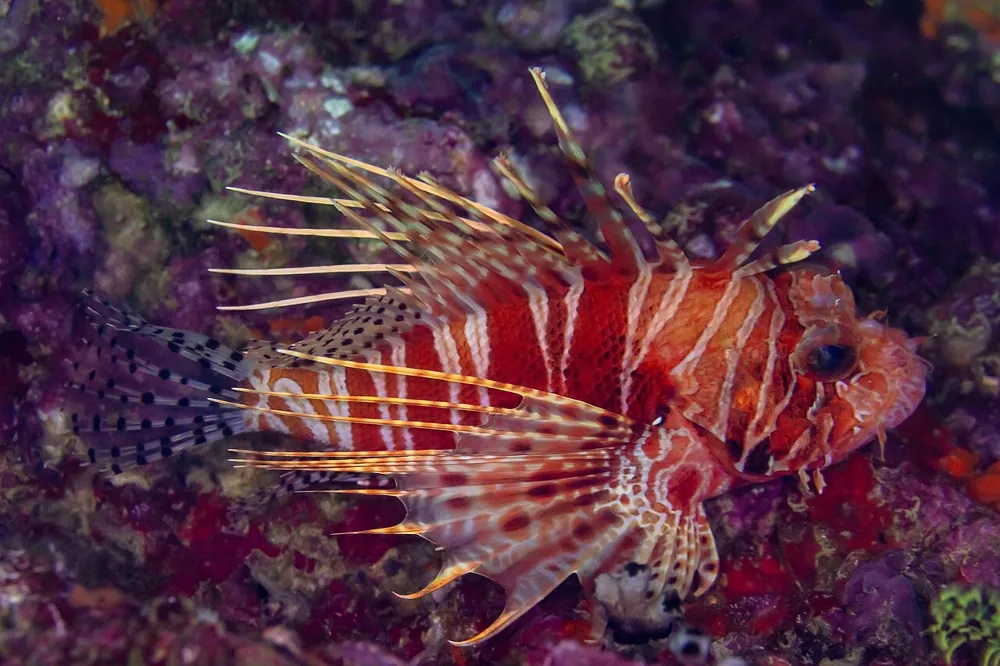
,_islas_Ad_Dimaniyat,_Om%C3%A1n,_2024-08-13,_DD_42.jpg)
 Comment le reconnaître
- Many brown to brownish red bars run along the body, and the bars near the base of the tail are thin and wavy.1
- A brownish red spot, smaller than the pupil of the eye, sits on the lower gill cover.1
- The soft-rayed parts of the dorsal, anal and tail fins are see-through, with small brownish red spots scattered on the rays.1
- The pelvic fin is blackish.1
- The dorsal fin has 13 spines and 10 soft rays. It has no tentacles above the eyes, or only very small ones.1
Souvent confondu avec : A closely related species, Pterois paucispinula, lives in the Western Pacific Ocean. The African lionfish is limited to the Indian Ocean, so the location of a sighting helps tell the two apart.1
Puissance du venin
Des épines pointues portent le venin. Marcher dessus ou l'attraper fait mal.
À quel point est-il dangereux pour l'homme ?
Danger pour l'homme: GraveSi ses épines s'enfoncent dans ta peau, va voir un médecin. Les décès sont très rares.Its spines can harm people who come into contact with it.1
 Si ses épines s'enfoncent dans ta peau
- Plonge la plaie dans de l'eau chaude, aussi chaude que la personne peut supporter sans se brûler (teste avec ta propre main), pendant 30 à 90 minutes. Va voir un médecin, surtout pour les poissons-pierres et les raies.
Appelle toujours d'abord ton numéro d'urgence (112, 000, 911). Ce sont des conseils généraux de premiers secours, pas un avis médical. Les bases des premiers secours
 Reste en sécurité
- Ne touche, n'attrape et n'embête jamais un animal sauvage, même petit, et même s'il a l'air endormi ou mort.
- Laisse-lui de la place. Si tu en croises un, reste calme, recule doucement et laisse-le passer son chemin.
- Si ses épines s'enfoncent dans ta peau : reste calme, ne bouge pas, appelle ton numéro d'urgence (112, 000, 911) ou va vite à l'hôpital. Souviens-toi de quoi il avait l'air, une photo aide.
Il ne t'en veut pas. Il utilise son venin pour attraper sa nourriture ou se protéger, et il préfère de loin se cacher. Plus d'infos pour rester en sécurité
Où dans le monde ?
Quelle taille fait-il ?
Quelle longueur fait-il ?
 aussi long que 10 briques de construction en ligne
 pourrait nager la longueur d'une grande piscine (50 m) en 38 secondes
Quelle taille fait African lionfish comparé à TOI ?
Juste des calculs dans ton navigateur. Rien n'est enregistré ni envoyé nulle part.
À quelle vitesse va-t-il ?
Faits
D'où viennent les faits
- Pterois mombasae (Wikipedia (CC BY-SA 4.0))
- Pterois mombasae (iNaturalist): noms et classification.
- Venom Wiki: le niveau de danger, la taille typique et la vitesse estimée sont les nôtres. Regarde comment on les calcule : Comment on évalue le danger.
Chaque fait sur cette page a un numéro qui renvoie à sa source. Si on s'est trompés, désolés, on est des fans d'animaux, pas une revue scientifique. Dis-le-nous à [email protected] et on corrigera.
 Le scorpion a faim ! Venom Wiki est le projet d'une seule personne : gratuit, sans pub et sans traceurs. Un petit pourboire aide à le garder en ligne.Nourris le scorpion
Plus du même groupe: Poissons venimeux
 Reef stonefishPoissons venimeuxPeut tuerNe pas toucher
 Red lionfishPoissons venimeuxNécessite un médecinNe pas toucher
 Estuarine stonefishPoissons venimeuxPeut tuerNe pas toucher
 Short-tail stingrayPoissons venimeuxPeut tuer
 Striped eel catfishPoissons venimeuxPeut tuerNe pas toucher
 Bluespotted ribbontail rayPoissons venimeuxNécessite un médecin
Vit aussi en: Océan Indien
 Guêpe de merMéduses et piqueurs marinsMortelNe pas toucher
 Cône géographeCônes et pieuvresMortel
 Grand poulpe à anneaux bleusCônes et pieuvresMortel
 Poulpe à anneaux bleus du SudCônes et pieuvresMortel
 Hawksbill sea turtleAutres animaux vénéneuxPeut tuer
 Irukandji jellyfishMéduses et piqueurs marinsPeut tuerNe pas toucher