
 Afrique
 Asie
Asie Europe
 Amérique du Sud
 Australie et Océanie
 Antarctique
 Océan Pacifique
 Océan Atlantique
 Océan Indien
 Océan Arctique
 Mer Méditerranée
 Mer Rouge
 Mer des Caraïbes
 Mer de Corail
 Mer de Chine méridionale
 Mer des Philippines
 Mer d'Andaman
 Mer du Nord
 Mer de Timor et d'Arafura
 Golfe du Bengale
 Golfe de Californie
Reef stonefish
 Épines venimeuses
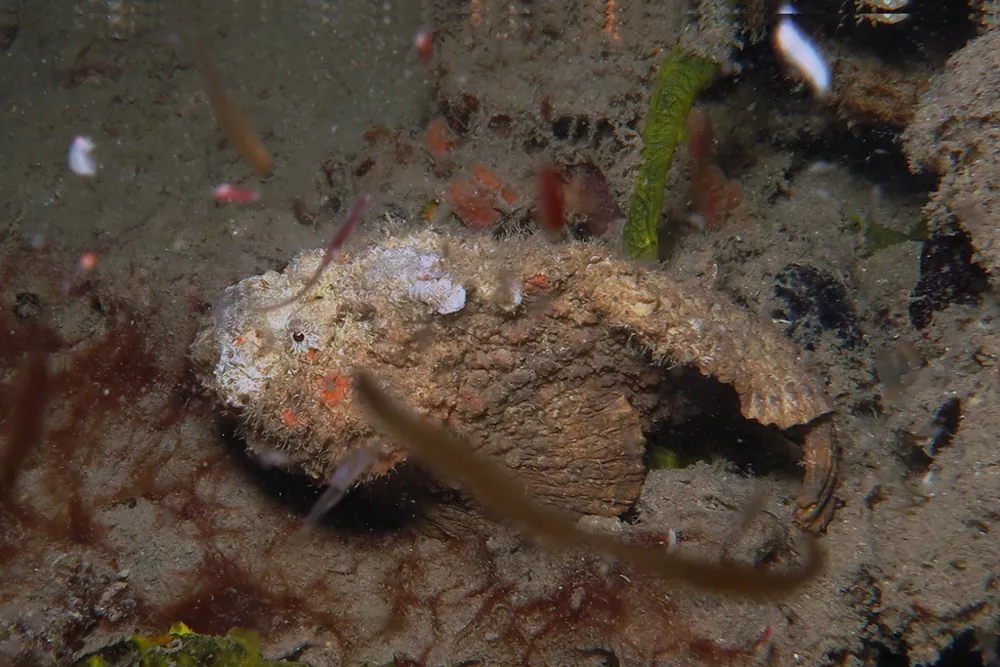
The reef stonefish is a fish that hides on coral reefs and looks like a rock or piece of coral. It is the most venomous fish in the world, and its venom can kill people. It lives in shallow warm seas across the Red Sea, the Indian Ocean and the western Pacific.1



 Comment le reconnaître
- Usually brown or grey, sometimes with patches of yellow, orange or red.1
- Rough, tough skin covered in warts, with no scales.1
- Wide, flattened head with small eyes that point upwards.1
- Back fin with 12 to 14 spines, all of equal length.1
- Its colour and skin texture help it blend in among rocks and corals.1
Puissance du venin
Des épines pointues portent le venin. Marcher dessus ou l'attraper fait mal.
Que fait son venin ?
Its venom is a mixture of proteins. Effects include severe pain, shock, paralysis and tissue death. A large dose can be fatal, and the fatal protein in this species is verrucotoxin. Stonefish venom can be fatal at a dose of only 18 mg, which six of its thirteen spines can release.1
À quel point est-il dangereux pour l'homme ?
Danger pour l'homme: Très dangereuxIl peut tuer une personne qui n'est pas soignée.It is the most venomous fish in the world and its venom can kill humans. A large dose can be fatal, and young children, the elderly and people with weakened immune systems are at greatest risk.1
 Bonne nouvelle : les médecins ont un médicament (antivenin) ou un traitement pour ça.1
Que fait-il quand il a peur ?
It relies on camouflage to stay hidden and, when necessary, on its back spines, each with venom sacs at its base.1
 Si ses épines s'enfoncent dans ta peau
- Immerse the affected limb in hot water, which is thought to help break down the venom proteins. A local anaesthetic can reduce the pain, and medical treatment includes antivenom. A tourniquet or firm constrictive bandage is no longer recommended.1
- Plonge la plaie dans de l'eau chaude, aussi chaude que la personne peut supporter sans se brûler (teste avec ta propre main), pendant 30 à 90 minutes. Va voir un médecin, surtout pour les poissons-pierres et les raies.
Appelle toujours d'abord ton numéro d'urgence (112, 000, 911). Ce sont des conseils généraux de premiers secours, pas un avis médical. Les bases des premiers secours
 Reste en sécurité
- Ne touche, n'attrape et n'embête jamais un animal sauvage, même petit, et même s'il a l'air endormi ou mort.
- Laisse-lui de la place. Si tu en croises un, reste calme, recule doucement et laisse-le passer son chemin.
- Si ses épines s'enfoncent dans ta peau : reste calme, ne bouge pas, appelle ton numéro d'urgence (112, 000, 911) ou va vite à l'hôpital. Souviens-toi de quoi il avait l'air, une photo aide.
Il ne t'en veut pas. Il utilise son venin pour attraper sa nourriture ou se protéger, et il préfère de loin se cacher. Plus d'infos pour rester en sécurité
Où dans le monde ?
Quelle taille fait-il ?
Quelle longueur fait-il ?
 aussi long que 2 bananes mises bout à bout
 aussi long que 12 briques de construction en ligne
 pourrait nager la longueur d'une grande piscine (50 m) en 90 secondes
Quelle taille fait Reef stonefish comparé à TOI ?
Juste des calculs dans ton navigateur. Rien n'est enregistré ni envoyé nulle part.
À quelle vitesse va-t-il ?

Faits
It is the most venomous fish in the world.1
It strikes its prey in as little as 0.015 seconds.1
Its spines are sharp and stiff enough to pierce boot soles.1
Only six of its thirteen spines can release a fatal dose of venom.1
It is sold as an aquarium pet and as meat in some markets in southern China, the Philippines and Japan.1
Démêle le vrai du faux
Idée reçue : Tying a tight tourniquet or bandage above a stonefish sting is the best first aid.
Vérité : This is no longer recommended. Hot water on the affected limb and medical treatment with antivenom are the advised steps.1
Pour les experts en venin
- Nom scientifique
- Synanceia verrucosa
- Groupe
- Poissons venimeux
- Famille
- Synanceiidae2
- Ordre
- Perciformes
- Continents
- Océan Pacifique, Océan Indien, Mer Rouge, Mer d'Andaman, Mer de Chine méridionale, Mer des Philippines, Mer de Corail, Mer d'Arabie et golfe Persique, Mer de Timor et d'Arafura, Golfe du Bengale, Les océans
- Petits
- Females lay large, unfertilised eggs on the reef floor, and a male fertilises them by releasing sperm over the eggs. The young hatch well developed.1
- Danger pour l'homme
- 4 / 5: Très dangereux3
D'où viennent les faits
- Synanceia verrucosa (Wikipedia (CC BY-SA 4.0))
- Synanceia verrucosa (iNaturalist): noms et classification.
- Venom Wiki: le niveau de danger, la taille typique et la vitesse estimée sont les nôtres. Regarde comment on les calcule : Comment on évalue le danger.
Chaque fait sur cette page a un numéro qui renvoie à sa source. Si on s'est trompés, désolés, on est des fans d'animaux, pas une revue scientifique. Dis-le-nous à [email protected] et on corrigera.
 Le scorpion a faim ! Venom Wiki est le projet d'une seule personne : gratuit, sans pub et sans traceurs. Un petit pourboire aide à le garder en ligne.Nourris le scorpion
Plus du même groupe: Poissons venimeux
 Red lionfishPoissons venimeuxNécessite un médecinNe pas toucher
 Estuarine stonefishPoissons venimeuxPeut tuerNe pas toucher
 Short-tail stingrayPoissons venimeuxPeut tuer
 Striped eel catfishPoissons venimeuxPeut tuerNe pas toucher
 Bluespotted ribbontail rayPoissons venimeuxNécessite un médecin
 Common stingrayPoissons venimeuxNécessite un médecin
Vit aussi en: Océan Pacifique
 Australian box jellyfishMéduses et piqueurs marinsMortelNe pas toucher
 Geography coneCônes et pieuvresMortel
 Greater blue-ringed octopusCônes et pieuvresMortel
 Japanese pufferfishAutres animaux vénéneuxMortel
 Southern blue-ringed octopusCônes et pieuvresMortel
 Hawksbill sea turtleAutres animaux vénéneuxPeut tuer