
 Afrique
 Asie
Asie Europe
 Amérique du Sud
 Australie et Océanie
 Antarctique
 Océan Pacifique
 Océan Atlantique
 Océan Indien
 Océan Arctique
 Mer Méditerranée
 Mer Rouge
 Mer des Caraïbes
 Mer de Corail
 Mer de Chine méridionale
 Mer des Philippines
 Mer d'Andaman
 Mer du Nord
 Mer de Timor et d'Arafura
 Golfe du Bengale
 Golfe de Californie
Armadillo wasp
 Piqûres
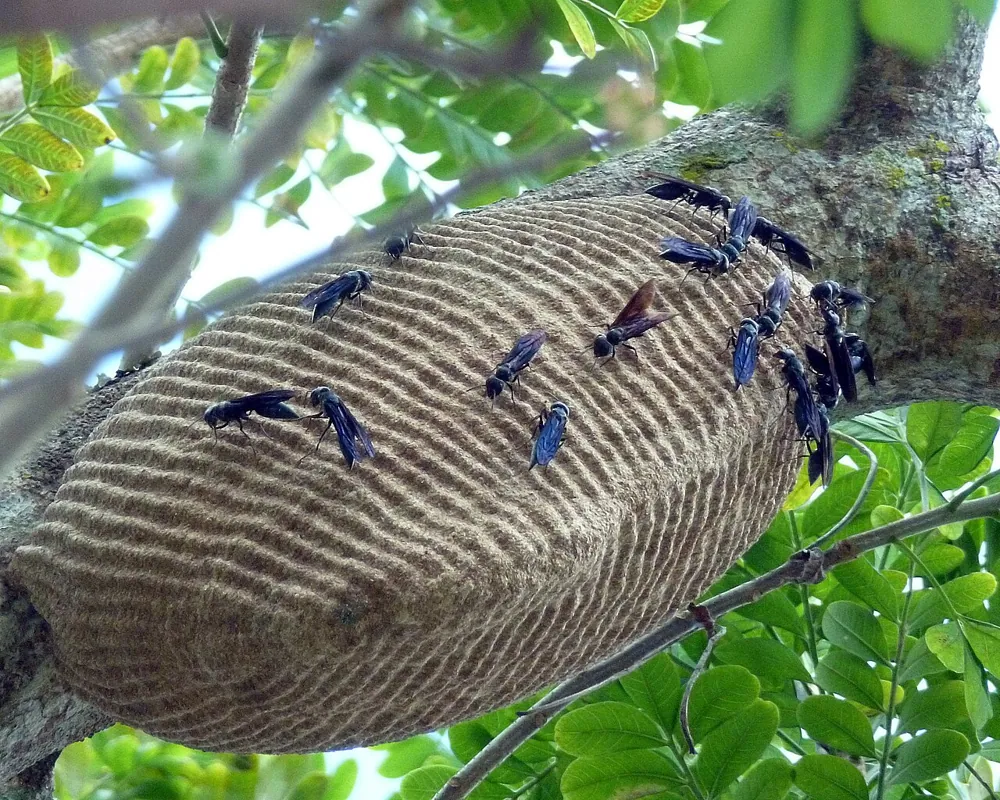
The armadillo wasp is a social wasp with a metallic blue-black body. It builds its nests on tree trunks in tropical South America. It is known for its painful sting, and it also visits flowers and helps pollinate plants.1


 Comment le reconnaître
- Medium-sized wasp with a blueish-black body1
- Body can look metallic in certain light1
- Dark, almost black wings1
- Head has a projecting vertex (a raised ridge on the top of the head)1
- Less dense small markings (punctation) on the first abdominal segment than S. chalibea and S. virginea1
Souvent confondu avec : Other Synoeca wasps, especially its sister species S. cyanea and S. septentrionalis, which also have less punctation on the first abdominal segment. S. chalibea and S. virginea have denser punctation on that segment, so this is one way to tell them apart.1
Puissance du venin
Le venin sort par un dard.
Que fait son venin ?
Its sting injects serotonin, a chemical also known as a neurotransmitter. Serotonin is a vasoconstrictor, meaning it narrows blood vessels, which could potentially be lethal to small animals. In people, it causes severe pain.1
À quel point est-il dangereux pour l'homme ?
Danger pour l'homme: GraveUne piqûre nécessite un médecin. Les décès sont très rares.Its sting is painful. The wasp only stings in defence, not to attack. Stings can leave the wasp's barbed stinger in the skin, and the wasp dies afterwards.1
Que fait-il quand il a peur ?
When a colony is threatened, workers perform buzzing runs, shaking from side to side and contacting other members, which warns the colony to swarm. Individual wasps may also sting, and the stinger stays in the victim.1
 S'il pique
- Gratte le dard d'abeille pour l'enlever et refroidis la zone.
- Si la personne a du mal à respirer, le visage ou la gorge qui gonflent, ou se sent mal, c'est une urgence allergique : appelle ton numéro d'urgence et utilise son stylo d'adrénaline si elle en a un.
Appelle toujours d'abord ton numéro d'urgence (112, 000, 911). Ce sont des conseils généraux de premiers secours, pas un avis médical. Les bases des premiers secours
 Reste en sécurité
- Ne touche, n'attrape et n'embête jamais un animal sauvage, même petit, et même s'il a l'air endormi ou mort.
- Laisse-lui de la place. Si tu en croises un, reste calme, recule doucement et laisse-le passer son chemin.
- S'il te pique : reste calme, ne bouge pas, appelle ton numéro d'urgence (112, 000, 911) ou va vite à l'hôpital. Souviens-toi de quoi il avait l'air, une photo aide.
Il ne t'en veut pas. Il utilise son venin pour attraper sa nourriture ou se protéger, et il préfère de loin se cacher. Plus d'infos pour rester en sécurité
Où dans le monde ?
Quelle taille fait-il ?
Quelle longueur fait-il ?
 à peu près aussi long qu'un trombone
 pourrait traverser tout un terrain de foot en volant en 14 secondes
Quelle taille fait Armadillo wasp comparé à TOI ?
Juste des calculs dans ton navigateur. Rien n'est enregistré ni envoyé nulle part.
À quelle vitesse va-t-il ?


Faits
When the wasp stings, its barbed stinger stays in the victim, and the wasp dies. This is called sting autotomy.1
The sting also releases alarm pheromones, which mark the target as a threat for the colony to deal with if it returns.1
Some older workers, over 21 days old, may eat large larvae and pupae before leaving the nest. This is called brood cannibalism.1
Queens are chosen through ritual dominance displays, in which potential queens face off, sometimes bending their abdomens.1
Colonies swarm together as a group. Scouts lay down scent trails so the other wasps can follow them to a new nest site.1
Scouts release scent from a special gland called the Richards' gland while they drag their body along the trail.1
D'où viennent les faits
- Synoeca surinama (Wikipedia (CC BY-SA 4.0))
- Synoeca surinama (iNaturalist): noms et classification.
- Venom Wiki: le niveau de danger, la taille typique et la vitesse estimée sont les nôtres. Regarde comment on les calcule : Comment on évalue le danger.
Chaque fait sur cette page a un numéro qui renvoie à sa source. Si on s'est trompés, désolés, on est des fans d'animaux, pas une revue scientifique. Dis-le-nous à [email protected] et on corrigera.
 Le scorpion a faim ! Venom Wiki est le projet d'une seule personne : gratuit, sans pub et sans traceurs. Un petit pourboire aide à le garder en ligne.Nourris le scorpion
Plus du même groupe: Abeilles, guêpes et frelons
 Tarantula hawkAbeilles, guêpes et frelonsFait juste mal
 Executioner waspAbeilles, guêpes et frelonsNécessite un médecin
 Warrior waspAbeilles, guêpes et frelonsNécessite un médecin
 Giant tarantula hawkAbeilles, guêpes et frelonsFait juste mal
 Paulista waspAbeilles, guêpes et frelonsFait juste mal
 Red paper waspAbeilles, guêpes et frelonsFait juste mal
 Golden poison frog
 Terciopelo
 Brazilian wandering spider
 Eyelash viper
 Golden lancehead
 South American bushmaster