
 Afrique
 Asie
Asie Europe
 Amérique du Sud
 Australie et Océanie
 Antarctique
 Océan Pacifique
 Océan Atlantique
 Océan Indien
 Océan Arctique
 Mer Méditerranée
 Mer Rouge
 Mer des Caraïbes
 Mer de Corail
 Mer de Chine méridionale
 Mer des Philippines
 Mer d'Andaman
 Mer du Nord
 Mer de Timor et d'Arafura
 Golfe du Bengale
 Golfe de Californie
Golden lancehead
 Morsures
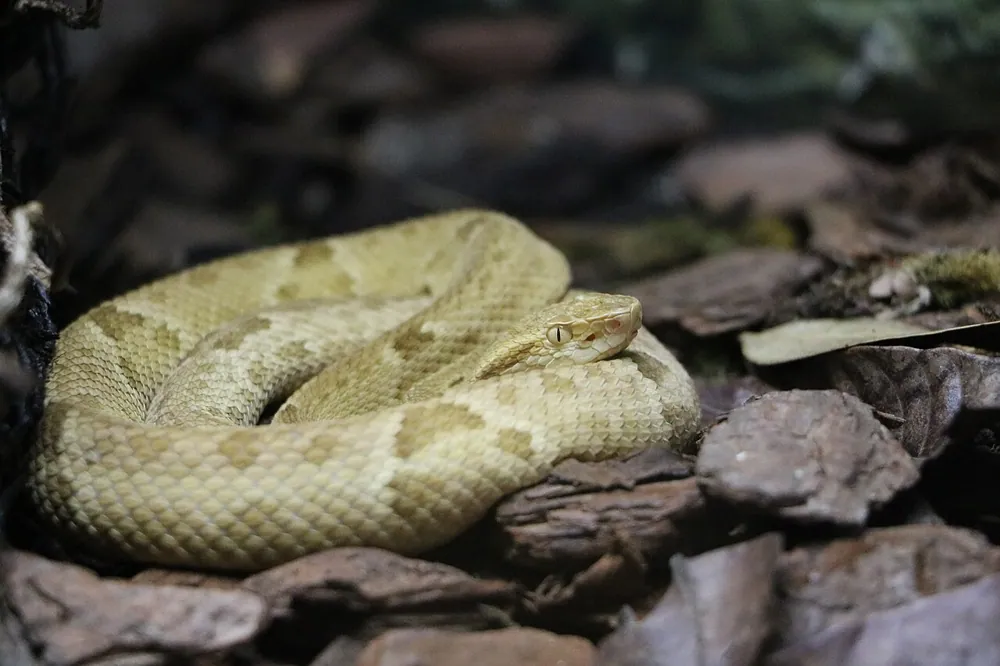
The golden lancehead is an extremely venomous pit viper that lives only on one small Brazilian island, Ilha da Queimada Grande. It is one of the most venomous snakes in Latin America. Because the island is uninhabited and closed to visitors, it is very unlikely that people will ever meet one.1


 Comment le reconnaître
- Pale yellowish-brown body with a series of dorsal blotches that may be triangular or square.1
- Belly is a uniform pale yellow or cream.1
- Lance-shaped head that comes to a point at the nose.1
- No well-defined stripe running behind the eye.1
- Has a longer tail than its closest relative, B. jararaca.1
Souvent confondu avec : Its closest relative is B. jararaca, which lives in southern Brazil, Paraguay and northern Argentina. The golden lancehead can be told apart from it mainly by its longer tail.1
Puissance du venin
Le venin sort par ses crochets ou ses dents quand il mord.
Que fait son venin ?
Its venom is adapted to the animals of the island, mainly reptiles, arthropods and migrating birds, so it works better on these than on mammals. Chemical analysis suggests it is five times as potent as the venom of B. jararaca and is the fastest-acting venom in the genus Bothrops. Its venom becomes more potent as the snake matures. Effects reported in envenomations include swelling, pain, nausea, vomiting, blood blisters, bruising, bleeding into the gut and brain, kidney failure and severe muscle damage.1
À quel point est-il dangereux pour l'homme ?
Danger pour l'homme: Très dangereuxIl peut tuer une personne qui n'est pas soignée.No official report of a human bite from this species has been made, because the island is uninhabited. Other lanceheads cause more human deaths than any other group of snakes in North or South America. One researcher reports four human envenomations by this species, three of which were fatal. For lanceheads in general, the mortality rate is 0.5 to 3.0% with treatment and 7.0% without it.1
 S'il mord
- Garde la personne immobile et calme, le membre mordu à hauteur du cœur, enlève bagues et objets serrés, et va vite à l'hôpital.
Appelle toujours d'abord ton numéro d'urgence (112, 000, 911). Ce sont des conseils généraux de premiers secours, pas un avis médical. Les bases des premiers secours
 Reste en sécurité
- Ne touche, n'attrape et n'embête jamais un animal sauvage, même petit, et même s'il a l'air endormi ou mort.
- Laisse-lui de la place. Si tu en croises un, reste calme, recule doucement et laisse-le passer son chemin.
- S'il te mord : reste calme, ne bouge pas, appelle ton numéro d'urgence (112, 000, 911) ou va vite à l'hôpital. Souviens-toi de quoi il avait l'air, une photo aide.
Il ne t'en veut pas. Il utilise son venin pour attraper sa nourriture ou se protéger, et il préfère de loin se cacher. Plus d'infos pour rester en sécurité
Où dans le monde ?
Quelle taille fait-il ?
Quelle longueur fait-il ?
 aussi long que 2,5 chats domestiques du museau à la queue
 aussi long que 7 bananes mises bout à bout
 pourrait parcourir 100 mètres en 100 secondes (l'humain le plus rapide met 9,6)
Quelle taille fait Golden lancehead comparé à TOI ?
Juste des calculs dans ton navigateur. Rien n'est enregistré ni envoyé nulle part.
À quelle vitesse va-t-il ?


Faits
Its venom is thought to be five times as potent as that of its closest relative, B. jararaca.1
Its venom has evolved to suit the animals of its island, which has no native mammals.1
Its tail is longer than that of its closest relative, which may help it climb through trees and catch larger birds from a younger age.1
The island's population was estimated at between 2,414 and 2,899 snakes in 2021.1
Travel to the island is strictly prohibited by the Brazilian government.1
It is found only on Ilha da Queimada Grande, an island of about 43 hectares, and nowhere else in the wild.1
Pour les experts en venin
- Nom scientifique
- Bothrops insularis
- Groupe
- Vipères à fossettes
- Famille
- Viperidae2
- Ordre
- Squamata
- Continents
- Amérique du Sud
- Petits
- Like most vipers, it gives birth to live young. The average number of young per pregnancy is 6.5.1
- Comment il se porte dans la nature
- Critically Endangered (IUCN Red List)1
- Danger pour l'homme
- 4 / 5: Très dangereux3
D'où viennent les faits
- Golden lancehead (Wikipedia (CC BY-SA 4.0))
- Bothrops insularis (iNaturalist): noms et classification.
- Venom Wiki: le niveau de danger, la taille typique et la vitesse estimée sont les nôtres. Regarde comment on les calcule : Comment on évalue le danger.
Chaque fait sur cette page a un numéro qui renvoie à sa source. Si on s'est trompés, désolés, on est des fans d'animaux, pas une revue scientifique. Dis-le-nous à [email protected] et on corrigera.
 Le scorpion a faim ! Venom Wiki est le projet d'une seule personne : gratuit, sans pub et sans traceurs. Un petit pourboire aide à le garder en ligne.Nourris le scorpion
Plus du même groupe: Vipères à fossettes
 Terciopelo
 Eyelash viper
 South American bushmaster
 Common lancehead
 Jararaca
 Jararacussu
Vit aussi en: Amérique du Sud
 Golden poison frogGrenouilles toxiques, crapauds et tritonsMortelNe pas toucher
 Brazilian wandering spiderAraignéesPeut tuer
 Cane toadGrenouilles toxiques, crapauds et tritonsNécessite un médecinNe pas toucher
 Peruvian giant centipedeScolopendresNécessite un médecin
 Bullet antFourmisFait juste mal
 Common vampire batMammifères venimeuxFait juste mal