
 Afrique
 Asie
Asie Europe
 Amérique du Sud
 Australie et Océanie
 Antarctique
 Océan Pacifique
 Océan Atlantique
 Océan Indien
 Océan Arctique
 Mer Méditerranée
 Mer Rouge
 Mer des Caraïbes
 Mer de Corail
 Mer de Chine méridionale
 Mer des Philippines
 Mer d'Andaman
 Mer du Nord
 Mer de Timor et d'Arafura
 Golfe du Bengale
 Golfe de Californie
Baron's mantella
 Poison dans la peau
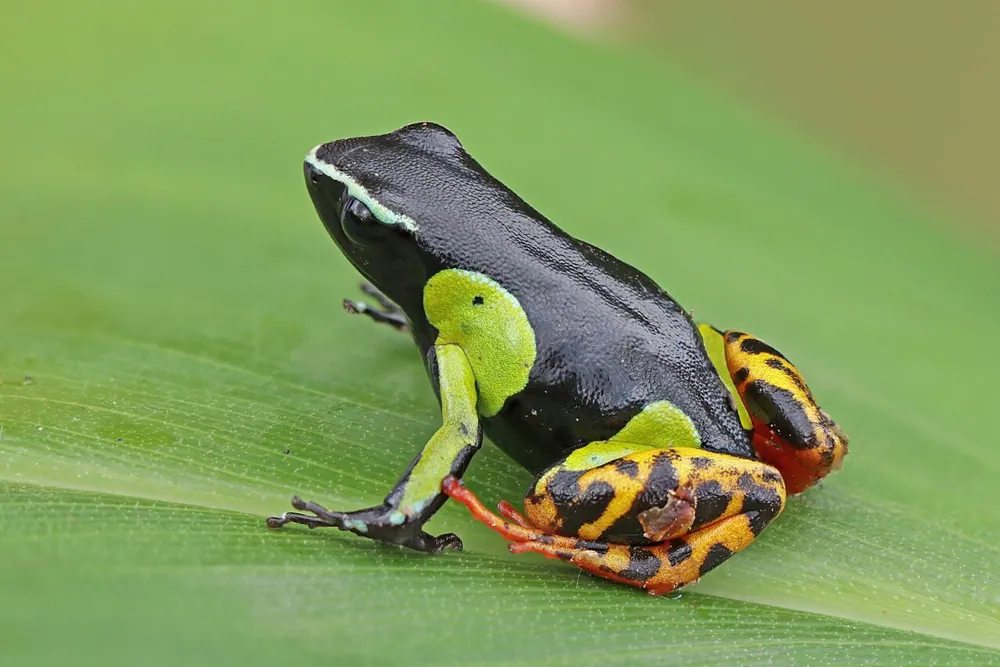
Baron's mantella is a small, brightly coloured frog that lives only on the island of Madagascar. Its skin contains toxic chemicals that make it harmful to predators, and its bright colours warn them to stay away.1



 Comment le reconnaître
- Has a light line above the eyes, called a rostral line.1
- Hind limbs are orange with irregular black stripes, giving a tiger-like pattern.1
- Front limbs range from light green to bright orange or yellow, with a large rounded flank blotch.1
- Adults are 2.4 to 3.2 cm long, and females are slightly larger than males.1
- Males call during the day, and it is an active hunter in daylight.1
Souvent confondu avec : It is often confused with the painted mantella (Mantella madagascariensis), which has a similar look. The painted mantella has a sky-blue, horseshoe-shaped marking on its throat. Baron's mantella does not have the flashmarks on its lower hind limbs.1
Puissance du poison
Sa peau est toxique. Il est dangereux de le toucher, de le lécher ou de le manger.
Que fait son poison ?
It does not inject venom. Its skin contains alkaloids, which are toxic chemicals it gets from eating mites. These make it harmful to predators that eat it, and they can cause sickness. The strength of the toxin varies over time and by location, and frogs in remote populations may be more potent.1
À quel point est-il dangereux pour l'homme ?
Danger pour l'homme: LégerComme une piqûre d'abeille ou moins. Pratiquement inoffensif pour l'homme.Its toxicity can vary, and careless handling is discouraged.1
Que fait-il quand il a peur ?
Its bright colours warn predators that eating it could be dangerous and cause sickness.1
 Si quelqu'un l'a touché ou mangé
- Si quelqu'un en a touché un : lave-toi bien les mains et ne touche pas tes yeux ni ta bouche. Si un enfant ou un animal en a léché ou mangé un : appelle le centre antipoison ou ton numéro d'urgence.
Appelle toujours d'abord ton numéro d'urgence (112, 000, 911). Ce sont des conseils généraux de premiers secours, pas un avis médical. Les bases des premiers secours
 Reste en sécurité
- Ne touche, n'attrape et n'embête jamais un animal sauvage, même petit, et même s'il a l'air endormi ou mort.
- Laisse-lui de la place. Si tu en croises un, reste calme, recule doucement et laisse-le passer son chemin.
- Si tu l'as touché ou mangé : ne frotte pas tes yeux ni ta bouche, lave-toi les mains et va voir un médecin.
Il ne t'en veut pas. Son poison ne sert qu'à ce que personne ne le mange. Plus d'infos pour rester en sécurité
Où dans le monde ?
Quelle taille fait-il ?
Quelle longueur fait-il ?
 à peu près aussi long qu'un trombone
 pourrait parcourir 100 mètres en 100 secondes (l'humain le plus rapide met 9,6)
Quelle taille fait Baron's mantella comparé à TOI ?
Juste des calculs dans ton navigateur. Rien n'est enregistré ni envoyé nulle part.
À quelle vitesse va-t-il ?


Faits
Its toxicity comes from the mites it eats, so its poison depends on its diet.1
Mantella frogs look like poison dart frogs from Latin America, but they are only distant relatives. The likeness is an example of convergent evolution.1
Unlike most frogs, which are active at night, it hunts during the day.1
Its bright colours and its toxins are a warning system, a pattern called aposematism.1
Its family arrived on Madagascar an estimated 76 to 87 million years ago.1
It is one of the largest species in the Mantella genus, with only some Mantella viridis individuals reaching a similar size.1
Démêle le vrai du faux
Idée reçue : Baron's mantella is the same as the painted mantella, and is sometimes called a painted mantella.
Vérité : The two are distinct species. They look alike, but the painted mantella has a sky-blue throat marking that Baron's mantella lacks.1
Pour les experts en venin
- Nom scientifique
- Mantella baroni
- Groupe
- Grenouilles toxiques, crapauds et tritons
- Famille
- Mantellidae2
- Ordre
- Anura
- Continents
- Afrique
- Petits
- Females can lay up to 130 eggs in a single clutch, usually near water. Rain washes the tadpoles into the water.1
- Comment il se porte dans la nature
- Least Concern (IUCN, 2016). It appears in CITES Appendix II.1
- Danger pour l'homme
- 1 / 5: Léger3
D'où viennent les faits
- Mantella baroni (Wikipedia (CC BY-SA 4.0))
- Mantella baroni (iNaturalist): noms et classification.
- Venom Wiki: le niveau de danger, la taille typique et la vitesse estimée sont les nôtres. Regarde comment on les calcule : Comment on évalue le danger.
Chaque fait sur cette page a un numéro qui renvoie à sa source. Si on s'est trompés, désolés, on est des fans d'animaux, pas une revue scientifique. Dis-le-nous à [email protected] et on corrigera.
 Le scorpion a faim ! Venom Wiki est le projet d'une seule personne : gratuit, sans pub et sans traceurs. Un petit pourboire aide à le garder en ligne.Nourris le scorpion
Plus du même groupe: Grenouilles toxiques, crapauds et tritons
 Golden mantellaGrenouilles toxiques, crapauds et tritonsInoffensif
 Iberian ribbed newtGrenouilles toxiques, crapauds et tritonsInoffensif
 Tomato frogGrenouilles toxiques, crapauds et tritonsInoffensif
 African common toadGrenouilles toxiques, crapauds et tritonsFait juste malNe pas toucher
 Blue-legged mantellaGrenouilles toxiques, crapauds et tritonsInoffensif
 Climbing mantellaGrenouilles toxiques, crapauds et tritonsInoffensif
 Mamba noir
 Scorpion jaune de Palestine
 Cobra égyptien
 Vipère heurtante
 Boomslang
 Fat-tailed scorpion
_Ranomafana.jpg)