
 Afrique
 Asie
Asie Europe
 Amérique du Sud
 Australie et Océanie
 Antarctique
 Océan Pacifique
 Océan Atlantique
 Océan Indien
 Océan Arctique
 Mer Méditerranée
 Mer Rouge
 Mer des Caraïbes
 Mer de Corail
 Mer de Chine méridionale
 Mer des Philippines
 Mer d'Andaman
 Mer du Nord
 Mer de Timor et d'Arafura
 Golfe du Bengale
 Golfe de Californie
Climbing mantella
 Poison dans la peau
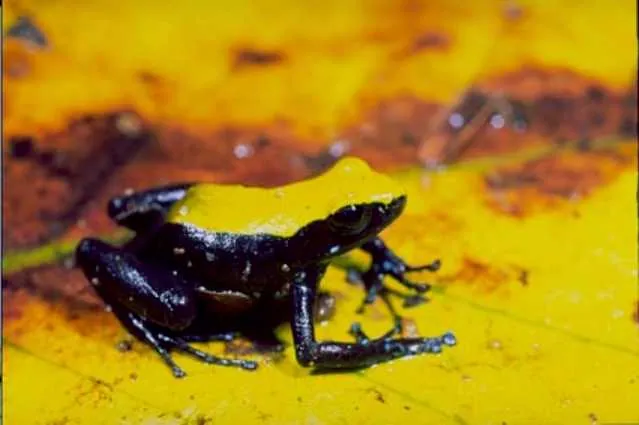
The climbing mantella is a small, brightly coloured frog that lives in the lowland rainforests of northeast Madagascar. It is a poison frog, so its skin holds chemicals that can harm predators. It is special because it is one of the few frogs whose parents care for their tadpoles by feeding them eggs.1



 Comment le reconnaître
- Adults are 24–30 mm long and weigh 1.2–2.0 g1
- Front of the back is bright yellow or pale green1
- Arms, legs, belly and rear are black, with blue spots on the limbs1
- Eyes are completely black1
- Has discs at the tips of its fingers and toes, and the toes are webbed1
Souvent confondu avec : M. betsileo, M. viridis and M. expectata look similar but are differently coloured. They often have blue spots on the throat rather than the limbs, and they have a faint line along the upper lip, which the climbing mantella lacks.1
Puissance du poison
Sa peau est toxique. Il est dangereux de le toucher, de le lécher ou de le manger.
Que fait son poison ?
This frog is poisonous rather than venomous. Its skin glands contain lipophilic alkaloids, the chemicals that make up its poison, which it gets from the arthropods it eats. Researchers have found 41 different potent alkaloids in its skin. Captive frogs lose their toxicity over time.1
À quel point est-il dangereux pour l'homme ?
Danger pour l'homme: LégerComme une piqûre d'abeille ou moins. Pratiquement inoffensif pour l'homme.Que fait-il quand il a peur ?
Its bright colours warn predators that its skin is toxic.1
 Si quelqu'un l'a touché ou mangé
- Si quelqu'un en a touché un : lave-toi bien les mains et ne touche pas tes yeux ni ta bouche. Si un enfant ou un animal en a léché ou mangé un : appelle le centre antipoison ou ton numéro d'urgence.
Appelle toujours d'abord ton numéro d'urgence (112, 000, 911). Ce sont des conseils généraux de premiers secours, pas un avis médical. Les bases des premiers secours
 Reste en sécurité
- Ne touche, n'attrape et n'embête jamais un animal sauvage, même petit, et même s'il a l'air endormi ou mort.
- Laisse-lui de la place. Si tu en croises un, reste calme, recule doucement et laisse-le passer son chemin.
- Si tu l'as touché ou mangé : ne frotte pas tes yeux ni ta bouche, lave-toi les mains et va voir un médecin.
Il ne t'en veut pas. Son poison ne sert qu'à ce que personne ne le mange. Plus d'infos pour rester en sécurité
Où dans le monde ?
Quelle taille fait-il ?
Quelle longueur fait-il ?
Combien pèse-t-il ?
 à peu près aussi long qu'un trombone
 si léger que tu ne le sentirais pas sur ta main
 pourrait parcourir 100 mètres en 100 secondes (l'humain le plus rapide met 9,6)
Quelle taille fait Climbing mantella comparé à TOI ?
Juste des calculs dans ton navigateur. Rien n'est enregistré ni envoyé nulle part.
À quelle vitesse va-t-il ?


Faits
Its tadpoles eat only the eggs of their own species, and the parents feed them unfertilized eggs.1
Males defend territories of about 2 square metres and fight by wrestling, chasing and leaping, sometimes for over 1.5 hours.1
Female frogs choose a mate based on the quality of the male's well, not on his call.1
The climbing mantella is the only member of the Mantella genus that breeds in water-filled wells in trees, tree holes or broken bamboo stalks.1
Its chemical defence has developed in a similar way to that of the dart frogs of Dendrobatidae, although the two families are only distantly related.1
Pour les experts en venin
- Nom scientifique
- Mantella laevigata
- Groupe
- Grenouilles toxiques, crapauds et tritons
- Famille
- Mantellidae2
- Ordre
- Anura
- Continents
- Afrique
- Petits
- Usually lays only one large egg, 3–3.5 mm across, at the side of a water-filled well or above the water line. The parents feed tadpoles unfertilized eggs.1
- Comment il se porte dans la nature
- Least Concern (IUCN Red List, 2016), though its population is suspected to be decreasing1
- Danger pour l'homme
- 1 / 5: Léger3
D'où viennent les faits
- Climbing mantella (Wikipedia (CC BY-SA 4.0))
- Mantella laevigata (iNaturalist): noms et classification.
- Venom Wiki: le niveau de danger, la taille typique et la vitesse estimée sont les nôtres. Regarde comment on les calcule : Comment on évalue le danger.
Chaque fait sur cette page a un numéro qui renvoie à sa source. Si on s'est trompés, désolés, on est des fans d'animaux, pas une revue scientifique. Dis-le-nous à [email protected] et on corrigera.
 Le scorpion a faim ! Venom Wiki est le projet d'une seule personne : gratuit, sans pub et sans traceurs. Un petit pourboire aide à le garder en ligne.Nourris le scorpion
Plus du même groupe: Grenouilles toxiques, crapauds et tritons
 Golden mantellaGrenouilles toxiques, crapauds et tritonsInoffensif
 Iberian ribbed newtGrenouilles toxiques, crapauds et tritonsInoffensif
 Tomato frogGrenouilles toxiques, crapauds et tritonsInoffensif
 African common toadGrenouilles toxiques, crapauds et tritonsFait juste malNe pas toucher
 Baron's mantellaGrenouilles toxiques, crapauds et tritonsInoffensif
 Blue-legged mantellaGrenouilles toxiques, crapauds et tritonsInoffensif
 Mamba noir
 Scorpion jaune de Palestine
 Cobra égyptien
 Vipère heurtante
 Boomslang
 Fat-tailed scorpion