
 Afrique
 Asie
Asie Europe
 Amérique du Sud
 Australie et Océanie
 Antarctique
 Océan Pacifique
 Océan Atlantique
 Océan Indien
 Océan Arctique
 Mer Méditerranée
 Mer Rouge
 Mer des Caraïbes
 Mer de Corail
 Mer de Chine méridionale
 Mer des Philippines
 Mer d'Andaman
 Mer du Nord
 Mer de Timor et d'Arafura
 Golfe du Bengale
 Golfe de Californie
Bat ray
 Piqûres
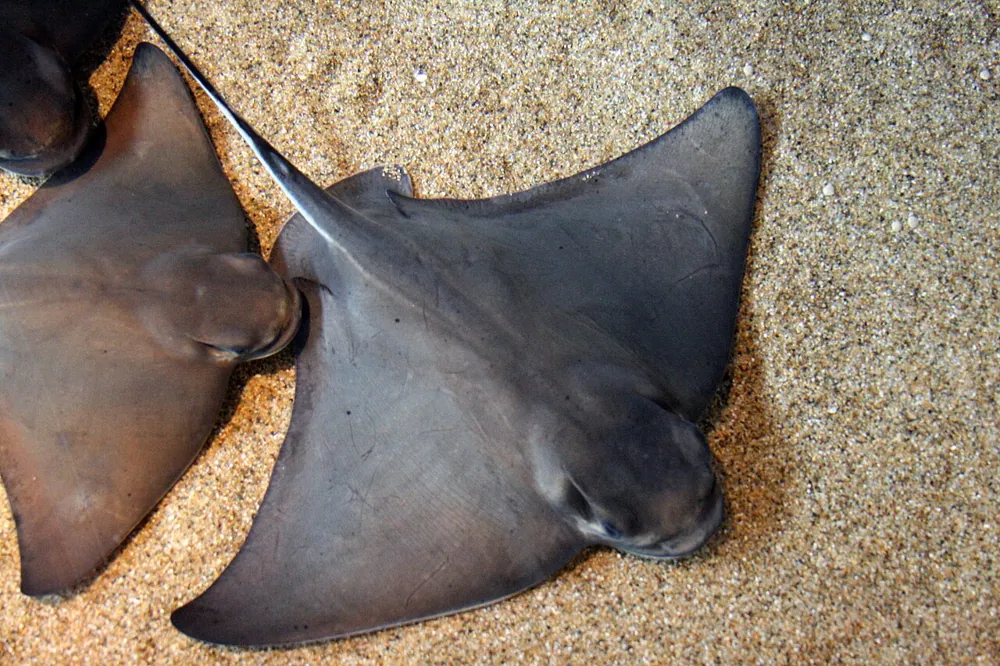
The bat ray is a flat, diamond-shaped fish related to sharks, with wing-like fins that it flaps to swim. It lives in shallow coastal waters from central Oregon in the USA down to the Gulf of California in Mexico, and around the Galápagos Islands. It has a venomous spine near the base of its tail, but it uses it only when it feels threatened.1
 Comment le reconnaître
- Diamond-shaped body, with wing-like pectoral fins that end in blunt points1
- Broad head raised higher than the fins, with eyes set on the sides of the head1
- Dark back, black or dark brown, with a white underside1
- Whip-like tail with at least one venomous spine at its base1
- Usually two small cephalic horns (projections from the front of the head) used for pushing food into the mouth1
Puissance du venin
Le venin sort par un dard.
À quel point est-il dangereux pour l'homme ?
Danger pour l'homme: DouloureuxÇa peut faire très mal, mais ce n'est presque jamais grave.The bat ray is not considered dangerous to people. It uses its venomous tail spine only when it is attacked or frightened.1
Que fait-il quand il a peur ?
The bat ray camouflages itself in the sand and uses its tail spine only when attacked or frightened.1
 S'il pique
- Plonge la plaie dans de l'eau chaude, aussi chaude que la personne peut supporter sans se brûler (teste avec ta propre main), pendant 30 à 90 minutes. Va voir un médecin, surtout pour les poissons-pierres et les raies.
Appelle toujours d'abord ton numéro d'urgence (112, 000, 911). Ce sont des conseils généraux de premiers secours, pas un avis médical. Les bases des premiers secours
 Reste en sécurité
- Ne touche, n'attrape et n'embête jamais un animal sauvage, même petit, et même s'il a l'air endormi ou mort.
- Laisse-lui de la place. Si tu en croises un, reste calme, recule doucement et laisse-le passer son chemin.
- S'il te pique : reste calme, ne bouge pas, appelle ton numéro d'urgence (112, 000, 911) ou va vite à l'hôpital. Souviens-toi de quoi il avait l'air, une photo aide.
Il ne t'en veut pas. Il utilise son venin pour attraper sa nourriture ou se protéger, et il préfère de loin se cacher. Plus d'infos pour rester en sécurité
Où dans le monde ?
Quelle taille fait-il ?
Quelle longueur fait-il ?
Combien pèse-t-il ?

 aussi long que 4 chats domestiques du museau à la queue
 aussi long que 10 bananes mises bout à bout
 pourrait nager la longueur d'une grande piscine (50 m) en 8,2 secondes
Quelle taille fait Bat ray comparé à TOI ?
Juste des calculs dans ton navigateur. Rien n'est enregistré ni envoyé nulle part.
À quelle vitesse va-t-il ?


Faits
Bat rays dig pits in the seabed that can be up to 4 m long, and small fish gather to eat the creatures the rays expose.1
The bat ray's young are born with the spine's sheath, which falls off within hours of birth.1
Bat rays can grow to a wingspan of 1.8 m, and the largest individuals weigh about 91 kg.1
Some bat rays live alone, while others form schools of thousands.1
Bat rays have teeth that are replaced continuously, as is the case with all elasmobranchs (sharks, rays and their relatives).1
Démêle le vrai du faux
Idée reçue : Bat rays are dangerous to people because of their venomous spine.
Vérité : Bat rays are not considered dangerous. They use the spine only when attacked or frightened, and people can avoid it by shuffling their feet when walking through shallow sand.1
Pour les experts en venin
- Nom scientifique
- Myliobatis californica
- Groupe
- Poissons venimeux
- Famille
- Myliobatidae2
- Ordre
- Myliobatiformes
- Continents
- Océan Pacifique, Golfe de Californie, Les océans
- Petits
- Bat rays are ovoviviparous, so the eggs hatch inside the mother and the young are born live. A litter has two to ten pups, which are born tail first with their fins wrapped around their bodies.1
- Durée de vie
- environ 23 ans1
- Comment il se porte dans la nature
- Least Concern1
- Danger pour l'homme
- 2 / 5: Douloureux3
D'où viennent les faits
- Bat ray (Wikipedia (CC BY-SA 4.0))
- Myliobatis californica (iNaturalist): noms et classification.
- Venom Wiki: le niveau de danger, la taille typique et la vitesse estimée sont les nôtres. Regarde comment on les calcule : Comment on évalue le danger.
Chaque fait sur cette page a un numéro qui renvoie à sa source. Si on s'est trompés, désolés, on est des fans d'animaux, pas une revue scientifique. Dis-le-nous à [email protected] et on corrigera.
 Le scorpion a faim ! Venom Wiki est le projet d'une seule personne : gratuit, sans pub et sans traceurs. Un petit pourboire aide à le garder en ligne.Nourris le scorpion
Plus du même groupe: Poissons venimeux
 Reef stonefishPoissons venimeuxPeut tuerNe pas toucher
 Red lionfishPoissons venimeuxNécessite un médecinNe pas toucher
 Estuarine stonefishPoissons venimeuxPeut tuerNe pas toucher
 Short-tail stingrayPoissons venimeuxPeut tuer
 Striped eel catfishPoissons venimeuxPeut tuerNe pas toucher
 Bluespotted ribbontail rayPoissons venimeuxNécessite un médecin
Vit aussi en: Océan Pacifique
 Australian box jellyfishMéduses et piqueurs marinsMortelNe pas toucher
 Geography coneCônes et pieuvresMortel
 Greater blue-ringed octopusCônes et pieuvresMortel
 Japanese pufferfishAutres animaux vénéneuxMortel
 Southern blue-ringed octopusCônes et pieuvresMortel
 Hawksbill sea turtleAutres animaux vénéneuxPeut tuer