
 Afrique
 Asie
Asie Europe
 Amérique du Sud
 Australie et Océanie
 Antarctique
 Océan Pacifique
 Océan Atlantique
 Océan Indien
 Océan Arctique
 Mer Méditerranée
 Mer Rouge
 Mer des Caraïbes
 Mer de Corail
 Mer de Chine méridionale
 Mer des Philippines
 Mer d'Andaman
 Mer du Nord
 Mer de Timor et d'Arafura
 Golfe du Bengale
 Golfe de Californie
Cinnabar moth
 Toxique à manger
The cinnabar moth is a brightly coloured day-flying moth with red and black wings. It is native to Europe and parts of Asia, and it has been introduced to New Zealand, Australia and North America. Its bright colours warn predators that it is poisonous.1


 Comment le reconnaître
- Predominantly black wings with red patches1
- Adults are about 2 cm long, with a wingspan of 3.4 to 4.6 cm1
- Often seen flying in daylight, though it is also active at night1
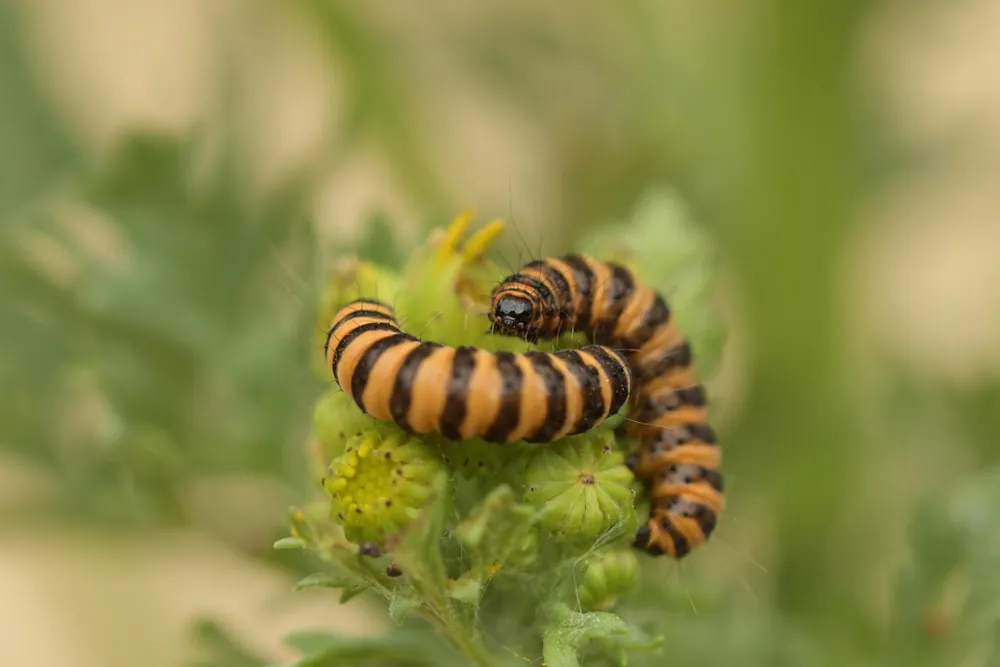
- Young caterpillars are pale yellow; later caterpillars are jet-black with orange or yellow stripes1
- Rarely, the red can be yellow, the forewing can be all red with a black border, or the wings can be completely black1
Puissance du poison
Il n'est dangereux que si quelque chose le mange.
À quel point est-il dangereux pour l'homme ?
Danger pour l'homme: LégerComme une piqûre d'abeille ou moins. Pratiquement inoffensif pour l'homme.Que fait-il quand il a peur ?
Its bright red and black colours warn predators that it is unpalatable, and predators seldom eat it.1
 Si quelqu'un l'a touché ou mangé
- Si quelqu'un l'a mangé ou a des symptômes après en avoir mangé : appelle tout de suite ton numéro d'urgence ou le centre antipoison.
Appelle toujours d'abord ton numéro d'urgence (112, 000, 911). Ce sont des conseils généraux de premiers secours, pas un avis médical. Les bases des premiers secours
 Reste en sécurité
- Ne touche, n'attrape et n'embête jamais un animal sauvage, même petit, et même s'il a l'air endormi ou mort.
- Laisse-lui de la place. Si tu en croises un, reste calme, recule doucement et laisse-le passer son chemin.
- Si tu l'as touché ou mangé : ne frotte pas tes yeux ni ta bouche, lave-toi les mains et va voir un médecin.
Il ne t'en veut pas. Son poison ne sert qu'à ce que personne ne le mange. Plus d'infos pour rester en sécurité
Où dans le monde ?
Quelle taille fait-il ?
Quelle longueur fait-il ?
 à peu près aussi long qu'un trombone
 pourrait traverser tout un terrain de foot en volant en 42 secondes
Quelle taille fait Cinnabar moth comparé à TOI ?
Juste des calculs dans ton navigateur. Rien n'est enregistré ni envoyé nulle part.
À quelle vitesse va-t-il ?


Faits
The caterpillars can turn cannibalistic, mainly when food is short, and will eat other cinnabar caterpillars.1
Cuckoos are an exception to the moth's protection, as some species eat its hairy, poisonous caterpillars.1
The moth was used as a biocontrol agent against ragwort, working alongside the Tansy ragwort flea beetle in the western United States.1
Very few caterpillars usually survive to the pupal stage, because they can eat their food plant bare before they mature.1
Evidence suggests the Brown long-eared bat preys on this moth.1
The caterpillars overwinter as cocoons on the ground.1
D'où viennent les faits
- Cinnabar moth (Wikipedia (CC BY-SA 4.0))
- Tyria jacobaeae (iNaturalist): noms et classification.
- Venom Wiki: le niveau de danger, la taille typique et la vitesse estimée sont les nôtres. Regarde comment on les calcule : Comment on évalue le danger.
Chaque fait sur cette page a un numéro qui renvoie à sa source. Si on s'est trompés, désolés, on est des fans d'animaux, pas une revue scientifique. Dis-le-nous à [email protected] et on corrigera.
 Le scorpion a faim ! Venom Wiki est le projet d'une seule personne : gratuit, sans pub et sans traceurs. Un petit pourboire aide à le garder en ligne.Nourris le scorpion
Plus du même groupe: Autres animaux vénéneux
 Spanish flyAutres animaux vénéneuxNécessite un médecinNe pas toucher
 Green spotted pufferAutres animaux vénéneuxNécessite un médecin
 Common quailAutres animaux vénéneuxFait juste mal
 Black oil beetleAutres animaux vénéneuxFait juste malNe pas toucher
 Red-striped oil beetleAutres animaux vénéneuxFait juste malNe pas toucher
 Six-spot burnetAutres animaux vénéneuxInoffensif
Vit aussi en: Europe
 Common European adderVipèresNécessite un médecin
 Common waspAbeilles, guêpes et frelonsFait juste mal
 European hornetAbeilles, guêpes et frelonsFait juste mal
 Fire salamanderGrenouilles toxiques, crapauds et tritonsFait juste malNe pas toucher
 Western honey beeAbeilles, guêpes et frelonsFait juste mal
 Blunt-nosed viperVipèresPeut tuer