
 Afrique
 Asie
Asie Europe
 Amérique du Sud
 Australie et Océanie
 Antarctique
 Océan Pacifique
 Océan Atlantique
 Océan Indien
 Océan Arctique
 Mer Méditerranée
 Mer Rouge
 Mer des Caraïbes
 Mer de Corail
 Mer de Chine méridionale
 Mer des Philippines
 Mer d'Andaman
 Mer du Nord
 Mer de Timor et d'Arafura
 Golfe du Bengale
 Golfe de Californie
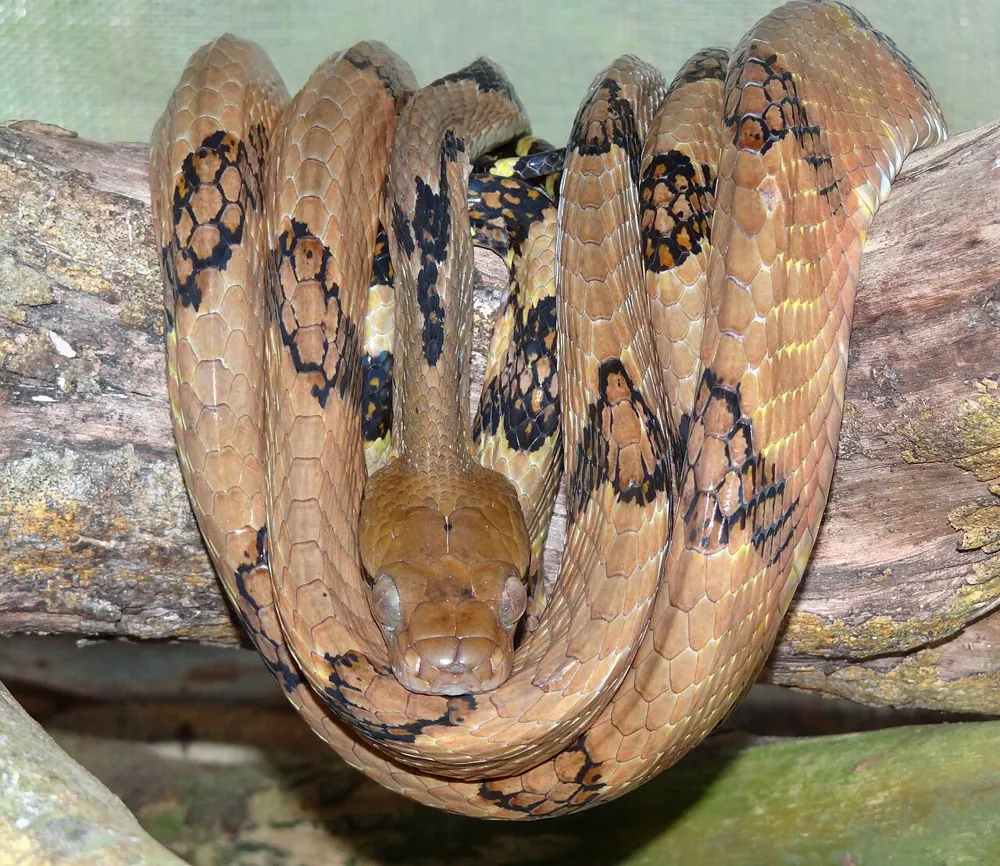
Dog-toothed cat snake
 Morsures
The dog-toothed cat snake is a large, nocturnal snake that is active at night. It lives across Southeast Asia, from southern Thailand to the Philippines and Indonesia, and it is often found in gardens, plantations and towns as well as forests. It is a rear-fanged snake, so its venom is delivered through teeth at the back of its mouth.1


 Comment le reconnaître
- A slender, large snake that can reach more than 2 m in total length1
- Yellowish or pale reddish-brown back with dark brown or black crossbars or spots1
- A wavy or irregular dark stripe behind each eye, with a dark streak on each side of the head1
- Yellowish belly, sometimes plain or marbled with brown1
- Strongly enlarged front teeth in the upper and lower jaws. Indonesian populations include black individuals.1
Souvent confondu avec : Other similar snakes have a more even or nearly even upper and lower line behind the eye, while this species has a distinctly wavy or irregular one. The closely related Boiga hoeseli is found in the Lesser Sundas east of Bali, including Sumbawa and Flores, and not where this species lives.1
Puissance du venin
Le venin sort par ses crochets ou ses dents quand il mord.
Que fait son venin ?
It may have a potent neurotoxic venom, which attacks the nerves. Its effects have been shown to be reversible with neostigmine, a drug that affects nerve signalling, so envenoming from this species can be treated with anticholinesterase therapy.1
À quel point est-il dangereux pour l'homme ?
Danger pour l'homme: DouloureuxÇa peut faire très mal, mais ce n'est presque jamais grave.Its venom may be potent, so any bite should be taken seriously. The effects of the venom have been shown to be reversible with treatment.1
 S'il mord
- Envenoming from this species is said to be treatable with anticholinesterase therapy, which is a medical treatment.1
- Lave la morsure, garde la personne calme et va voir un médecin. Certaines espèces (comme le boomslang) peuvent être mortelles des heures plus tard.
Appelle toujours d'abord ton numéro d'urgence (112, 000, 911). Ce sont des conseils généraux de premiers secours, pas un avis médical. Les bases des premiers secours
 Reste en sécurité
- Ne touche, n'attrape et n'embête jamais un animal sauvage, même petit, et même s'il a l'air endormi ou mort.
- Laisse-lui de la place. Si tu en croises un, reste calme, recule doucement et laisse-le passer son chemin.
- S'il te mord : reste calme, ne bouge pas, appelle ton numéro d'urgence (112, 000, 911) ou va vite à l'hôpital. Souviens-toi de quoi il avait l'air, une photo aide.
Il ne t'en veut pas. Il utilise son venin pour attraper sa nourriture ou se protéger, et il préfère de loin se cacher. Plus d'infos pour rester en sécurité
Où dans le monde ?
Quelle taille fait-il ?
Quelle longueur fait-il ?
 aussi long que 4 chats domestiques du museau à la queue
 aussi long que 11 bananes mises bout à bout
 pourrait parcourir 100 mètres en 54 secondes (l'humain le plus rapide met 9,6)
Quelle taille fait Dog-toothed cat snake comparé à TOI ?
Juste des calculs dans ton navigateur. Rien n'est enregistré ni envoyé nulle part.
À quelle vitesse va-t-il ?


Faits
Its venom is neurotoxic, but its effects have been shown to be reversible with a drug called neostigmine.1
It is known to live high in the forest canopy, where it hunts birds, lizards and small bats.1
The eggs often stick together in a clutch, and the young cut a slit from inside the egg about one day before they hatch.1
The black spitting cobra (Naja sumatrana) is known to prey on this snake.1
Pour les experts en venin
- Nom scientifique
- Boiga cynodon
- Groupe
- Serpents à crochets arrière
- Famille
- Colubridae2
- Ordre
- Squamata
- Continents
- Asie
- Petits
- It is egg-laying (oviparous). Females lay 6 to 12 eggs per clutch, and the eggs are about 52 mm long and 24.6 mm wide on average.1
- Comment il se porte dans la nature
- Least concern1
- Danger pour l'homme
- 2 / 5: Douloureux3
D'où viennent les faits
- Boiga cynodon (Wikipedia (CC BY-SA 4.0))
- Boiga cynodon (iNaturalist): noms et classification.
- Venom Wiki: le niveau de danger, la taille typique et la vitesse estimée sont les nôtres. Regarde comment on les calcule : Comment on évalue le danger.
Chaque fait sur cette page a un numéro qui renvoie à sa source. Si on s'est trompés, désolés, on est des fans d'animaux, pas une revue scientifique. Dis-le-nous à [email protected] et on corrigera.
 Le scorpion a faim ! Venom Wiki est le projet d'une seule personne : gratuit, sans pub et sans traceurs. Un petit pourboire aide à le garder en ligne.Nourris le scorpion
Plus du même groupe: Serpents à crochets arrière
 Brown tree snakeSerpents à crochets arrièreFait juste mal
 Tiger keelbackSerpents à crochets arrièrePeut tuer
 Red-necked keelbackSerpents à crochets arrièreNécessite un médecin
 Green cat snakeSerpents à crochets arrièreFait juste mal
 Mangrove snakeSerpents à crochets arrièreFait juste mal
 Asian vine snakeSerpents à crochets arrièreInoffensif
 Scorpion jaune de Palestine
 Cobra indien
 Vipère des pyramides indienne
 Cobra royal
 Vipère heurtante
 Vipère de Russell