
 Afrique
 Asie
Asie Europe
 Amérique du Sud
 Australie et Océanie
 Antarctique
 Océan Pacifique
 Océan Atlantique
 Océan Indien
 Océan Arctique
 Mer Méditerranée
 Mer Rouge
 Mer des Caraïbes
 Mer de Corail
 Mer de Chine méridionale
 Mer des Philippines
 Mer d'Andaman
 Mer du Nord
 Mer de Timor et d'Arafura
 Golfe du Bengale
 Golfe de Californie
German wasp
 Piqûres
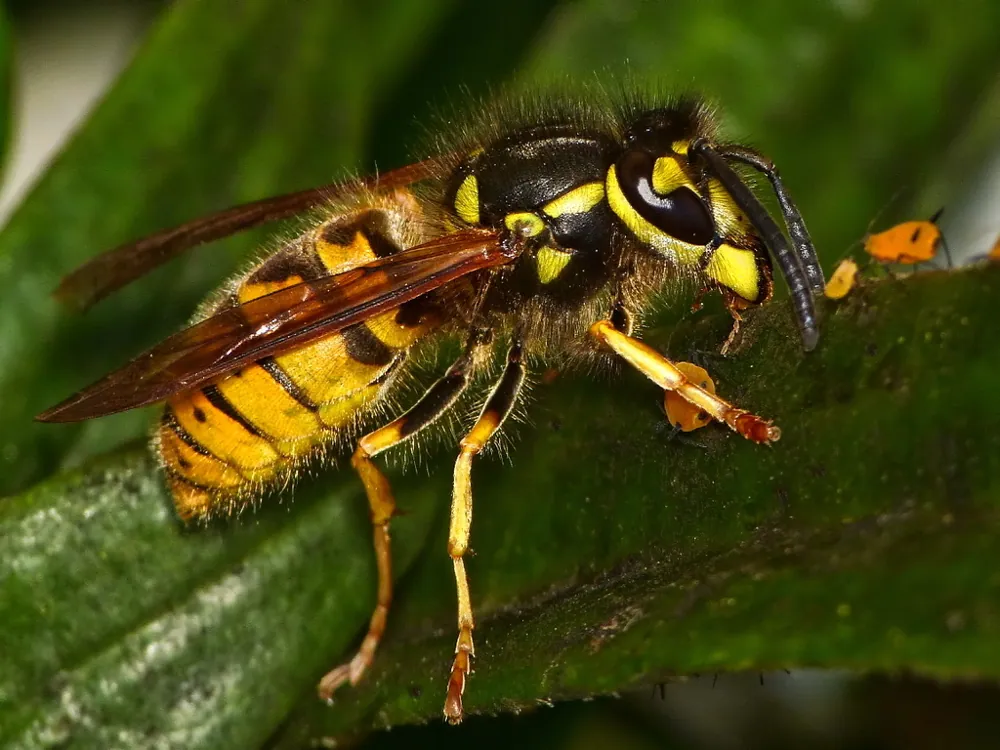
The German wasp is a black and yellow social wasp that lives in colonies. It is native to Europe, Northern Africa and temperate Asia, but it has spread to many other parts of the world. Because it competes with local wildlife, it is treated as a pest in most areas outside its native range.1


 Comment le reconnaître
- About 13 mm long, with typical wasp colours of black and yellow1
- Workers have three tiny black dots on the clypeus (the front part of the head, between the eyes and mouthparts)1
- Black marks on the abdomen are highly variable, so they are not a reliable way to identify it1
- Grey paper nests, often in the soil or in attics1
Souvent confondu avec : The German wasp is very similar to the common wasp (Vespula vulgaris). Unlike the common wasp, it has three tiny black dots on the clypeus, but this only applies to workers. In males, the normally unbroken black mark on the common wasp's clypeus can look broken, which makes it hard to tell the two apart. Members of Vespula are also often confused with the paper wasp Polistes dominula.1
Puissance du venin
Le venin sort par un dard.
À quel point est-il dangereux pour l'homme ?
Danger pour l'homme: DouloureuxÇa peut faire très mal, mais ce n'est presque jamais grave. S'il pique
- Gratte le dard d'abeille pour l'enlever et refroidis la zone.
- Si la personne a du mal à respirer, le visage ou la gorge qui gonflent, ou se sent mal, c'est une urgence allergique : appelle ton numéro d'urgence et utilise son stylo d'adrénaline si elle en a un.
Appelle toujours d'abord ton numéro d'urgence (112, 000, 911). Ce sont des conseils généraux de premiers secours, pas un avis médical. Les bases des premiers secours
 Reste en sécurité
- Ne touche, n'attrape et n'embête jamais un animal sauvage, même petit, et même s'il a l'air endormi ou mort.
- Laisse-lui de la place. Si tu en croises un, reste calme, recule doucement et laisse-le passer son chemin.
- S'il te pique : reste calme, ne bouge pas, appelle ton numéro d'urgence (112, 000, 911) ou va vite à l'hôpital. Souviens-toi de quoi il avait l'air, une photo aide.
Il ne t'en veut pas. Il utilise son venin pour attraper sa nourriture ou se protéger, et il préfère de loin se cacher. Plus d'infos pour rester en sécurité
Où dans le monde ?
Quelle taille fait-il ?
Quelle longueur fait-il ?
Combien pèse-t-il ?
 assez petit pour tenir sur ton ongle
 si léger que tu ne le sentirais pas sur ta main
 pourrait traverser tout un terrain de foot en volant en 16 secondes
Quelle taille fait German wasp comparé à TOI ?
Juste des calculs dans ton navigateur. Rien n'est enregistré ni envoyé nulle part.
À quelle vitesse va-t-il ?


Faits
German wasps are invasive. They have spread to many continents and are especially successful at colonising new areas.1
They can outcompete many other animals for food, which has caused considerable harm to native wildlife where they have invaded.1
Female bee moths (Aphomia sociella) sometimes lay eggs in German wasp nests. Their larvae feed on the eggs, larvae and pupae, and can destroy large parts of the nest.1
In Australia, nests can grow very large and some survive the winter. In England, none of the nests in the study survive the winter.1
Queens mate with between one and seven males, and workers can lay eggs, although worker policing keeps most of their sons from reaching adulthood.1
Colonies grow rapidly over summer, with a large increase in worker numbers and nest size. In late summer, the colony focuses on producing new queens and males.1
Démêle le vrai du faux
Idée reçue : German wasps are paper wasps because they build grey paper nests.
Vérité : The name is used by mistake. Strictly speaking, paper wasps belong to the subfamily Polistinae, while German wasps belong to the genus Vespula.1
Pour les experts en venin
- Nom scientifique
- Vespula germanica
- Groupe
- Abeilles, guêpes et frelons
- Famille
- Vespidae2
- Ordre
- Hymenoptera
- Continents
- Europe, Asie, Afrique
- Petits
- A single queen starts a nest in spring and lays eggs in hexagonal cells, with one wasp developing in each cell through the egg, larva and pupa stages.1
- Danger pour l'homme
- 2 / 5: Douloureux3
D'où viennent les faits
- Vespula germanica (Wikipedia (CC BY-SA 4.0))
- Vespula germanica (iNaturalist): noms et classification.
- Venom Wiki: le niveau de danger, la taille typique et la vitesse estimée sont les nôtres. Regarde comment on les calcule : Comment on évalue le danger.
Chaque fait sur cette page a un numéro qui renvoie à sa source. Si on s'est trompés, désolés, on est des fans d'animaux, pas une revue scientifique. Dis-le-nous à [email protected] et on corrigera.
 Le scorpion a faim ! Venom Wiki est le projet d'une seule personne : gratuit, sans pub et sans traceurs. Un petit pourboire aide à le garder en ligne.Nourris le scorpion
Plus du même groupe: Abeilles, guêpes et frelons
 Asian giant hornetAbeilles, guêpes et frelonsPeut tuer
 Common waspAbeilles, guêpes et frelonsFait juste mal
 European hornetAbeilles, guêpes et frelonsFait juste mal
 Western honey beeAbeilles, guêpes et frelonsFait juste mal
 Giant honey beeAbeilles, guêpes et frelonsNécessite un médecin
 Asian hornetAbeilles, guêpes et frelonsFait juste mal
 Common European adder
 Spanish fly
 Fire salamander
 Blunt-nosed viper
 Nose-horned viper
 Ottoman viper