
 Afrique
 Asie
Asie Europe
 Amérique du Sud
 Australie et Océanie
 Antarctique
 Océan Pacifique
 Océan Atlantique
 Océan Indien
 Océan Arctique
 Mer Méditerranée
 Mer Rouge
 Mer des Caraïbes
 Mer de Corail
 Mer de Chine méridionale
 Mer des Philippines
 Mer d'Andaman
 Mer du Nord
 Mer de Timor et d'Arafura
 Golfe du Bengale
 Golfe de Californie
Goldenrod crab spider
 Morsures
The goldenrod crab spider is a small, flat spider that hides on flowers and waits for insects to land nearby. It lives in Europe and North America. It is named for the way it walks, and it can change its colour to match the flower it sits on.1



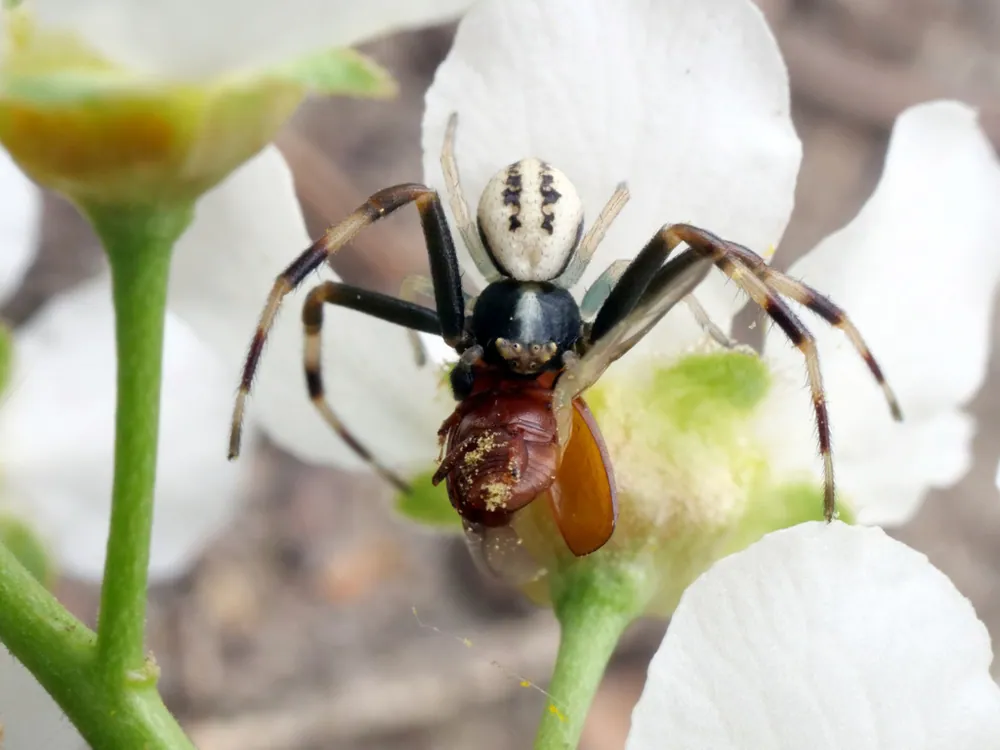
 Comment le reconnaître
- Wide, flat, short body that is shaped like a crab.1
- Usually yellow or white, or a pattern of these two colours. It can also be pale green or pink, with white.1
- Females have white or yellow legs. Males are darker, with red or brown outer shells and red and white bands.1
- Holds its first two pairs of legs open, which are the longest, ready to grab prey.1
- Can walk sideways, forwards and backwards.1
Souvent confondu avec : Mecaphesa asperata is similar in size and shape, but it is light grey to brown with pink stripes on its abdomen and cephalothorax. Diaea crab spiders can be lime green, and some Xysticus and Coriarchne species are brown.1
Puissance du venin
Le venin sort par ses crochets ou ses dents quand il mord.
Que fait son venin ?
Its venom is paralysing, which means it stops prey from moving. The spider injects digestive enzymes with its fangs to break down the insides of its prey. The venom is too weak to harm larger animals.1
À quel point est-il dangereux pour l'homme ?
Danger pour l'homme: LégerComme une piqûre d'abeille ou moins. Pratiquement inoffensif pour l'homme.This spider is harmless to humans. Its fangs are not strong enough to pierce human skin, and its venom is too weak to harm larger animals.1
 S'il mord
- Lave la morsure et mets de la glace contre la douleur. Va voir un médecin si la douleur est forte, s'étend ou si la personne se sent mal.
Appelle toujours d'abord ton numéro d'urgence (112, 000, 911). Ce sont des conseils généraux de premiers secours, pas un avis médical. Les bases des premiers secours
 Reste en sécurité
- Ne touche, n'attrape et n'embête jamais un animal sauvage, même petit, et même s'il a l'air endormi ou mort.
- Laisse-lui de la place. Si tu en croises un, reste calme, recule doucement et laisse-le passer son chemin.
- S'il te mord : reste calme, ne bouge pas, appelle ton numéro d'urgence (112, 000, 911) ou va vite à l'hôpital. Souviens-toi de quoi il avait l'air, une photo aide.
Il ne t'en veut pas. Il utilise son venin pour attraper sa nourriture ou se protéger, et il préfère de loin se cacher. Plus d'infos pour rester en sécurité
Où dans le monde ?
Quelle taille fait-il ?
Quelle longueur fait-il ?
 assez petit pour tenir sur ton ongle
Quelle taille fait Goldenrod crab spider comparé à TOI ?
Juste des calculs dans ton navigateur. Rien n'est enregistré ni envoyé nulle part.
À quelle vitesse va-t-il ?


Faits
Females can change colour from yellow to white, or back again, to match the flower they sit on. This process can take up to 25 days.1
The spider can catch prey much larger than itself, because its paralysing venom works so well.1
Unlike many spiders, it does not wrap its prey in silk. It relies entirely on venom to hold its meals still.1
Females leave silk trails called draglines behind them as they move, and males follow these trails rather than pheromones.1
Females wait on flowers and do not travel far, while males roam over great distances to look for mates.1
Females live longer than males, on average.1
Démêle le vrai du faux
Idée reçue : Because it is a venomous spider with a name like Whitedeath, it is dangerous to people.
Vérité : The goldenrod crab spider is harmless to humans. Its fangs cannot pierce human skin, and its venom is too weak to harm larger animals.1
D'où viennent les faits
- Misumena vatia (Wikipedia (CC BY-SA 4.0))
- Misumena vatia (iNaturalist): noms et classification.
- Venom Wiki: le niveau de danger, la taille typique et la vitesse estimée sont les nôtres. Regarde comment on les calcule : Comment on évalue le danger.
Chaque fait sur cette page a un numéro qui renvoie à sa source. Si on s'est trompés, désolés, on est des fans d'animaux, pas une revue scientifique. Dis-le-nous à [email protected] et on corrigera.
 Le scorpion a faim ! Venom Wiki est le projet d'une seule personne : gratuit, sans pub et sans traceurs. Un petit pourboire aide à le garder en ligne.Nourris le scorpion
Plus du même groupe: Araignées
 Brown recluse
 Southern black widow
 Mediterranean black widow
 Northern black widow
 Western black widow
 Diving bell spider
Vit aussi en: Europe
 Common European adderVipèresNécessite un médecin
 Spanish flyAutres animaux vénéneuxNécessite un médecinNe pas toucher
 Common waspAbeilles, guêpes et frelonsFait juste mal
 European hornetAbeilles, guêpes et frelonsFait juste mal
 Fire salamanderGrenouilles toxiques, crapauds et tritonsFait juste malNe pas toucher
 Western honey beeAbeilles, guêpes et frelonsFait juste mal