
 Afrique
 Asie
Asie Europe
 Amérique du Sud
 Australie et Océanie
 Antarctique
 Océan Pacifique
 Océan Atlantique
 Océan Indien
 Océan Arctique
 Mer Méditerranée
 Mer Rouge
 Mer des Caraïbes
 Mer de Corail
 Mer de Chine méridionale
 Mer des Philippines
 Mer d'Andaman
 Mer du Nord
 Mer de Timor et d'Arafura
 Golfe du Bengale
 Golfe de Californie
McMahon's viper
 Morsures
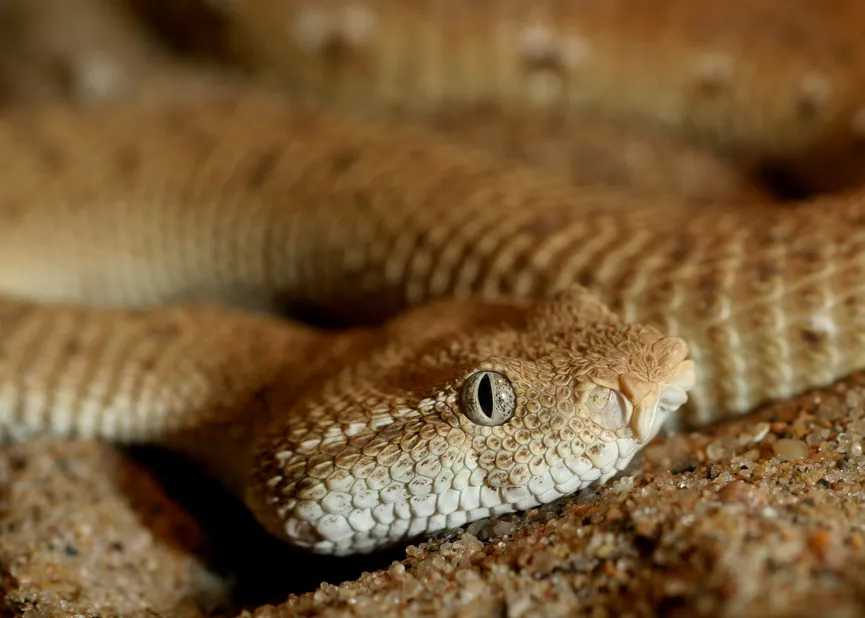
McMahon's viper is a small, venomous snake that lives in the sandy deserts of Balochistan, near the borders of Iran, Pakistan and Afghanistan. It is well known for its habit of sinking into loose sand so that only its snout and eyes stay uncovered. Scientists have also studied a protein from its venom for its possible use against melanoma, a type of skin cancer.1



 Comment le reconnaître
- Reddish to yellowish brown body with a regular series of 20 to 25 dark spots, each bordered partly or fully with white scales1
- A white stripe runs from the back of the eye to the corner of the mouth1
- Large, broad, flat, wedge-shaped head that is clearly distinct from the neck1
- Short tail with a yellow tip and distinct crossbands1
- Adults are under 1 m (39 in) in total length, tail included1
Puissance du venin
Le venin sort par ses crochets ou ses dents quand il mord.
Que fait son venin ?
Relatively few data are available on its venom. The species is regarded as potentially dangerous, and its venom is said to be similar to that of snakes in the genus Echis. A venom protein called eristostatin has been reported to help in the fight against melanoma.1
À quel point est-il dangereux pour l'homme ?
Danger pour l'homme: GraveUne morsure nécessite un médecin. Les décès sont très rares.It is regarded as a potentially dangerous species. It is described as bad-tempered, hissing very loudly and deeply, and it will strike aggressively when threatened.1
Que fait-il quand il a peur ?
It hisses very loudly and deeply, raises the front of its body off the ground in a loop and strikes aggressively. It may also sink into sand and cover its head, leaving only its snout and eyes uncovered.1
 S'il mord
- Garde la personne immobile et calme, le membre mordu à hauteur du cœur, enlève bagues et objets serrés, et va vite à l'hôpital.
Appelle toujours d'abord ton numéro d'urgence (112, 000, 911). Ce sont des conseils généraux de premiers secours, pas un avis médical. Les bases des premiers secours
 Reste en sécurité
- Ne touche, n'attrape et n'embête jamais un animal sauvage, même petit, et même s'il a l'air endormi ou mort.
- Laisse-lui de la place. Si tu en croises un, reste calme, recule doucement et laisse-le passer son chemin.
- S'il te mord : reste calme, ne bouge pas, appelle ton numéro d'urgence (112, 000, 911) ou va vite à l'hôpital. Souviens-toi de quoi il avait l'air, une photo aide.
Il ne t'en veut pas. Il utilise son venin pour attraper sa nourriture ou se protéger, et il préfère de loin se cacher. Plus d'infos pour rester en sécurité
Où dans le monde ?
Quelle taille fait-il ?
Quelle longueur fait-il ?
 aussi long que 4 bananes mises bout à bout
 pourrait parcourir 100 mètres en 110 secondes (l'humain le plus rapide met 9,6)
Quelle taille fait McMahon's viper comparé à TOI ?
Juste des calculs dans ton navigateur. Rien n'est enregistré ni envoyé nulle part.
À quelle vitesse va-t-il ?


Faits
A protein in its venom, called eristostatin, has been reported to help in the fight against melanoma.1
It can sink down into loose sand using a rocking or wave-like motion, then shake its head to cover it with sand.1
Its enlarged nasorostral scales are thought to keep sand out of its nostrils.1
It moves by sidewinding when crossing loose sand or when alarmed.1
Its short tail is prehensile, and it sometimes climbs into bushes with it.1
D'où viennent les faits
- Eristicophis (Wikipedia (CC BY-SA 4.0))
- Venom Wiki: le niveau de danger, la taille typique et la vitesse estimée sont les nôtres. Regarde comment on les calcule : Comment on évalue le danger.
Chaque fait sur cette page a un numéro qui renvoie à sa source. Si on s'est trompés, désolés, on est des fans d'animaux, pas une revue scientifique. Dis-le-nous à [email protected] et on corrigera.
 Le scorpion a faim ! Venom Wiki est le projet d'une seule personne : gratuit, sans pub et sans traceurs. Un petit pourboire aide à le garder en ligne.Nourris le scorpion
 Vipère des pyramides indienne
 Vipère heurtante
 Vipère de Russell
 Common European adder
 Eastern Russell's viper
 Northeast African carpet viper
 Scorpion jaune de Palestine
 Cobra indien
 Cobra royal
 Asian giant hornet
 Komodo dragon
 Spanish fly