
 Afrique
 Asie
Asie Europe
 Amérique du Sud
 Australie et Océanie
 Antarctique
 Océan Pacifique
 Océan Atlantique
 Océan Indien
 Océan Arctique
 Mer Méditerranée
 Mer Rouge
 Mer des Caraïbes
 Mer de Corail
 Mer de Chine méridionale
 Mer des Philippines
 Mer d'Andaman
 Mer du Nord
 Mer de Timor et d'Arafura
 Golfe du Bengale
 Golfe de Californie
Noble false widow
 Morsures
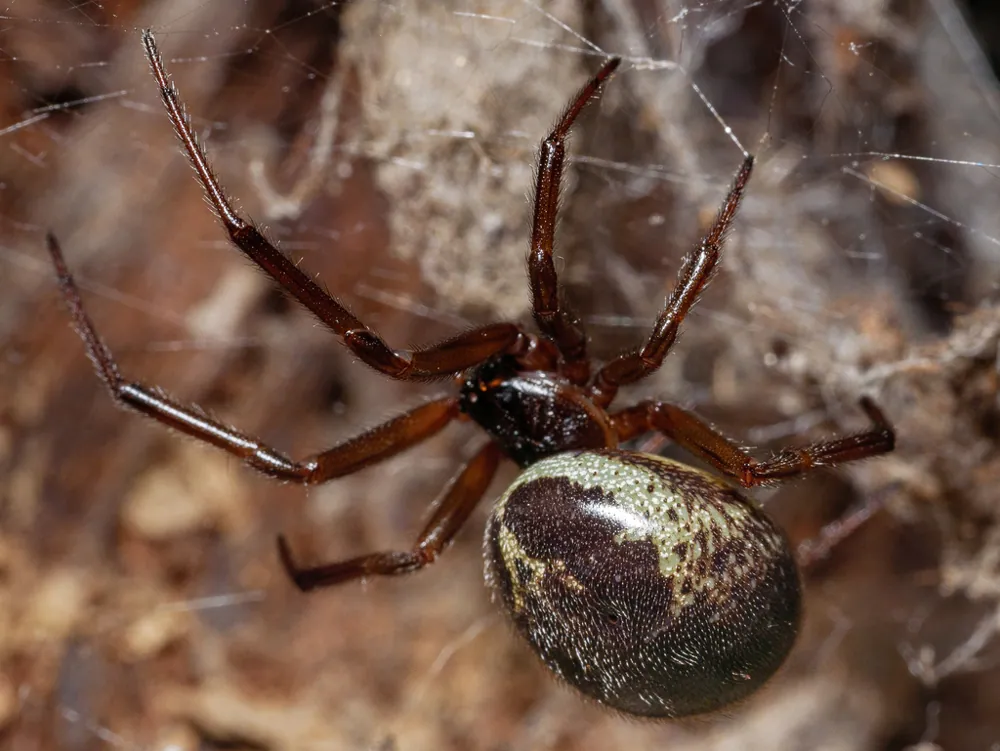
The noble false widow is a spider that looks a lot like the black widow, which is why it has its name. It is now found in many parts of the world, including Europe, the United States and New Zealand, and it is one of the world's most invasive spiders. Its bite can be painful, so it is worth knowing what it looks like.1


 Comment le reconnaître
- The abdomen (rear body) is brown and rounded, with cream markings that are often said to look like a skull.1
- The legs are reddish-orange.1
- Adult females are about 9.5 to 14 mm in size, and males are about 7 to 11 mm.1
- It is larger than other spiders in its genus, Steatoda, and has a typical colour pattern.1
Souvent confondu avec : It is often mistaken for the black widow (Latrodectus) and other false widow species. It can be told apart from the black widow by its larger size within its genus and its typical colouring, though many spiders in this group look similar.1
Puissance du venin
Le venin sort par ses crochets ou ses dents quand il mord.
Que fait son venin ?
Most of its venom is made of toxins similar to those of the widow spiders, mainly alpha-latrotoxin. This toxin makes holes in nerve cells, which releases chemical messengers and blocks the signals between nerves and muscles, causing paralysis. In people, the venom is most noticeable as pain at the bite site, along with swelling, redness and fever.1
À quel point est-il dangereux pour l'homme ?
Danger pour l'homme: DouloureuxÇa peut faire très mal, mais ce n'est presque jamais grave.It is considered moderately medically significant. Most bites cause symptoms similar to a bee or wasp sting, but some can be more serious, partly because of bacteria. It is considered one of the most dangerous spiders in western Europe. Bites from males are less severe than bites from females, and the bite itself is usually painless, with pain coming from the venom.1
 S'il mord
- Without proper treatment, a bite wound can become infected and develop into gangrene or sepsis, so medical care should be sought.1
- Lave la morsure et mets de la glace contre la douleur. Va voir un médecin si la douleur est forte, s'étend ou si la personne se sent mal.
Appelle toujours d'abord ton numéro d'urgence (112, 000, 911). Ce sont des conseils généraux de premiers secours, pas un avis médical. Les bases des premiers secours
 Reste en sécurité
- Ne touche, n'attrape et n'embête jamais un animal sauvage, même petit, et même s'il a l'air endormi ou mort.
- Laisse-lui de la place. Si tu en croises un, reste calme, recule doucement et laisse-le passer son chemin.
- S'il te mord : reste calme, ne bouge pas, appelle ton numéro d'urgence (112, 000, 911) ou va vite à l'hôpital. Souviens-toi de quoi il avait l'air, une photo aide.
Il ne t'en veut pas. Il utilise son venin pour attraper sa nourriture ou se protéger, et il préfère de loin se cacher. Plus d'infos pour rester en sécurité
Où dans le monde ?
Quelle taille fait-il ?
Quelle longueur fait-il ?
 assez petit pour tenir sur ton ongle
Quelle taille fait Noble false widow comparé à TOI ?
Juste des calculs dans ton navigateur. Rien n'est enregistré ni envoyé nulle part.
À quelle vitesse va-t-il ?


Faits
The spider often catches prey much larger than itself, including bats, because its venom works quickly.1
It can survive without drinking water, getting all its liquid from its prey.1
Males court females by tapping the web and vibrating their bodies, and they can make scraping sounds with their abdomens.1
It has poor eyesight and relies mainly on vibrations travelling through its web.1
It produces three-dimensional cobwebs, and its silk is unusually strong for its genus.1
One adult female lived almost five and a half years in captivity, and adult females are long-lived.1
Démêle le vrai du faux
Idée reçue : It is the same spider as the black widow.
Vérité : It only looks similar to the black widow. It belongs to the genus Steatoda, while the black widow belongs to the genus Latrodectus.1
Pour les experts en venin
- Nom scientifique
- Steatoda nobilis
- Groupe
- Araignées
- Famille
- Theridiidae2
- Ordre
- Araneae
- Continents
- Europe, Afrique
- Petits
- Females make egg sacs containing an average of 94 eggs, with a range of 34 to 208 eggs. The young hatch inside the egg sac about 18 days after the eggs are laid.1
- Durée de vie
- environ 5 ans1
- Danger pour l'homme
- 2 / 5: Douloureux3
D'où viennent les faits
- Steatoda nobilis (Wikipedia (CC BY-SA 4.0))
- Steatoda nobilis (iNaturalist): noms et classification.
- Venom Wiki: le niveau de danger, la taille typique et la vitesse estimée sont les nôtres. Regarde comment on les calcule : Comment on évalue le danger.
Chaque fait sur cette page a un numéro qui renvoie à sa source. Si on s'est trompés, désolés, on est des fans d'animaux, pas une revue scientifique. Dis-le-nous à [email protected] et on corrigera.
 Le scorpion a faim ! Venom Wiki est le projet d'une seule personne : gratuit, sans pub et sans traceurs. Un petit pourboire aide à le garder en ligne.Nourris le scorpion
Plus du même groupe: Araignées
 Mediterranean black widow
 Six-eyed sand spider
 Brown widow
 Diving bell spider
 European yellow sac spider
 Tarantula wolf spider
Vit aussi en: Europe
 Common European adderVipèresNécessite un médecin
 Spanish flyAutres animaux vénéneuxNécessite un médecinNe pas toucher
 Common waspAbeilles, guêpes et frelonsFait juste mal
 European hornetAbeilles, guêpes et frelonsFait juste mal
 Fire salamanderGrenouilles toxiques, crapauds et tritonsFait juste malNe pas toucher
 Western honey beeAbeilles, guêpes et frelonsFait juste mal