
 Afrique
 Asie
Asie Europe
 Amérique du Sud
 Australie et Océanie
 Antarctique
 Océan Pacifique
 Océan Atlantique
 Océan Indien
 Océan Arctique
 Mer Méditerranée
 Mer Rouge
 Mer des Caraïbes
 Mer de Corail
 Mer de Chine méridionale
 Mer des Philippines
 Mer d'Andaman
 Mer du Nord
 Mer de Timor et d'Arafura
 Golfe du Bengale
 Golfe de Californie
Panamanian golden frog
 Poison dans la peau
The Panamanian golden frog is a bright yellow-gold toad that lives only in Panama. It sits on the mountain streams and cloud forests of the west-central part of the country. It is a national symbol, and it is also one of the most endangered amphibians in the world.1

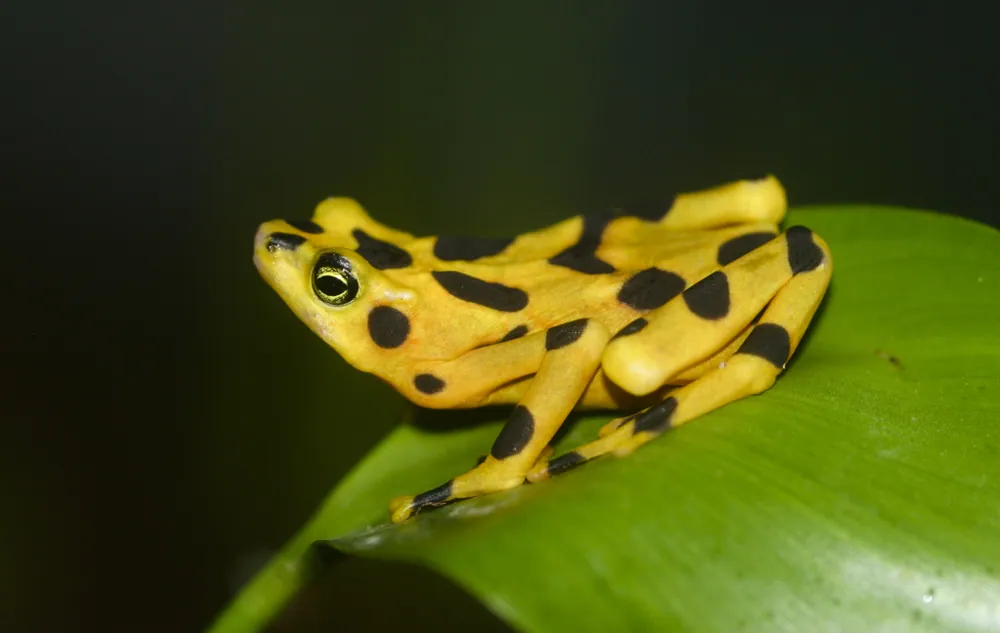
 Comment le reconnaître
Puissance du poison
Sa peau est toxique. Il est dangereux de le toucher, de le lécher ou de le manger.
Que fait son poison ?
It is poisonous rather than venomous, because its toxins work on contact with the skin and are not injected. The toxin is water-soluble and affects the nerve cells of anyone who touches it. Large doses can be fatal within 20 to 30 minutes, after convulsions that stop breathing and blood circulation.1
À quel point est-il dangereux pour l'homme ?
Danger pour l'homme: GraveSi quelqu'un le touche ou le mange, il faut voir un médecin. Les décès sont très rares.Its toxin affects the nerve cells of anyone who comes into contact with it, and large doses can be fatal. Because it is critically endangered, the frog should be left alone in the wild.1
Que fait-il quand il a peur ?
When a predator approaches, it waves and lifts its foot to show its bright colours, which warn of its toxicity. If the predator keeps coming, the waving and calls increase in speed and volume.1
 Si quelqu'un l'a touché ou mangé
- Si quelqu'un en a touché un : lave-toi bien les mains et ne touche pas tes yeux ni ta bouche. Si un enfant ou un animal en a léché ou mangé un : appelle le centre antipoison ou ton numéro d'urgence.
Appelle toujours d'abord ton numéro d'urgence (112, 000, 911). Ce sont des conseils généraux de premiers secours, pas un avis médical. Les bases des premiers secours
 Reste en sécurité
- Ne touche, n'attrape et n'embête jamais un animal sauvage, même petit, et même s'il a l'air endormi ou mort.
- Laisse-lui de la place. Si tu en croises un, reste calme, recule doucement et laisse-le passer son chemin.
- Si tu l'as touché ou mangé : ne frotte pas tes yeux ni ta bouche, lave-toi les mains et va voir un médecin.
Il ne t'en veut pas. Son poison ne sert qu'à ce que personne ne le mange. Plus d'infos pour rester en sécurité
Où dans le monde ?
Quelle taille fait-il ?
Quelle longueur fait-il ?
Combien pèse-t-il ?

 aussi long que 2 briques de construction en ligne
 si léger que tu ne le sentirais pas sur ta main
 pourrait parcourir 100 mètres en 90 secondes (l'humain le plus rapide met 9,6)
Quelle taille fait Panamanian golden frog comparé à TOI ?
Juste des calculs dans ton navigateur. Rien n'est enregistré ni envoyé nulle part.
À quelle vitesse va-t-il ?


Faits
It is able to communicate by waving its feet, a bit like semaphore, as well as by sound.1
It is an 'earless' frog with no eardrums, yet it can still hear sounds and work out where they come from.1
Its toxins are powerful enough that some predators avoid it, though a few snakes can cope with its poison.1
Tadpoles have black and gold colouring, which helps protect them from the sun.1
It was filmed in the wild for the last time in 2006 for the BBC series Life in Cold Blood.1
Démêle le vrai du faux
Idée reçue : It is a frog.
Vérité : Despite its common name, it is a true toad, a member of the family Bufonidae.1
Pour les experts en venin
- Nom scientifique
- Atelopus zeteki
- Groupe
- Grenouilles toxiques, crapauds et tritons
- Famille
- Bufonidae2
- Ordre
- Anura
- Continents
- Amérique du Nord
- Petits
- Eggs are laid in shallow streams and hatch after 2 to 10 days. The tadpoles then take 6 to 7 months to grow.1
- Durée de vie
- environ 12 ans1
- Comment il se porte dans la nature
- Critically Endangered (IUCN). It may have been extinct in the wild since 2007.1
- Danger pour l'homme
- 3 / 5: Grave3
D'où viennent les faits
- Panamanian golden frog (Wikipedia (CC BY-SA 4.0))
- Atelopus zeteki (iNaturalist): noms et classification.
- Venom Wiki: le niveau de danger, la taille typique et la vitesse estimée sont les nôtres. Regarde comment on les calcule : Comment on évalue le danger.
Chaque fait sur cette page a un numéro qui renvoie à sa source. Si on s'est trompés, désolés, on est des fans d'animaux, pas une revue scientifique. Dis-le-nous à [email protected] et on corrigera.
 Le scorpion a faim ! Venom Wiki est le projet d'une seule personne : gratuit, sans pub et sans traceurs. Un petit pourboire aide à le garder en ligne.Nourris le scorpion
Plus du même groupe: Grenouilles toxiques, crapauds et tritons
 Cane toadGrenouilles toxiques, crapauds et tritonsNécessite un médecinNe pas toucher
 Strawberry poison-dart frogGrenouilles toxiques, crapauds et tritonsFait juste malNe pas toucher
 California newtGrenouilles toxiques, crapauds et tritonsPeut tuerNe pas toucher
 Rough-skinned newtGrenouilles toxiques, crapauds et tritonsPeut tuerNe pas toucher
 Colorado River toadGrenouilles toxiques, crapauds et tritonsNécessite un médecinNe pas toucher
 Eastern newtGrenouilles toxiques, crapauds et tritonsFait juste malNe pas toucher
 Fer-de-lance d'Amérique centrale
 Eastern coral snake
 Eastern diamondback rattlesnake
 Eyelash viper
 Timber rattlesnake
 Western diamondback rattlesnake