
 Afrique
 Asie
Asie Europe
 Amérique du Sud
 Australie et Océanie
 Antarctique
 Océan Pacifique
 Océan Atlantique
 Océan Indien
 Océan Arctique
 Mer Méditerranée
 Mer Rouge
 Mer des Caraïbes
 Mer de Corail
 Mer de Chine méridionale
 Mer des Philippines
 Mer d'Andaman
 Mer du Nord
 Mer de Timor et d'Arafura
 Golfe du Bengale
 Golfe de Californie
Phinda button spider
 Morsures
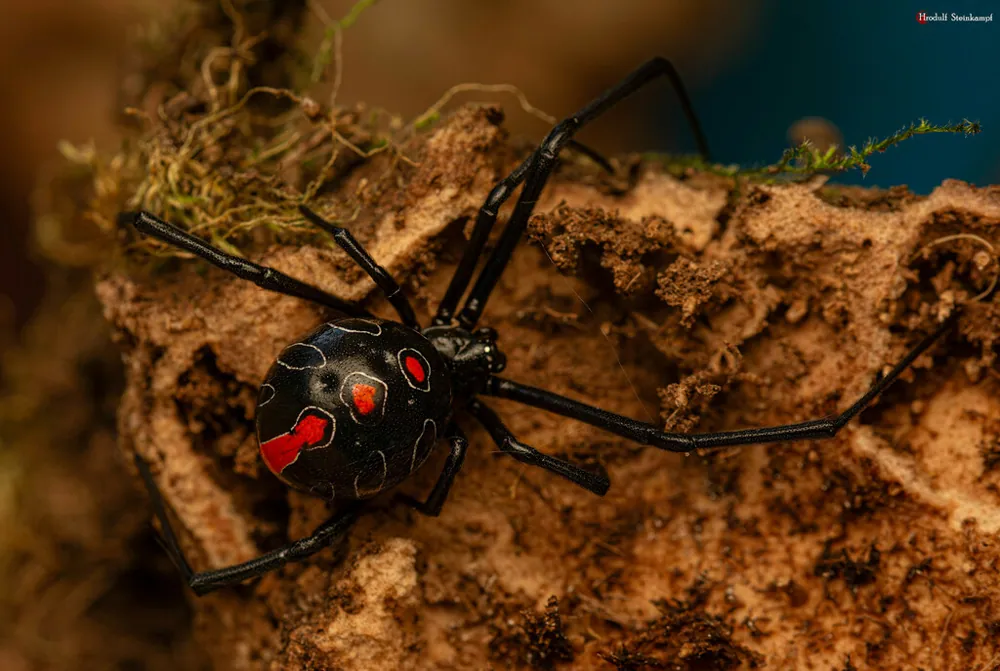
The Phinda button spider is a type of button, or widow, spider. It was formally described as a new species in 2019. It lives only in sand forests in northern Zululand, in South Africa's KwaZulu-Natal province, and is believed to be the largest member of its genus.1
 Comment le reconnaître
- Females have red markings on both the top and underside of the abdomen, which no other African Latrodectus species has.1
- Males have white markings on the underside of the abdomen, which darken with age.1
- Egg sacs are large and smooth, bright purple when freshly laid, fading to shiny grey as they dry.1
- Webs are not usually found outside the tree hollow. When present, they are typical hackle webs spreading out from the hollow.1
Souvent confondu avec : Other African button spiders do not have the red markings on both the top and underside of the female abdomen, which is the main feature that sets this species apart.1
Puissance du venin
Le venin sort par ses crochets ou ses dents quand il mord.
À quel point est-il dangereux pour l'homme ?
Danger pour l'homme: DouloureuxÇa peut faire très mal, mais ce n'est presque jamais grave. S'il mord
- Lave la morsure et mets de la glace contre la douleur. Va voir un médecin si la douleur est forte, s'étend ou si la personne se sent mal.
Appelle toujours d'abord ton numéro d'urgence (112, 000, 911). Ce sont des conseils généraux de premiers secours, pas un avis médical. Les bases des premiers secours
 Reste en sécurité
- Ne touche, n'attrape et n'embête jamais un animal sauvage, même petit, et même s'il a l'air endormi ou mort.
- Laisse-lui de la place. Si tu en croises un, reste calme, recule doucement et laisse-le passer son chemin.
- S'il te mord : reste calme, ne bouge pas, appelle ton numéro d'urgence (112, 000, 911) ou va vite à l'hôpital. Souviens-toi de quoi il avait l'air, une photo aide.
Il ne t'en veut pas. Il utilise son venin pour attraper sa nourriture ou se protéger, et il préfère de loin se cacher. Plus d'infos pour rester en sécurité
Où dans le monde ?
Quelle taille fait-il ?
Quelle longueur fait-il ?
 à peu près aussi long qu'un trombone
Quelle taille fait Phinda button spider comparé à TOI ?
Juste des calculs dans ton navigateur. Rien n'est enregistré ni envoyé nulle part.
À quelle vitesse va-t-il ?


Faits
It is believed to be the largest member of the button spider genus, Latrodectus.1
Its discovery was the first new addition to the genus in 28 years. Before this, 31 button or widow spiders were known, eight of them from Africa.1
Females nest in tree hollows and stumps higher above the ground than most other members of the genus.1
It was first found in 2014 in Tembe Elephant Park, but was only confirmed as a new species in 2019, after live specimens were collected from Phinda reserve.1
One female kept in a laboratory lived for two years until her natural death, and her offspring were also studied.1
D'où viennent les faits
- Latrodectus umbukwane (Wikipedia (CC BY-SA 4.0))
- Latrodectus umbukwane (iNaturalist): noms et classification.
- Venom Wiki: le niveau de danger, la taille typique et la vitesse estimée sont les nôtres. Regarde comment on les calcule : Comment on évalue le danger.
Chaque fait sur cette page a un numéro qui renvoie à sa source. Si on s'est trompés, désolés, on est des fans d'animaux, pas une revue scientifique. Dis-le-nous à [email protected] et on corrigera.
 Le scorpion a faim ! Venom Wiki est le projet d'une seule personne : gratuit, sans pub et sans traceurs. Un petit pourboire aide à le garder en ligne.Nourris le scorpion
 Mediterranean black widow
 Six-eyed sand spider
 Brown widow
 Noble false widow
 Darwin's bark spider
 Wasp spider
 Black mamba
 Deathstalker
 Egyptian cobra
 Vipère heurtante
 Boomslang
 Fat-tailed scorpion