
 Afrique
 Asie
Asie Europe
 Amérique du Sud
 Australie et Océanie
 Antarctique
 Océan Pacifique
 Océan Atlantique
 Océan Indien
 Océan Arctique
 Mer Méditerranée
 Mer Rouge
 Mer des Caraïbes
 Mer de Corail
 Mer de Chine méridionale
 Mer des Philippines
 Mer d'Andaman
 Mer du Nord
 Mer de Timor et d'Arafura
 Golfe du Bengale
 Golfe de Californie
Pygmy copperhead
 Morsures
The pygmy copperhead is a small, venomous snake found only in South Australia, mainly on Kangaroo Island and in the Fleurieu Peninsula and Mount Lofty Ranges. It is the smallest of the Australian copperheads. Its venom is dangerous, so prompt medical treatment matters.1


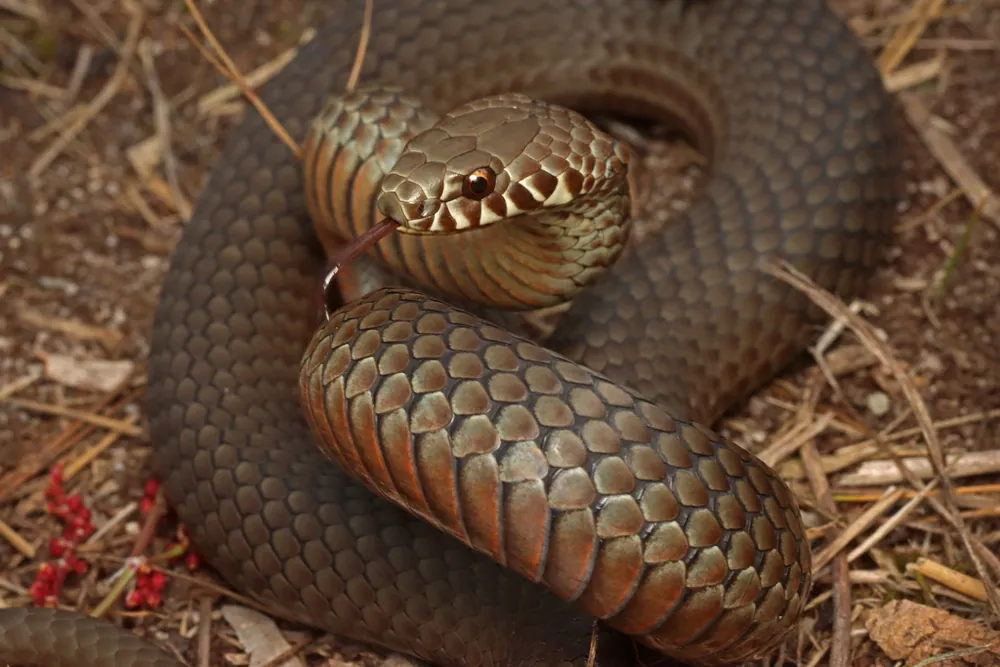
 Comment le reconnaître
- Dorsal scales are brown to grey, with a darker stripe along the spine.1
- The belly is cream to light grey, with red along the edges that fades to a brown-grey underside.1
- The lip scales are barred with dark colour.1
- Adults average about 80 cm long, with males usually larger than females.1
- Newborns often have paler backsides than adults.1
Souvent confondu avec : The highland and lowland copperheads are larger, and the pygmy copperhead is the smallest of the Australian copperheads. It is not closely related to the American copperhead, Agkistrodon contortrix.1
Puissance du venin
Le venin sort par ses crochets ou ses dents quand il mord.
Que fait son venin ?
The venom is strongly neurotoxic, which means it attacks the nerves, and its toxicity is similar to that of the Indian cobra. It is weakly coagulant and strongly anticoagulant, meaning it can both disrupt blood clotting and destroy blood and muscle. Without prompt treatment, a bite can cause possibly irreversible damage to nerve endings.1
À quel point est-il dangereux pour l'homme ?
Danger pour l'homme: GraveUne morsure nécessite un médecin. Les décès sont très rares.Bites are considered possibly lethal. The snake is not known for being aggressive and is unlikely to attack unless it is stepped on or purposely provoked.1
 Bonne nouvelle : les médecins ont un médicament (antivenin) ou un traitement pour ça.1
Que fait-il quand il a peur ?
It is generally unobtrusive and usually hides under leaf litter, old iron and haystacks.1
 S'il mord
- Prompt antivenom treatment is essential, because bites are considered lethal without it. Antivenom developed from tiger snake venom cannot completely neutralise the neurotoxicity of pygmy copperhead venom.1
- Immobilisation par compression : enroule un bandage élastique serré sur la morsure puis sur tout le membre, pose une attelle et garde la personne complètement immobile jusqu'à l'arrivée des secours.
- Ne lave pas la morsure : l'hôpital peut analyser le venin resté sur la peau pour choisir le bon antivenin.
Appelle toujours d'abord ton numéro d'urgence (112, 000, 911). Ce sont des conseils généraux de premiers secours, pas un avis médical. Les bases des premiers secours
 Reste en sécurité
- Ne touche, n'attrape et n'embête jamais un animal sauvage, même petit, et même s'il a l'air endormi ou mort.
- Laisse-lui de la place. Si tu en croises un, reste calme, recule doucement et laisse-le passer son chemin.
- S'il te mord : reste calme, ne bouge pas, appelle ton numéro d'urgence (112, 000, 911) ou va vite à l'hôpital. Souviens-toi de quoi il avait l'air, une photo aide.
Il ne t'en veut pas. Il utilise son venin pour attraper sa nourriture ou se protéger, et il préfère de loin se cacher. Plus d'infos pour rester en sécurité
Où dans le monde ?
Quelle taille fait-il ?
Quelle longueur fait-il ?
 aussi long que 2,5 chats domestiques du museau à la queue
 aussi long que 7 bananes mises bout à bout
 pourrait parcourir 100 mètres en 56 secondes (l'humain le plus rapide met 9,6)
Quelle taille fait Pygmy copperhead comparé à TOI ?
Juste des calculs dans ton navigateur. Rien n'est enregistré ni envoyé nulle part.
À quelle vitesse va-t-il ?


Faits
Sightings on islands near Tasmania are probably the result of snakes stowing away on boats.1
It is the only snake endemic to South Australia.1
It is the smallest of the Australian copperhead snakes.1
Its litter size is about half that of the other Australian copperheads, which is linked to its smaller body size.1
In field research, only about two thirds of surveyed adult females were reproductive, which suggests females do not breed every year.1
Démêle le vrai du faux
Idée reçue : Because it is small and not aggressive, the pygmy copperhead is harmless.
Vérité : Its venom is strongly neurotoxic, and its bite is considered possibly lethal without prompt antivenom treatment.1
D'où viennent les faits
- Pygmy copperhead (Wikipedia (CC BY-SA 4.0))
- Austrelaps labialis (iNaturalist): noms et classification.
- Venom Wiki: le niveau de danger, la taille typique et la vitesse estimée sont les nôtres. Regarde comment on les calcule : Comment on évalue le danger.
Chaque fait sur cette page a un numéro qui renvoie à sa source. Si on s'est trompés, désolés, on est des fans d'animaux, pas une revue scientifique. Dis-le-nous à [email protected] et on corrigera.
 Le scorpion a faim ! Venom Wiki est le projet d'une seule personne : gratuit, sans pub et sans traceurs. Un petit pourboire aide à le garder en ligne.Nourris le scorpion
Plus du même groupe: Serpents australiens
 Taïpan du littoral
 Vipère de la mort commune
 Serpent brun de l'Est
 Taïpan du désert
 Serpent-tigre
 Collett's snake
Vit aussi en: Australie et Océanie
 Araignée à toile en entonnoir de SydneyMygales et araignées à toile en entonnoirMortel
 Redback spiderAraignéesNécessite un médecin
 Brown tree snakeSerpents à crochets arrièreFait juste mal
 Hooded pitohuiAutres animaux vénéneuxFait juste malNe pas toucher
 PlatypusMammifères venimeuxFait juste mal
 Northern tree-dwelling funnel-web spiderMygales et araignées à toile en entonnoirMortel