
 Afrique
 Asie
Asie Europe
 Amérique du Sud
 Australie et Océanie
 Antarctique
 Océan Pacifique
 Océan Atlantique
 Océan Indien
 Océan Arctique
 Mer Méditerranée
 Mer Rouge
 Mer des Caraïbes
 Mer de Corail
 Mer de Chine méridionale
 Mer des Philippines
 Mer d'Andaman
 Mer du Nord
 Mer de Timor et d'Arafura
 Golfe du Bengale
 Golfe de Californie
Red-headed krait
 Morsures
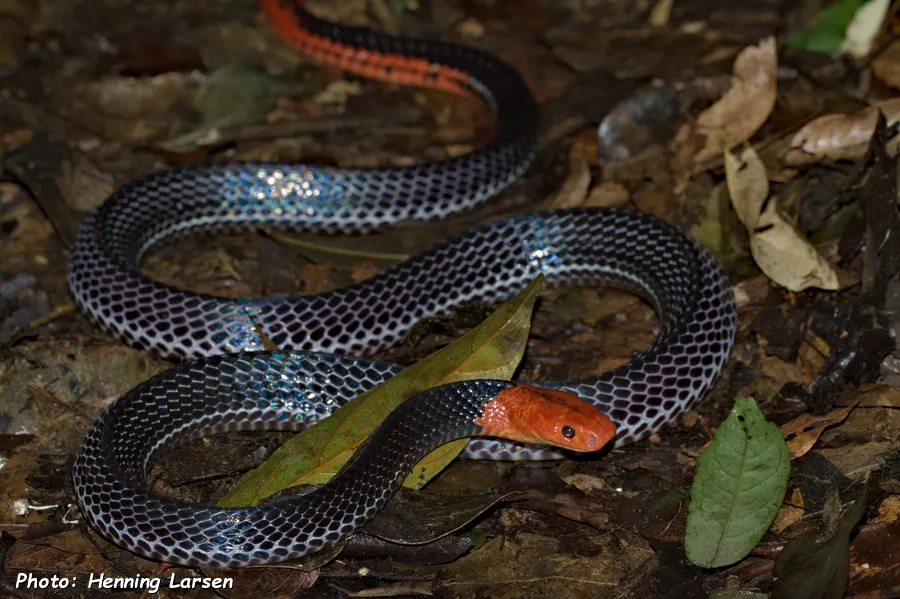
The red-headed krait is a large, highly venomous snake with a striking look: a bright red head and tail and a glossy black body. It lives in lowland rain forests across Southeast Asia, including on some islands, and it is uncommon. It is a night-time hunter, and people rarely meet it.1



 Comment le reconnaître
- A bright red head and tail1
- A black body with a narrow bluish white stripe along the side1
- Large, smooth, glossy scales1
- Adults can reach 2.1 metres, with an average of 1.2 to 1.5 metres1
Souvent confondu avec : It is similar to the blue Malayan coral snake, which is also venomous, and to the nonvenomous red-headed reed snake.1
Puissance du venin
Le venin sort par ses crochets ou ses dents quand il mord.
Que fait son venin ?
Its venom is a neurotoxin, which attacks the nerves. It blocks signals between nerves and muscles, causing paralysis. Victims can stop breathing, which can lead to death by asphyxiation. Between 20 minutes and several hours after a bite, drooping eyelids may appear, along with double vision, difficulty swallowing, vomiting, headache and excess saliva. Symptoms can then worsen as more muscles, including the jaw, become paralysed, and breathing can become difficult.1
À quel point est-il dangereux pour l'homme ?
Danger pour l'homme: Très dangereuxIl peut tuer une personne qui n'est pas soignée.Bites are reported rarely, and the venom is little studied for this reason. It is not usually considered high risk to people in the daytime, because it is sluggish and hides. At night it is active and extremely dangerous.1
 Bonne nouvelle : les médecins ont un médicament (antivenin) ou un traitement pour ça.1
Que fait-il quand il a peur ?
When disturbed, it presses its head into the ground or hides its head within its flattened or rolled coils. Captives will generally refuse to strike until they have been teased for a long time.1
 S'il mord
- Get to a hospital fast. Neurotoxic symptoms can be treated in hospital with antivenin or with drugs that inactivate acetylcholinesterase, an enzyme that breaks down the chemical messenger between nerves and muscles. Symptoms may also settle on their own.1
- Garde la personne immobile et calme, enlève bagues et objets serrés, et va vite à l'hôpital : le traitement, c'est l'antivenin.
Appelle toujours d'abord ton numéro d'urgence (112, 000, 911). Ce sont des conseils généraux de premiers secours, pas un avis médical. Les bases des premiers secours
 Reste en sécurité
- Ne touche, n'attrape et n'embête jamais un animal sauvage, même petit, et même s'il a l'air endormi ou mort.
- Laisse-lui de la place. Si tu en croises un, reste calme, recule doucement et laisse-le passer son chemin.
- S'il te mord : reste calme, ne bouge pas, appelle ton numéro d'urgence (112, 000, 911) ou va vite à l'hôpital. Souviens-toi de quoi il avait l'air, une photo aide.
Il ne t'en veut pas. Il utilise son venin pour attraper sa nourriture ou se protéger, et il préfère de loin se cacher. Plus d'infos pour rester en sécurité
Où dans le monde ?
Quelle taille fait-il ?
Quelle longueur fait-il ?
 aussi long que 4 chats domestiques du museau à la queue
 aussi long que 12 bananes mises bout à bout
 pourrait parcourir 100 mètres en 46 secondes (l'humain le plus rapide met 9,6)
Quelle taille fait Red-headed krait comparé à TOI ?
Juste des calculs dans ton navigateur. Rien n'est enregistré ni envoyé nulle part.
À quelle vitesse va-t-il ?


Faits
Its venom contains a novel toxin called κ-flavitoxin, which blocks nicotinic transmission in autonomic ganglia, clusters of nerve cells that control automatic body functions.1
It has short, hollow fangs at the front of its upper jaw, and venom is forced out through a hole near the tip of each fang.1
It is partly aquatic and mainly active at night.1
It was once thought to eat mainly other snakes, but its diet is now known to be much wider.1
Démêle le vrai du faux
Idée reçue : It only eats other snakes.
Vérité : Its diet includes skinks, lizards, frogs, caecilians, small mammals and snake eggs, as well as snakes.1
D'où viennent les faits
- Red-headed krait (Wikipedia (CC BY-SA 4.0))
- Bungarus flaviceps (iNaturalist): noms et classification.
- Venom Wiki: le niveau de danger, la taille typique et la vitesse estimée sont les nôtres. Regarde comment on les calcule : Comment on évalue le danger.
Chaque fait sur cette page a un numéro qui renvoie à sa source. Si on s'est trompés, désolés, on est des fans d'animaux, pas une revue scientifique. Dis-le-nous à [email protected] et on corrigera.
 Le scorpion a faim ! Venom Wiki est le projet d'une seule personne : gratuit, sans pub et sans traceurs. Un petit pourboire aide à le garder en ligne.Nourris le scorpion
 Indian cobra
 King cobra
 Caspian cobra
 Common krait
 Malayan krait
 Many-banded krait
 Deathstalker
 Indian saw-scaled viper
 Vipère heurtante
 Vipère de Russell
 Asian giant hornet
 Komodo dragon