
 Afrique
 Asie
Asie Europe
 Amérique du Sud
 Australie et Océanie
 Antarctique
 Océan Pacifique
 Océan Atlantique
 Océan Indien
 Océan Arctique
 Mer Méditerranée
 Mer Rouge
 Mer des Caraïbes
 Mer de Corail
 Mer de Chine méridionale
 Mer des Philippines
 Mer d'Andaman
 Mer du Nord
 Mer de Timor et d'Arafura
 Golfe du Bengale
 Golfe de Californie
Common stingray
 Piqûres
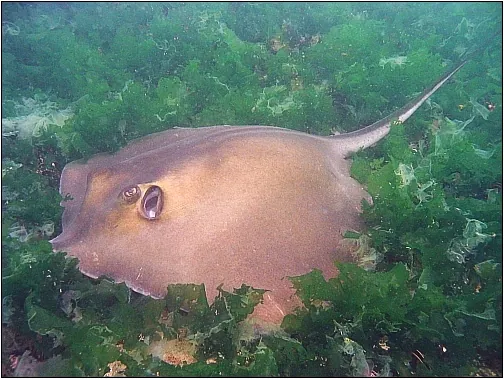
The common stingray is a flat, diamond-shaped ray that lives on sandy or muddy seabeds in shallow coastal waters. It is found in the northeastern Atlantic, the Mediterranean and the Black Sea. It has a venomous spine on its tail, which can give a very painful sting.1
 Comment le reconnaître
- Diamond-shaped pectoral fin disc that is slightly wider than it is long1
- Plain colour: solid grey, brown, reddish or olive-green above, and whitish below with dark fin edges1
- Mostly smooth skin; the largest individuals have a row of bony knobs along the middle of the back1
- Slender, whip-like tail with a serrated venomous spine about a third of the way along it1
Souvent confondu avec : The blue stingray of southern Africa was once thought to be a variant of this species, but it is a separate species. The common stingray lacks the blue markings of the blue stingray. Tortonese's stingray of the Mediterranean is similar, and the difference between the two is poorly understood.1
Puissance du venin
Le venin sort par un dard.
Que fait son venin ?
The venom comes from a gland at the base of a serrated tail spine. A sting causes an excruciatingly painful wound. It is rarely life-threatening.1
À quel point est-il dangereux pour l'homme ?
Danger pour l'homme: GraveUne piqûre nécessite un médecin. Les décès sont très rares.The common stingray is not aggressive, but it can inflict a very painful wound with its tail spine. The wound is rarely life-threatening.1
 S'il pique
- Plonge la plaie dans de l'eau chaude, aussi chaude que la personne peut supporter sans se brûler (teste avec ta propre main), pendant 30 à 90 minutes. Va voir un médecin, surtout pour les poissons-pierres et les raies.
Appelle toujours d'abord ton numéro d'urgence (112, 000, 911). Ce sont des conseils généraux de premiers secours, pas un avis médical. Les bases des premiers secours
 Reste en sécurité
- Ne touche, n'attrape et n'embête jamais un animal sauvage, même petit, et même s'il a l'air endormi ou mort.
- Laisse-lui de la place. Si tu en croises un, reste calme, recule doucement et laisse-le passer son chemin.
- S'il te pique : reste calme, ne bouge pas, appelle ton numéro d'urgence (112, 000, 911) ou va vite à l'hôpital. Souviens-toi de quoi il avait l'air, une photo aide.
Il ne t'en veut pas. Il utilise son venin pour attraper sa nourriture ou se protéger, et il préfère de loin se cacher. Plus d'infos pour rester en sécurité
Où dans le monde ?
Quelle taille fait-il ?
Quelle longueur fait-il ?
 aussi long que 2,5 chiens du museau à la queue
 aussi long que 14 bananes mises bout à bout
 pourrait nager la longueur d'une grande piscine (50 m) en 9,5 secondes
Quelle taille fait Common stingray comparé à TOI ?
Juste des calculs dans ton navigateur. Rien n'est enregistré ni envoyé nulle part.
À quelle vitesse va-t-il ?


Faits
The tail spine is replaced regularly, and a second or even third spine may be growing in behind the first.1
The largest recorded specimen was found in 2016 in İzmir Province, Turkey, with fins measuring 2.21 m across.1
Welsh fishermen once used its liver oil to treat burns and other injuries, and its liver is a delicacy in French cuisine.1
The oldest known wild individual was ten years old, but the species has lived up to 21 years in captivity.1
Démêle le vrai du faux
Idée reçue : The stingray's spine could kill trees, pierce armour like an arrow, corrode iron and even dissolve stone, as some ancient writers claimed.
Vérité : The common stingray's wound is painful but rarely life-threatening. These ancient claims about its spine were legends.1
Pour les experts en venin
- Nom scientifique
- Dasyatis pastinaca
- Groupe
- Poissons venimeux
- Famille
- Dasyatidae2
- Ordre
- Myliobatiformes
- Continents
- Océan Atlantique, Mer Méditerranée, Mer du Nord, Les océans
- Petits
- It is aplacental viviparous, meaning it gives birth to live young. Females bear 4–9 young twice a year in shallow inshore water, after a gestation period of four months.1
- Durée de vie
- environ 21 ans1
- Comment il se porte dans la nature
- Vulnerable1
- Danger pour l'homme
- 3 / 5: Grave3
D'où viennent les faits
- Common stingray (Wikipedia (CC BY-SA 4.0))
- Dasyatis pastinaca (iNaturalist): noms et classification.
- Venom Wiki: le niveau de danger, la taille typique et la vitesse estimée sont les nôtres. Regarde comment on les calcule : Comment on évalue le danger.
Chaque fait sur cette page a un numéro qui renvoie à sa source. Si on s'est trompés, désolés, on est des fans d'animaux, pas une revue scientifique. Dis-le-nous à [email protected] et on corrigera.
 Le scorpion a faim ! Venom Wiki est le projet d'une seule personne : gratuit, sans pub et sans traceurs. Un petit pourboire aide à le garder en ligne.Nourris le scorpion
Plus du même groupe: Poissons venimeux
 Reef stonefishPoissons venimeuxPeut tuerNe pas toucher
 Red lionfishPoissons venimeuxNécessite un médecinNe pas toucher
 Estuarine stonefishPoissons venimeuxPeut tuerNe pas toucher
 Short-tail stingrayPoissons venimeuxPeut tuer
 Striped eel catfishPoissons venimeuxPeut tuerNe pas toucher
 Bluespotted ribbontail rayPoissons venimeuxNécessite un médecin
Vit aussi en: Océan Atlantique
 Hawksbill sea turtleAutres animaux vénéneuxPeut tuer
 Portuguese man o' warMéduses et piqueurs marinsNécessite un médecinNe pas toucher
 Blue sea dragonCônes et pieuvresFait juste mal
 Greenland sharkAutres animaux vénéneuxFait juste mal
 Lion's mane jellyfishMéduses et piqueurs marinsFait juste malNe pas toucher
 Common octopusCônes et pieuvresInoffensif