
 Afrique
 Asie
Asie Europe
 Amérique du Sud
 Australie et Océanie
 Antarctique
 Océan Pacifique
 Océan Atlantique
 Océan Indien
 Océan Arctique
 Mer Méditerranée
 Mer Rouge
 Mer des Caraïbes
 Mer de Corail
 Mer de Chine méridionale
 Mer des Philippines
 Mer d'Andaman
 Mer du Nord
 Mer de Timor et d'Arafura
 Golfe du Bengale
 Golfe de Californie
Socotra Island blue baboon spider
 Morsures
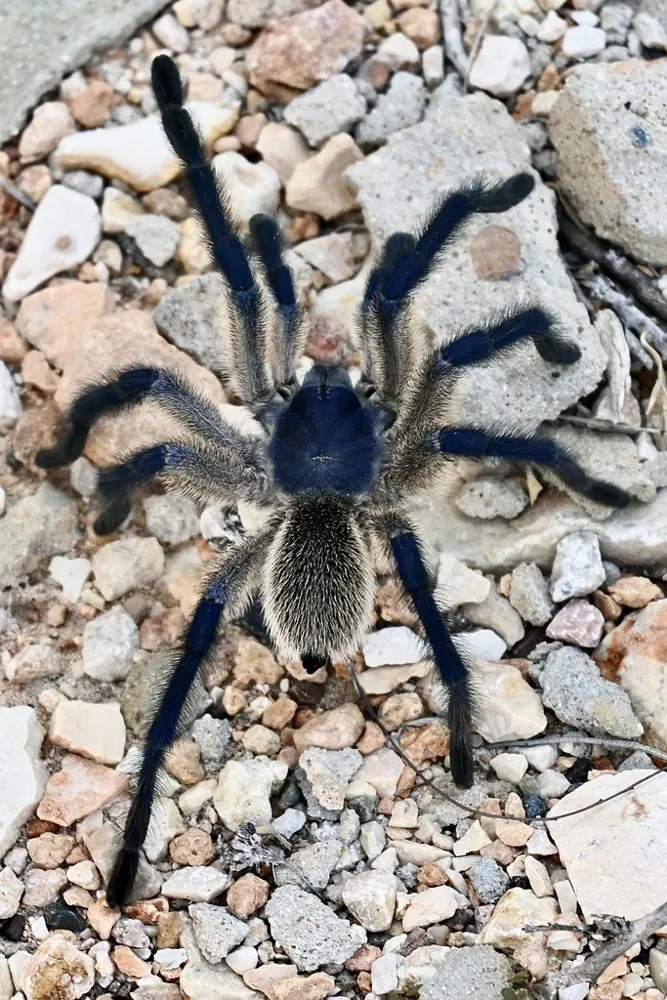
The Socotra Island blue baboon tarantula is a large, vivid blue spider that lives on the ground. It is found only on Socotra Island, which is part of Yemen, and it is known for its unusual group behaviour, where mother spiders guard their young. Its venom has not been studied enough to know how strong it is.1
 Comment le reconnaître
Puissance du venin
Le venin sort par ses crochets ou ses dents quand il mord.
Que fait son venin ?
The potency of its venom is not known. Some people believe it can kill a dromedary (a one-humped camel), but this is most likely not the case.1
À quel point est-il dangereux pour l'homme ?
Danger pour l'homme: DouloureuxÇa peut faire très mal, mais ce n'est presque jamais grave.How strong its venom is has not been established. When provoked, especially when a mother is protecting an egg sac, it will deliver a fast strike and bite.1
Que fait-il quand il a peur ?
When threatened, it rears up on its hind legs and bares its chelicerae (fang-bearing mouthparts) in a characteristic threat pose. Further provocation leads to a fast strike and bite.1
 S'il mord
- Lave la morsure et refroidis-la. Va voir un médecin si la douleur est forte ou si la personne se sent mal.
Appelle toujours d'abord ton numéro d'urgence (112, 000, 911). Ce sont des conseils généraux de premiers secours, pas un avis médical. Les bases des premiers secours
 Reste en sécurité
- Ne touche, n'attrape et n'embête jamais un animal sauvage, même petit, et même s'il a l'air endormi ou mort.
- Laisse-lui de la place. Si tu en croises un, reste calme, recule doucement et laisse-le passer son chemin.
- S'il te mord : reste calme, ne bouge pas, appelle ton numéro d'urgence (112, 000, 911) ou va vite à l'hôpital. Souviens-toi de quoi il avait l'air, une photo aide.
Il ne t'en veut pas. Il utilise son venin pour attraper sa nourriture ou se protéger, et il préfère de loin se cacher. Plus d'infos pour rester en sécurité
Où dans le monde ?
Quelle taille fait-il ?
Quelle longueur fait-il ?
 aussi long que 4 briques de construction en ligne
 pourrait parcourir 100 mètres en 220 secondes (l'humain le plus rapide met 9,6)
Quelle taille fait Socotra Island blue baboon spider comparé à TOI ?
Juste des calculs dans ton navigateur. Rien n'est enregistré ni envoyé nulle part.
À quelle vitesse va-t-il ?


Faits
Its vivid blue colour is the striking feature of the adult, although red and amber forms have been seen very rarely.1
This tarantula is communal: mother spiders care for their young and will attack predators that get too close to their egg sac.1
In captivity, several males and females of different ages can live together without attacking one another, as long as they have enough food and proper care.1
Females live for about 10 to 14 years, while males tend to live for only about 3 to 4 years.1
Because it is an Old World tarantula, it does not have urticating hairs, the irritating hairs that some New World tarantulas flick at attackers.1
Démêle le vrai du faux
Idée reçue : It can kill a dromedary (one-humped camel).
Vérité : Some people believe this, but it is most likely not the case. Its venom potency is not known.1
Pour les experts en venin
D'où viennent les faits
- Monocentropus balfouri (Wikipedia (CC BY-SA 4.0))
- Monocentropus balfouri (iNaturalist): noms et classification.
- Venom Wiki: le niveau de danger, la taille typique et la vitesse estimée sont les nôtres. Regarde comment on les calcule : Comment on évalue le danger.
Chaque fait sur cette page a un numéro qui renvoie à sa source. Si on s'est trompés, désolés, on est des fans d'animaux, pas une revue scientifique. Dis-le-nous à [email protected] et on corrigera.
 Le scorpion a faim ! Venom Wiki est le projet d'une seule personne : gratuit, sans pub et sans traceurs. Un petit pourboire aide à le garder en ligne.Nourris le scorpion
Plus du même groupe: Mygales et araignées à toile en entonnoir
 Gooty sapphire tarantulaMygales et araignées à toile en entonnoirNécessite un médecin
 Indian ornamental tarantulaMygales et araignées à toile en entonnoirNécessite un médecin
 Cobalt blue tarantulaMygales et araignées à toile en entonnoirFait juste mal
 Chinese bird spiderMygales et araignées à toile en entonnoirNécessite un médecin
 Chinese black earth tiger tarantulaMygales et araignées à toile en entonnoirNécessite un médecin
 Fringed ornamental tarantulaMygales et araignées à toile en entonnoirNécessite un médecin
 Scorpion jaune de Palestine
 Cobra indien
 Vipère des pyramides indienne
 Cobra royal
 Vipère heurtante
 Vipère de Russell