
 Afrique
 Asie
Asie Europe
 Amérique du Sud
 Australie et Océanie
 Antarctique
 Océan Pacifique
 Océan Atlantique
 Océan Indien
 Océan Arctique
 Mer Méditerranée
 Mer Rouge
 Mer des Caraïbes
 Mer de Corail
 Mer de Chine méridionale
 Mer des Philippines
 Mer d'Andaman
 Mer du Nord
 Mer de Timor et d'Arafura
 Golfe du Bengale
 Golfe de Californie
Southern yellowjacket
 Piqûres
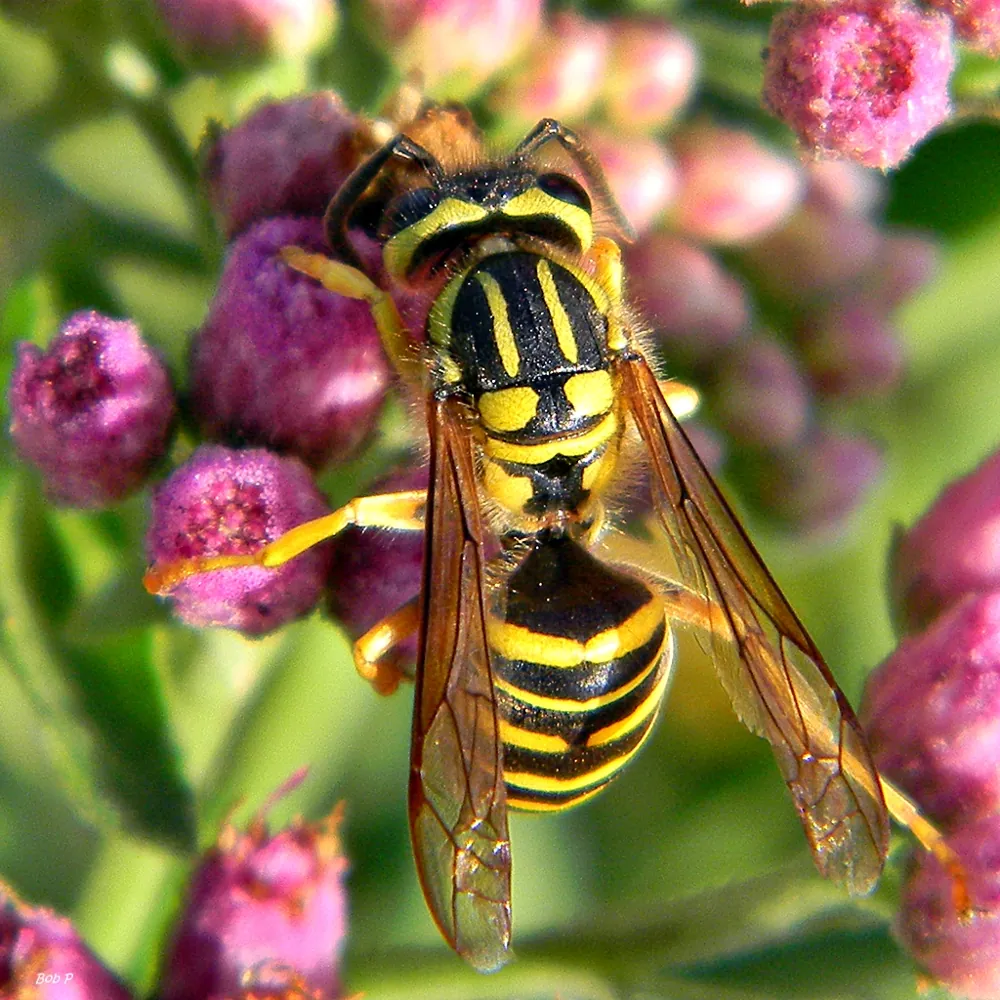
The southern yellowjacket is a social wasp with black and yellow stripes and an orange queen. It lives in eastern North America and further south into Central America. Its nests are often in yards, parks and by roads, so people meet it often, and its stings are painful.1



 Comment le reconnaître
- Black body with yellow striping over the whole body1
- Clear wings and a hairless body1
- About 1.3 cm long1
- The queen is larger than the males and workers and is more orange in colour1
- Has two stripes on its scuta1
Souvent confondu avec : Its two stripes on the scuta are shared with V. sulphurea. The queen looks different from the workers and males, so check the colour and size of the wasp you see.1
Puissance du venin
Le venin sort par un dard.
Que fait son venin ?
Its stings are venomous, and the venom causes pain. Workers can sting several times in one attack.1
À quel point est-il dangereux pour l'homme ?
Danger pour l'homme: DouloureuxÇa peut faire très mal, mais ce n'est presque jamais grave.The species is considered a pest because its nests are close to people and can be large. Close contact with people commonly leads to multiple, painful stings. Disturbing a nest can result in several stings.1
Que fait-il quand il a peur ?
Workers release alarm pheromones that signal the rest of the colony to attack whatever threatens the nest. Their stings are typically used in defence of the colony.1
 S'il pique
- Gratte le dard d'abeille pour l'enlever et refroidis la zone.
- Si la personne a du mal à respirer, le visage ou la gorge qui gonflent, ou se sent mal, c'est une urgence allergique : appelle ton numéro d'urgence et utilise son stylo d'adrénaline si elle en a un.
Appelle toujours d'abord ton numéro d'urgence (112, 000, 911). Ce sont des conseils généraux de premiers secours, pas un avis médical. Les bases des premiers secours
 Reste en sécurité
- Ne touche, n'attrape et n'embête jamais un animal sauvage, même petit, et même s'il a l'air endormi ou mort.
- Laisse-lui de la place. Si tu en croises un, reste calme, recule doucement et laisse-le passer son chemin.
- S'il te pique : reste calme, ne bouge pas, appelle ton numéro d'urgence (112, 000, 911) ou va vite à l'hôpital. Souviens-toi de quoi il avait l'air, une photo aide.
Il ne t'en veut pas. Il utilise son venin pour attraper sa nourriture ou se protéger, et il préfère de loin se cacher. Plus d'infos pour rester en sécurité
Où dans le monde ?
Quelle taille fait-il ?
Quelle longueur fait-il ?
 assez petit pour tenir sur ton ongle
 pourrait traverser tout un terrain de foot en volant en 16 secondes
Quelle taille fait Southern yellowjacket comparé à TOI ?
Juste des calculs dans ton navigateur. Rien n'est enregistré ni envoyé nulle part.
À quelle vitesse va-t-il ?


Faits
Most southern yellowjackets are social parasites: they build their nests around the nests of another species.1
About 85% of colonies start when a queen takes over a small nest of the eastern yellowjacket, V. maculifrons, and only about 15% are founded independently.1
Some nests are very large. One of the biggest reported was in a pine tree and the dirt beneath it, and it had over 50 combs in the trunk alone.1
In Florida and other southern coastal areas, some nests survive the winter and last for several years.1
Workers and queens use pheromones to communicate, with alarm signals for attacks and a different pheromone that attracts males to the queen.1
D'où viennent les faits
- Vespula squamosa (Wikipedia (CC BY-SA 4.0))
- Vespula squamosa (iNaturalist): noms et classification.
- Venom Wiki: le niveau de danger, la taille typique et la vitesse estimée sont les nôtres. Regarde comment on les calcule : Comment on évalue le danger.
Chaque fait sur cette page a un numéro qui renvoie à sa source. Si on s'est trompés, désolés, on est des fans d'animaux, pas une revue scientifique. Dis-le-nous à [email protected] et on corrigera.
 Le scorpion a faim ! Venom Wiki est le projet d'une seule personne : gratuit, sans pub et sans traceurs. Un petit pourboire aide à le garder en ligne.Nourris le scorpion
Plus du même groupe: Abeilles, guêpes et frelons
 Tarantula hawkAbeilles, guêpes et frelonsFait juste mal
 Executioner waspAbeilles, guêpes et frelonsNécessite un médecin
 Warrior waspAbeilles, guêpes et frelonsNécessite un médecin
 Bald-faced hornetAbeilles, guêpes et frelonsFait juste mal
 Cow killer velvet antAbeilles, guêpes et frelonsFait juste mal
 Eastern cicada killerAbeilles, guêpes et frelonsInoffensif
 Terciopelo
 Eastern coral snake
 Eastern diamondback rattlesnake
 Eyelash viper
 Timber rattlesnake
 Western diamondback rattlesnake
_(7225863346).jpg)