
 Afrique
 Asie
Asie Europe
 Amérique du Sud
 Australie et Océanie
 Antarctique
 Océan Pacifique
 Océan Atlantique
 Océan Indien
 Océan Arctique
 Mer Méditerranée
 Mer Rouge
 Mer des Caraïbes
 Mer de Corail
 Mer de Chine méridionale
 Mer des Philippines
 Mer d'Andaman
 Mer du Nord
 Mer de Timor et d'Arafura
 Golfe du Bengale
 Golfe de Californie
Stephens' banded snake
 Morsures
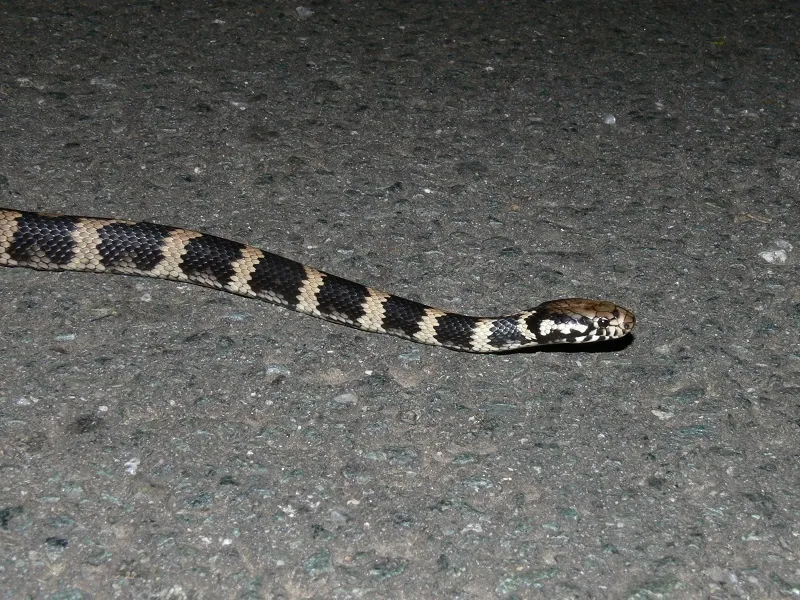
Stephens' banded snake is a tree-dwelling snake that lives only on the east coast of Australia. It is highly venomous, and its venom affects the blood, so it is one of the snakes that people should give plenty of space. It spends most of its life high in the trees of forests.1



 Comment le reconnaître
- Alternating bands of grey or black and dirty-white along the back, with over 40 of each colour from the back of the head to the tip of the tail1
- A flat, mostly dirty-white belly, with occasional grey splotches towards the head and tail1
- A dark brown top of the head, with pale blotches or bars along the lips1
- A slender body with a broadened, arrow-shaped head1
- Mostly active at night, and often found in tree hollows high in the canopy1
Souvent confondu avec : Its closest relatives are the broad-headed snake, which shares its coastal range, and the pale-headed snake, which lives further inland. All three are tree-dwelling snakes in the same genus.1
Puissance du venin
Le venin sort par ses crochets ou ses dents quand il mord.
Que fait son venin ?
Its venom is procoagulant, meaning it makes blood clot. It contains prothrombinase, which triggers the production of thrombin in the blood, causing tiny clots throughout the body. Symptoms include nausea, headache, abdominal pain, vomiting, diarrhoea and sweating. If left untreated, the clotting leads to excessive bleeding as blood vessels rupture.1
À quel point est-il dangereux pour l'homme ?
Danger pour l'homme: GraveUne morsure nécessite un médecin. Les décès sont très rares.It is described as a ready biter, and its envenoming is potentially fatal. Only one death has been recorded: an elderly man in his 60s in Kalang, New South Wales, whose rescue was delayed by torrential rain and floods.1
 Bonne nouvelle : les médecins ont un médicament (antivenin) ou un traitement pour ça.1
Que fait-il quand il a peur ?
It is described as nervous and defensive towards other animals, and it is a ready biter when threatened.1
 S'il mord
- Victims have been successfully treated with up to four doses of 3,000 unit tiger snake antivenom. The wounded person must be transported to hospital for medical treatment.1
- Immobilisation par compression : enroule un bandage élastique serré sur la morsure puis sur tout le membre, pose une attelle et garde la personne complètement immobile jusqu'à l'arrivée des secours.
- Ne lave pas la morsure : l'hôpital peut analyser le venin resté sur la peau pour choisir le bon antivenin.
Appelle toujours d'abord ton numéro d'urgence (112, 000, 911). Ce sont des conseils généraux de premiers secours, pas un avis médical. Les bases des premiers secours
 Reste en sécurité
- Ne touche, n'attrape et n'embête jamais un animal sauvage, même petit, et même s'il a l'air endormi ou mort.
- Laisse-lui de la place. Si tu en croises un, reste calme, recule doucement et laisse-le passer son chemin.
- S'il te mord : reste calme, ne bouge pas, appelle ton numéro d'urgence (112, 000, 911) ou va vite à l'hôpital. Souviens-toi de quoi il avait l'air, une photo aide.
Il ne t'en veut pas. Il utilise son venin pour attraper sa nourriture ou se protéger, et il préfère de loin se cacher. Plus d'infos pour rester en sécurité
Où dans le monde ?
Quelle taille fait-il ?
Quelle longueur fait-il ?
Combien pèse-t-il ?
 aussi long que 2,5 chats domestiques du museau à la queue
 aussi long que 7 bananes mises bout à bout
 pourrait parcourir 100 mètres en 55 secondes (l'humain le plus rapide met 9,6)
Quelle taille fait Stephens' banded snake comparé à TOI ?
Juste des calculs dans ton navigateur. Rien n'est enregistré ni envoyé nulle part.
À quelle vitesse va-t-il ?


Faits
It is one of the few mainly tree-dwelling elapid snakes in Australia.1
A single individual may use up to 30 different trees within its range.1
It hibernates, or brumates, for up to five months through winter inside a tree hollow.1
Males may use home ranges averaging 20.2 hectares, while females average 5.4 hectares.1
It is the largest species in the genus Hoplocephalus, and females are usually larger than males.1
It is slow to mature, with males reaching sexual maturity at three years and females at four years.1
Pour les experts en venin
- Nom scientifique
- Hoplocephalus stephensii
- Groupe
- Serpents australiens
- Famille
- Elapidae2
- Ordre
- Squamata
- Continents
- Australie et Océanie
- Petits
- It gives birth to live young, with between one and nine offspring per litter. Females are only pregnant every two years.1
- Comment il se porte dans la nature
- Near Threatened (IUCN Red List)1
- Danger pour l'homme
- 3 / 5: Grave3
D'où viennent les faits
- Stephens's banded snake (Wikipedia (CC BY-SA 4.0))
- Hoplocephalus stephensii (iNaturalist): noms et classification.
- Venom Wiki: le niveau de danger, la taille typique et la vitesse estimée sont les nôtres. Regarde comment on les calcule : Comment on évalue le danger.
Chaque fait sur cette page a un numéro qui renvoie à sa source. Si on s'est trompés, désolés, on est des fans d'animaux, pas une revue scientifique. Dis-le-nous à [email protected] et on corrigera.
 Le scorpion a faim ! Venom Wiki est le projet d'une seule personne : gratuit, sans pub et sans traceurs. Un petit pourboire aide à le garder en ligne.Nourris le scorpion
Plus du même groupe: Serpents australiens
 Taïpan du littoral
 Vipère de la mort commune
 Serpent brun de l'Est
 Taïpan du désert
 Serpent-tigre
 Collett's snake
Vit aussi en: Australie et Océanie
 Araignée à toile en entonnoir de SydneyMygales et araignées à toile en entonnoirMortel
 Redback spiderAraignéesNécessite un médecin
 Brown tree snakeSerpents à crochets arrièreFait juste mal
 Hooded pitohuiAutres animaux vénéneuxFait juste malNe pas toucher
 PlatypusMammifères venimeuxFait juste mal
 Northern tree-dwelling funnel-web spiderMygales et araignées à toile en entonnoirMortel