
 Afrique
 Asie
Asie Europe
 Amérique du Sud
 Australie et Océanie
 Antarctique
 Océan Pacifique
 Océan Atlantique
 Océan Indien
 Océan Arctique
 Mer Méditerranée
 Mer Rouge
 Mer des Caraïbes
 Mer de Corail
 Mer de Chine méridionale
 Mer des Philippines
 Mer d'Andaman
 Mer du Nord
 Mer de Timor et d'Arafura
 Golfe du Bengale
 Golfe de Californie
Turkish deathstalker
 Piqûres
The Turkish deathstalker is a scorpion from the family Buthidae. Its venom is highly toxic to humans, but scientists also use scorpion venom in medical research. It lives in dry, rocky places and usually keeps away from people.1


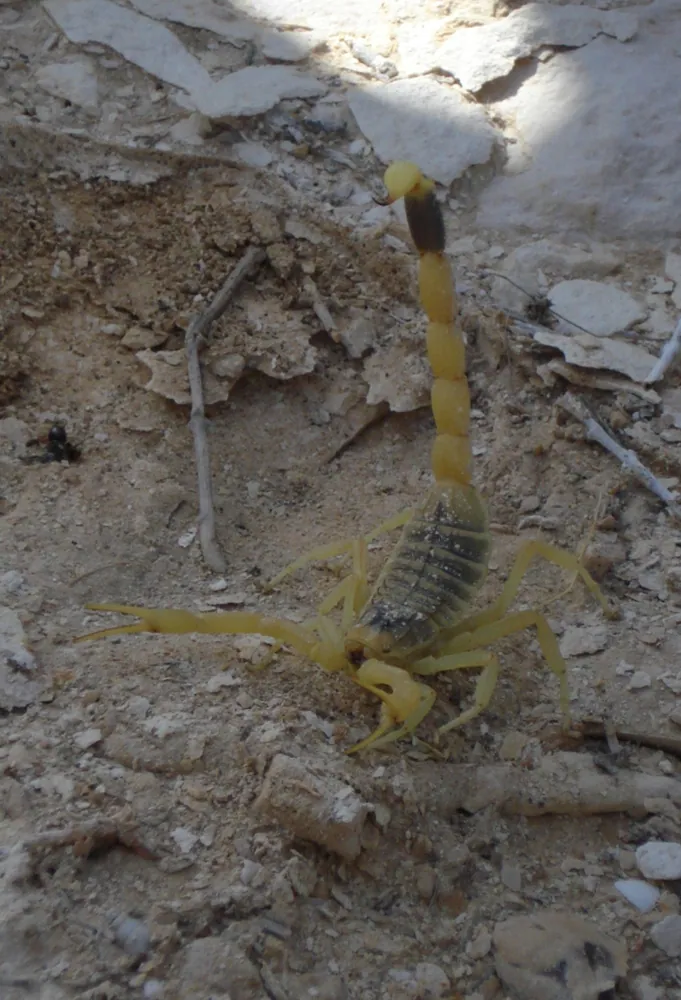
 Comment le reconnaître
- Brown front body section (cephalothorax), with a yellow head, legs and tail.1
- The very last segment of the tail is brown instead of yellow.1
- Its pincers and other body parts are yellowish, against a mostly black background on the front body and tail.1
Souvent confondu avec : It was once considered the same species as the deathstalker (L. quinquestriatus), but was reclassified as a separate species in 2009 based on mitochondrial DNA analysis. Its tail segments are shorter than those of the deathstalker.1
Puissance du venin
Le venin sort par un dard.
Que fait son venin ?
Its venom comes from two venom glands and is mainly made of proteins. It stimulates voltage-gated sodium and potassium channels, which control the electrical signals in nerves and muscles. Symptoms can be severe: after a sting, pain can come in waves with seizures, and blisters can form at the site of the sting.1
À quel point est-il dangereux pour l'homme ?
Danger pour l'homme: Très dangereuxIl peut tuer une personne qui n'est pas soignée.Only a small portion of scorpions are harmful to humans, but this species' venom is very toxic and can cause severe symptoms from a single sting. The sting is much worse in children, and it may pose a serious health threat to infants because of their small body weight.1
Que fait-il quand il a peur ?
Its venom is used for self-defence as well as for hunting.1
 S'il pique
- Anyone who has been stung should have an early echocardiogram, which is a heart ultrasound, because the venom can affect the heart. In the case described, the patient was given sodium chloride (saline) and a local painkiller at hospital.1
- Refroidis la piqûre avec de la glace et garde la personne immobile. Va vite voir un médecin, surtout pour les enfants : certains scorpions sont mortels pour eux.
Appelle toujours d'abord ton numéro d'urgence (112, 000, 911). Ce sont des conseils généraux de premiers secours, pas un avis médical. Les bases des premiers secours
 Reste en sécurité
- Ne touche, n'attrape et n'embête jamais un animal sauvage, même petit, et même s'il a l'air endormi ou mort.
- Laisse-lui de la place. Si tu en croises un, reste calme, recule doucement et laisse-le passer son chemin.
- S'il te pique : reste calme, ne bouge pas, appelle ton numéro d'urgence (112, 000, 911) ou va vite à l'hôpital. Souviens-toi de quoi il avait l'air, une photo aide.
Il ne t'en veut pas. Il utilise son venin pour attraper sa nourriture ou se protéger, et il préfère de loin se cacher. Plus d'infos pour rester en sécurité
Où dans le monde ?
Quelle taille fait-il ?
Quelle longueur fait-il ?
 aussi long que 3 briques de construction en ligne
 pourrait parcourir 100 mètres en 200 secondes (l'humain le plus rapide met 9,6)
Quelle taille fait Turkish deathstalker comparé à TOI ?
Juste des calculs dans ton navigateur. Rien n'est enregistré ni envoyé nulle part.
À quelle vitesse va-t-il ?


Faits
In one recorded case, a sting on the thumb of a 30-year-old man caused pain, reddening, seizures and blisters, and he was unable to move his arm up for a time.1
When a male wants to mate, he injects a small dose of venom into the female to calm her before they move together in a dance-like pattern.1
In tests on rats, the venom of this species had a greater effect than the venom of the Arabian fat-tailed scorpion (Androctonus crassicauda).1
Its venom is studied for treating nervous, immune, infection, cardiovascular and cancer (neoplastic) diseases.1
Birds, bats and mice prey on scorpions, which is why they are more active on moonless nights.1
D'où viennent les faits
- Leiurus abdullahbayrami (Wikipedia (CC BY-SA 4.0))
- Leiurus abdullahbayrami (iNaturalist): noms et classification.
- Venom Wiki: le niveau de danger, la taille typique et la vitesse estimée sont les nôtres. Regarde comment on les calcule : Comment on évalue le danger.
Chaque fait sur cette page a un numéro qui renvoie à sa source. Si on s'est trompés, désolés, on est des fans d'animaux, pas une revue scientifique. Dis-le-nous à [email protected] et on corrigera.
 Le scorpion a faim ! Venom Wiki est le projet d'une seule personne : gratuit, sans pub et sans traceurs. Un petit pourboire aide à le garder en ligne.Nourris le scorpion
 Scorpion jaune de Palestine
 Indian red scorpion
 Arabian fat-tailed scorpion
 Chinese scorpion
 Asian forest scorpion
 Giant forest scorpion
 Cobra indien
 Vipère des pyramides indienne
 Cobra royal
 Vipère heurtante
 Vipère de Russell
 Asian giant hornet