
 Afrique
 Asie
Asie Europe
 Amérique du Sud
 Australie et Océanie
 Antarctique
 Océan Pacifique
 Océan Atlantique
 Océan Indien
 Océan Arctique
 Mer Méditerranée
 Mer Rouge
 Mer des Caraïbes
 Mer de Corail
 Mer de Chine méridionale
 Mer des Philippines
 Mer d'Andaman
 Mer du Nord
 Mer de Timor et d'Arafura
 Golfe du Bengale
 Golfe de Californie
Yellow garden spider
 Morsures
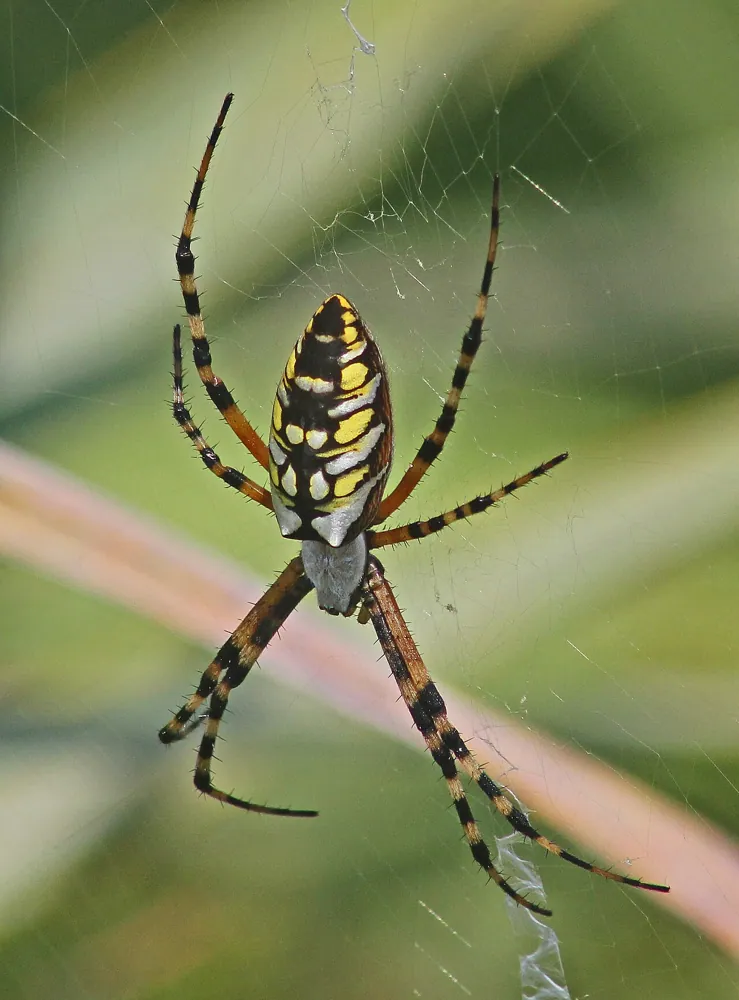
The yellow garden spider is a large, colourful spider with yellow and black markings on its abdomen. It builds big round webs in sunny fields, gardens and along the eaves of houses in North America, Mexico and Central America. It bites only if disturbed or handled, and its bite is comparable to a bee sting.1


 Comment le reconnaître
- Yellow and black markings on the abdomen (the rear part of the body).1
- A mostly white front body section (cephalothorax).1
- A large, circular web up to 60 cm across, with a dense zigzag of silk in the centre.1
- The female sits in the centre of the web, usually facing straight down.1
- Females measure 19–28 mm in body length, while males are much smaller at 5–9 mm.1
Puissance du venin
Le venin sort par ses crochets ou ses dents quand il mord.
Que fait son venin ?
The venom contains polyamine toxins, including one called argiotoxin ArgTX-636, which are being studied for possible medical uses. For most people the venom is harmless, and a bite causes redness and swelling, similar to a bee sting. It is harmless to people who are not allergic.1
À quel point est-il dangereux pour l'homme ?
Danger pour l'homme: LégerComme une piqûre d'abeille ou moins. Pratiquement inoffensif pour l'homme.These spiders are not aggressive and only bite if grabbed or disturbed. For a healthy adult, a bite is not considered an issue. People who are very young, elderly, or have weakened immune systems should take the same care they would around a beehive or hornet nest.1
Que fait-il quand il a peur ?
If disturbed by a possible predator, the female may drop from her web and hide on the ground nearby, and she can shake the web vigorously while staying attached in the centre.1
 S'il mord
- Lave la morsure et mets de la glace contre la douleur. Va voir un médecin si la douleur est forte, s'étend ou si la personne se sent mal.
Appelle toujours d'abord ton numéro d'urgence (112, 000, 911). Ce sont des conseils généraux de premiers secours, pas un avis médical. Les bases des premiers secours
 Reste en sécurité
- Ne touche, n'attrape et n'embête jamais un animal sauvage, même petit, et même s'il a l'air endormi ou mort.
- Laisse-lui de la place. Si tu en croises un, reste calme, recule doucement et laisse-le passer son chemin.
- S'il te mord : reste calme, ne bouge pas, appelle ton numéro d'urgence (112, 000, 911) ou va vite à l'hôpital. Souviens-toi de quoi il avait l'air, une photo aide.
Il ne t'en veut pas. Il utilise son venin pour attraper sa nourriture ou se protéger, et il préfère de loin se cacher. Plus d'infos pour rester en sécurité
Où dans le monde ?
Quelle taille fait-il ?
Quelle longueur fait-il ?
 à peu près aussi long qu'un trombone
 pourrait parcourir 100 mètres en 280 secondes (l'humain le plus rapide met 9,6)
Quelle taille fait Yellow garden spider comparé à TOI ?
Juste des calculs dans ton navigateur. Rien n'est enregistré ni envoyé nulle part.
À quelle vitesse va-t-il ?


Faits
The female can shake her web vigorously to make it harder for wasps and birds to target her, and to fully tangle an insect before it cuts itself free.1
After mating, the male often dies and is sometimes eaten by the female, as he inserts his second palpal bulb.1
The zigzag silk in the web, called a stabilimentum, may camouflage the spider, attract prey, or warn birds away, but its purpose is still disputed.1
In a case observed in Georgia, a European hornet cut free prey caught in a yellow garden spider's web, and the spider did not fight it, probably because it dropped from the web and hid.1
Démêle le vrai du faux
Idée reçue : Yellow garden spiders are dangerous and their bite can seriously harm a healthy adult.
Vérité : The venom is harmless to people who are not allergic. A bite is comparable to a bumblebee sting and is not considered an issue for healthy adults.1
Pour les experts en venin
- Nom scientifique
- Argiope aurantia
- Groupe
- Araignées
- Famille
- Araneidae2
- Ordre
- Araneae
- Continents
- Amérique du Nord
- Petits
- Each female produces one to four egg sacs, each holding perhaps over a thousand eggs, and in spring the tiny spiderlings emerge and some are carried away on silk strands by the breeze.1
- Danger pour l'homme
- 1 / 5: Léger3
D'où viennent les faits
- Argiope aurantia (Wikipedia (CC BY-SA 4.0))
- Argiope aurantia (iNaturalist): noms et classification.
- Venom Wiki: le niveau de danger, la taille typique et la vitesse estimée sont les nôtres. Regarde comment on les calcule : Comment on évalue le danger.
Chaque fait sur cette page a un numéro qui renvoie à sa source. Si on s'est trompés, désolés, on est des fans d'animaux, pas une revue scientifique. Dis-le-nous à [email protected] et on corrigera.
 Le scorpion a faim ! Venom Wiki est le projet d'une seule personne : gratuit, sans pub et sans traceurs. Un petit pourboire aide à le garder en ligne.Nourris le scorpion
 Brown recluse
 Southern black widow
 Northern black widow
 Western black widow
 Bold jumping spider
 Golden silk orb-weaver
 Fer-de-lance d'Amérique centrale
 Eastern coral snake
 Eastern diamondback rattlesnake
 Eyelash viper
 Timber rattlesnake
 Western diamondback rattlesnake