
 África
 Asia
Asia Europa
 América do Sur
 Australia e Oceanía
 Antártida
 Océano Pacífico
 Océano Atlántico
 Océano Índico
 Océano Glacial Ártico
 Mar Mediterráneo
 Mar Vermello
 Mar Caribe
 Mar do Coral
 Mar da China Meridional
 Mar de Filipinas
 Mar de Andamán
 Mar do Norte
 Mar de Timor e de Arafura
 Golfo de Bengala
 Golfo de California
Climbing mantella
 Veleno na pel
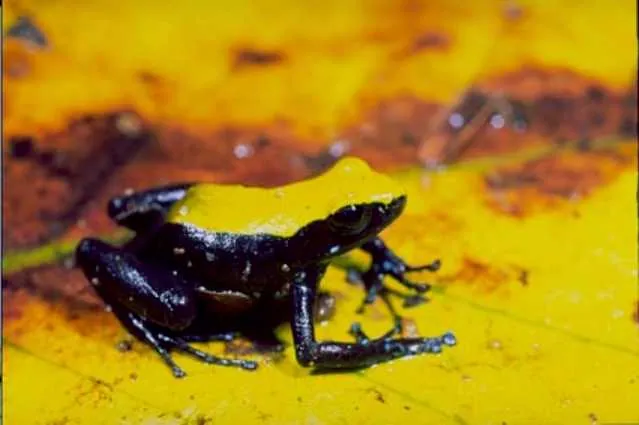
The climbing mantella is a small, brightly coloured frog that lives in the lowland rainforests of northeast Madagascar. It is a poison frog, so its skin holds chemicals that can harm predators. It is special because it is one of the few frogs whose parents care for their tadpoles by feeding them eggs.1



 Como recoñecelo
- Adults are 24–30 mm long and weigh 1.2–2.0 g1
- Front of the back is bright yellow or pale green1
- Arms, legs, belly and rear are black, with blue spots on the limbs1
- Eyes are completely black1
- Has discs at the tips of its fingers and toes, and the toes are webbed1
Adoita confundirse con: M. betsileo, M. viridis and M. expectata look similar but are differently coloured. They often have blue spots on the throat rather than the limbs, and they have a faint line along the upper lip, which the climbing mantella lacks.1
Poder do veleno
A súa pel é velenosa. É perigoso tocalo, lambelo ou comelo.
Que fai o seu veleno?
This frog is poisonous rather than venomous. Its skin glands contain lipophilic alkaloids, the chemicals that make up its poison, which it gets from the arthropods it eats. Researchers have found 41 different potent alkaloids in its skin. Captive frogs lose their toxicity over time.1
Que perigoso é para as persoas?
Perigo para as persoas: LeveComa unha picadura de abella ou menos. Practicamente inofensivo para as persoas.Que fai cando ten medo?
Its bright colours warn predators that its skin is toxic.1
 Se alguén o tocou ou o comeu
- Se alguén tocou un: lava ben as mans e non toques os ollos nin a boca. Se un neno ou unha mascota lambeu ou comeu un: chama ao centro de toxicoloxía ou ao teu número de emerxencias.
Chama sempre primeiro ao teu número de emerxencias (112, 000, 911). Isto son consellos xerais de primeiros auxilios, non consello médico. Primeiros auxilios básicos
 Mantente a salvo
- Nunca toques, collas nin molestes un animal salvaxe, aínda que sexa pequeno e aínda que pareza durmido ou morto.
- Déixalle espazo. Se atopas un, mantén a calma, recúa amodo e déixao ir polo seu camiño.
- Se o tocaches ou o comiches: non esfregues os ollos nin a boca, lava as mans e busca axuda médica.
Non vai a por ti. O seu veleno só está aí para que ninguén o coma. Máis sobre como estar a salvo
En que lugar do mundo?
Que tamaño ten?
Canto mide?
Canto pesa?
 mide máis ou menos coma un clip
 tan lixeiro que non o notarías na man
 podería percorrer 100 metros en 100 segundos (o humano máis rápido precisa 9,6)
Que tamaño ten Climbing mantella comparado CONTIGO?
Só son contas no teu navegador. Non se garda nin se envía nada a ningures.
Que rápido é?


Datos
Its tadpoles eat only the eggs of their own species, and the parents feed them unfertilized eggs.1
Males defend territories of about 2 square metres and fight by wrestling, chasing and leaping, sometimes for over 1.5 hours.1
Female frogs choose a mate based on the quality of the male's well, not on his call.1
The climbing mantella is the only member of the Mantella genus that breeds in water-filled wells in trees, tree holes or broken bamboo stalks.1
Its chemical defence has developed in a similar way to that of the dart frogs of Dendrobatidae, although the two families are only distantly related.1
Para expertos en pezoñas
- Nome científico
- Mantella laevigata
- Grupo
- Ras velenosas, sapos e tritóns
- Familia
- Mantellidae2
- Orde
- Anura
- Continentes
- África
- Crías
- Usually lays only one large egg, 3–3.5 mm across, at the side of a water-filled well or above the water line. The parents feed tadpoles unfertilized eggs.1
- Como lle vai na natureza
- Least Concern (IUCN Red List, 2016), though its population is suspected to be decreasing1
- Perigo para as persoas
- 1 / 5: Leve3
De onde veñen os datos
- Climbing mantella (Wikipedia (CC BY-SA 4.0))
- Mantella laevigata (iNaturalist): nomes e clasificación.
- Venom Wiki: o nivel de perigo, o tamaño típico e a velocidade estimada son nosos. Mira como os calculamos: Como valoramos o perigo.
Cada dato desta páxina ten un número que leva á súa fonte. Se nos equivocamos nalgo, sentímolo, somos fans dos animais, non unha revista científica. Dínolo en [email protected] e arranxarémolo.
 O escorpión ten fame! Venom Wiki é un proxecto dunha soa persoa: gratis, sen anuncios e sen rastrexadores. Unha pequena propina axuda a mantelo en liña.Dálle de comer ao escorpión
Máis do mesmo grupo: Ras velenosas, sapos e tritóns
 Golden mantellaRas velenosas, sapos e tritónsInofensivo
 Iberian ribbed newtRas velenosas, sapos e tritónsInofensivo
 Tomato frogRas velenosas, sapos e tritónsInofensivo
 African common toadRas velenosas, sapos e tritónsSó doeNon tocar
 Baron's mantellaRas velenosas, sapos e tritónsInofensivo
 Blue-legged mantellaRas velenosas, sapos e tritónsInofensivo
 Black mamba
 Deathstalker
 Egyptian cobra
 Puff adder
 Boomslang
 Fat-tailed scorpion